Conditions we help with
Massage for Achilles pain
Achilles pain is one of the few conditions where the first job is working out which of three quite different things you actually have. A tendon that has become overloaded, a calf muscle that has torn and a tendon that has ruptured are not variations of each other, and they are not managed the same way.
- Published in the British Journal of Sports Medicine
- Practising since 2007
- Level 4 SMA therapists
- Treated Olympic and Commonwealth athletes
The short answer
Can massage help Achilles pain?
The Achilles is the thick tendon at the back of the ankle, and it is the largest tendon in the body. Most persistent Achilles pain is tendinopathy, where the tendon has become overloaded and painful over weeks or months rather than through a single event. Massage can ease the tightness in the calf that loads the tendon, which often makes walking and training more comfortable. It does not repair the tendon on its own, and loading work is what changes the condition. A sudden sharp pain with a snap, an inability to push off, or a visible gap above the heel suggests a rupture and needs urgent assessment the same day.
Where it tends to help
Calf muscles that have tightened around a sore tendon, and the gradual return to walking and training once loading work is underway.
When to see a GP first
A sudden snap with an inability to push off or stand on tiptoe needs urgent assessment. This is not a wait and see situation.
The anatomy, in plain English
What is actually happening at the back of your ankle
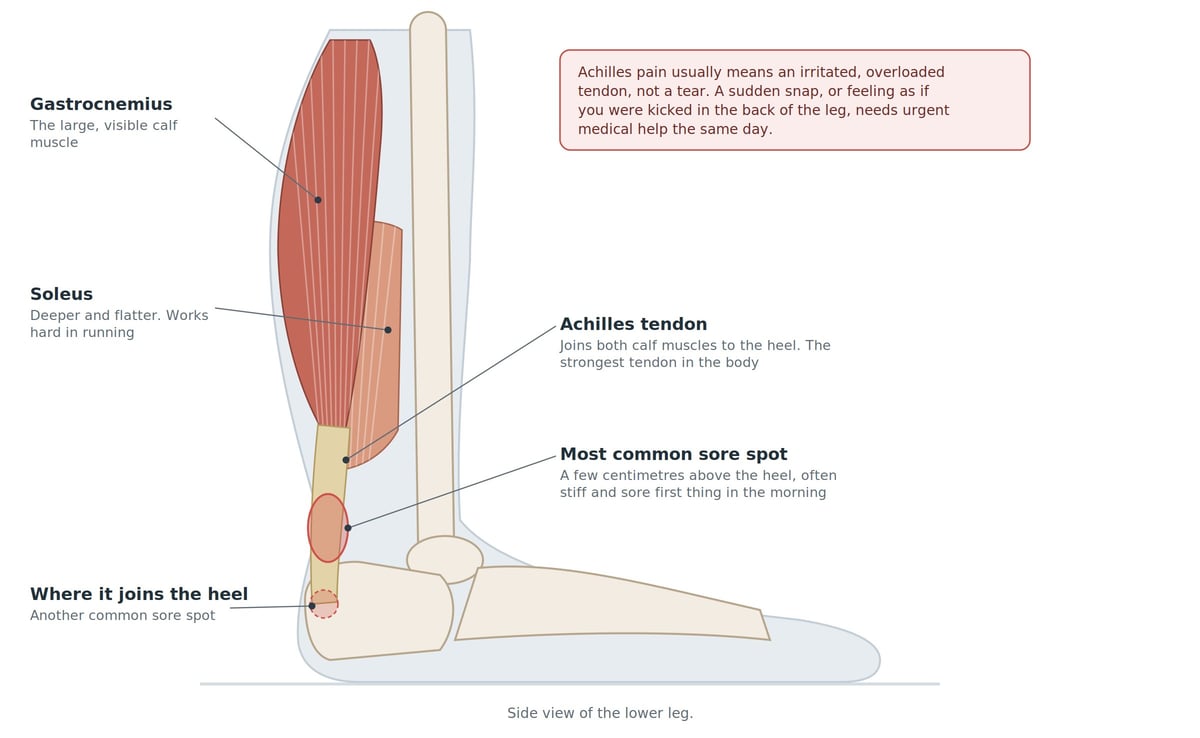
The Achilles tendon connects the calf muscles to the heel bone. It is the strongest tendon in the body, and it has to be, because it carries several times your body weight every time you push off to walk or run. It works like a spring. When you land it stores energy, and when you push off it releases that energy back and helps drive you forward. That spring is a large part of why running and jumping feel efficient rather than exhausting.
Tendons respond to load by adapting. Put a reasonable amount of demand through them consistently and they get stronger. Put too much through them too quickly, or put a normal amount through them without enough recovery, and the tissue becomes painful and less able to cope. That state is called tendinopathy, and it is what the great majority of persistent Achilles pain turns out to be. It develops over weeks, it is not caused by one specific moment, and it does not settle quickly.
The part of the tendon that usually becomes painful is the mid portion, a few centimetres above where it attaches to the heel. Attachment point problems do occur, particularly in people with a prominent heel bone or with inflammatory joint conditions, and they behave somewhat differently. Working out which part of the tendon is involved matters, because the loading programmes differ between the two.
The blood supply to the tendon is worth knowing about, because it explains a lot. The mid portion of the tendon has a relatively poor blood supply compared with the muscle above it and the bone below. That is part of why tendon injuries are slow to settle and why the tissue is sensitive to being overloaded repeatedly. It is also why the condition rarely resolves simply by waiting.
What the tendon is not is inflamed in the way a fresh injury is. The older term tendinitis is now understood to be misleading for this pattern. The tissue is disorganised and painful rather than acutely inflamed, which is why anti inflammatory approaches often disappoint, and why the treatment that works is gradual loading rather than rest.
An important distinction
Tendinopathy, a torn calf muscle or a ruptured tendon
These three are often grouped together as Achilles pain, and they are not the same thing at all. The table below sets out how they are usually told apart, but it is a guide rather than a diagnosis. If you are unsure which one describes you, that is exactly the question to bring to an assessment.
A torn calf muscle sits between the two. It happens suddenly rather than gradually, it usually affects the muscle belly rather than the tendon itself, and it produces immediate pain with bruising that appears over the following days. We treat calf strains, though that page has not been written yet.
The line that matters most is the one between tendinopathy and a rupture, because getting that wrong has real consequences. A tendon that has ruptured and is treated as though it were tendinopathy will not be managed properly, and the window for straightforward treatment closes. If you cannot stand on tiptoe on that leg, or if the pain came on suddenly with a snap, that is a medical assessment rather than a massage appointment.
Causes
Why it happens
Where the problem is tendinopathy, the cause is almost always a mismatch between what the tendon was asked to do and what it was ready for. Below are the patterns we see most.
A sudden increase in training
The commonest trigger by a long way. A new training block, a return after time off, adding hill work or speed sessions, or a change of surface all raise the load through the tendon faster than it can adapt. It is not the running that causes it. It is the rate at which the running increased. People often look back and find the pain began two to four weeks after a step up in volume.
Age, because tendons change
Tendons lose some of their elasticity and some of their capacity to recover with age, and this condition becomes considerably more common from the late thirties onwards. That does not mean you should stop being active, which would make things worse rather than better. It means the amount of increase the tissue tolerates in a given week becomes smaller, and it repays being deliberate about it.
Tight or weak calf muscles
A calf that is tight limits how far the ankle can move, which changes how the tendon is loaded with every step. A calf that is weak cannot absorb the load it should, so more of it passes into the tendon. Both are common findings alongside Achilles pain, and both are addressed by the same loading work that treats the tendon. Massage helps with the tightness, and the strength work is something you do.
A change in footwear
Moving to a shoe with a lower heel drop changes how much the tendon is stretched during walking and running, and it is a well recognised trigger where the change is made suddenly. Worn out shoes matter too, because the cushioning that protected the tendon has gone. If the pain began shortly after changing shoes, that is worth mentioning, because it is a factor that can simply be reversed.
A long history of repeated loading
Certain antibiotics in the fluoroquinolone family are associated with tendon problems, and this is worth raising with your GP if it applies to you. Some inflammatory joint conditions also affect where the tendon attaches to the heel. These are less common causes, but they change the management, which is why we ask about them at assessment.
The honest picture
How massage may help, and what it cannot do
What it cannot do
Massage will not heal a tendon. The changes in an overloaded tendon happen at a tissue level that responds to loading over months, and no hands on technique can substitute for that. It will not speed up the adaptation of the tendon itself, and it will not make a rupture better. Anyone offering to fix an Achilles tendon with a course of massage is promising something the evidence does not support.
It is also worth knowing what not to do. Working aggressively directly into an irritable tendon tends to make it worse, not better, which is why we do not treat the tendon itself with deep pressure when it is sore. The productive work is in the muscle above it rather than in the tendon.
What it may help with
What treatment can do is work on the calf. A tight calf changes how the ankle moves, and the way the ankle moves changes how the tendon is loaded with every step. Reducing that tightness can make walking and running feel easier, and it gives the loading work a better chance of being tolerable enough to keep up with.
It also helps with the compensating that happens around a painful lower leg. People change how they walk to protect the sore spot, and that puts extra demand through the sole of the foot, the shin and sometimes the hip and back on that side. Those areas are often uncomfortable in their own right by the time someone comes in, and they respond well to treatment.
The honest position is that treatment supports the loading work rather than replacing it. The evidence for progressive loading in Achilles tendinopathy is much stronger than for anything done on a treatment table, and we would rather say so than let you expect massage to do the job alone. What treatment can do well is make the months of rehabilitation more comfortable and help you stay consistent with it, which is often the difference between a plan that works and one that gets abandoned.
Loosening the calf
A tight calf changes how the ankle moves and how the tendon is loaded with every step.
Easing the compensation
Protecting a sore tendon loads the foot, shin, hip and back on that side instead.
Keeping you on plan
The loading work is what changes the tendon. Treatment helps you stay consistent with it.
What to expect here
What treatment looks like at the practice
The first job at assessment is working out which of the three possibilities you are dealing with, because everything else follows from that. We will ask how it started, whether there was a single moment or a gradual build, whether you can stand on tiptoe on that leg, and how the pain behaves first thing in the morning and after sitting. We will also ask about your training in the weeks before it began, what you have changed in your shoes, and any medication or health conditions that are relevant.
If anything in that points towards a rupture rather than tendinopathy, we will say so and send you to your GP or to urgent care rather than treating you. That is a straightforward judgement and there is no benefit in being vague about it.
Where it is tendinopathy, the treatment concentrates on the calf and the surrounding lower leg rather than on the tendon itself. Working into a sore tendon with deep pressure tends to aggravate it, so the tendon is left alone and the muscle above it is worked thoroughly. We will also look at how you walk and run, because the pattern you have adopted around the pain is often a factor.
You will get guidance on loading, and this is the part that matters most. That normally covers which exercises suit where the pain sits in the tendon, how to tell the difference between discomfort that is acceptable and pain that is not, how to keep some training going rather than stopping entirely, and how to build back up once things settle. We will be honest that it takes months rather than weeks, and that it is a slow progression rather than a quick fix.
This page is reviewed by senior therapist Richard Clarke. The treatment used is deep tissue massage, which works into the deeper layers of the calf and the lower leg. Where the tendon is irritable and the surrounding tissue is sensitive, gentler work is used. If you have not been to the practice before, our page on your first visit explains what happens when you arrive.
Important
When it is not massage, and you need medical help
Tendinopathy is not an emergency. A rupture is a different matter entirely, and telling them apart is not something to leave to chance. If any of the following apply, seek medical assessment rather than booking with us.
The pain came on suddenly with a snap or a pop
A sudden sharp pain at the back of the ankle, often described as feeling like a kick or a bang from behind when nobody was there, needs urgent assessment the same day.
You cannot stand on tiptoe on that leg
This is one of the clearest signs of a rupture. If you can push up onto the toes on the good leg but not the affected one, that needs medical assessment rather than treatment.
You cannot put the heel down or bear weight properly
Being unable to walk properly, or to put the heel down at all, is not the picture this page describes and needs prompt assessment.
There is a visible gap, dent or change in the shape of the tendon
A gap or a dent above the heel, or a change in the outline of the back of the leg, needs urgent medical assessment.
There is swelling and bruising that appeared after a sudden pain
Bruising that develops over the days after a sudden onset suggests a significant tear and needs assessing.
The tendon is hot, red, swollen and you feel unwell
A hot, red and swollen area together with fever or feeling generally unwell needs urgent medical attention the same day.
The pain is severe at night and does not ease with rest
Tendinopathy eases when you take the load off. Pain that behaves the opposite way, and particularly pain that wakes you, needs investigating.
You have taken fluoroquinolone antibiotics recently
This group of antibiotics is associated with tendon problems, and Achilles pain in these circumstances should be raised with your GP.
What to do
- Go to A&E or call 111 if the pain came on suddenly with a snap, if you cannot stand on tiptoe, or if there is a visible gap or dent above the heel. Do not wait to see whether it settles.
- Call 999 if the area is hot, red and swollen and you feel unwell or have a fever.
- See your GP if you have taken fluoroquinolone antibiotics recently, if the pain is not settling, or if you are unsure which of the three conditions described above you have.
Where none of those apply, and your pain fits the gradual pattern of tendinopathy described on this page, massage is a reasonable thing to try alongside the loading work. If we assess you and conclude that your tendon needs medical investigation or a different kind of help, we will say so plainly and refer you on. That is a normal part of the job and not a disappointment.
Questions
Questions we get asked
How do I know if my Achilles is ruptured?
The clearest sign is being unable to stand on tiptoe on that leg. A rupture usually comes on suddenly with a sharp pain, often described as feeling like a kick or a bang from behind when nobody was there, and it may come with a snap that you hear or feel. Swelling and bruising follow over the next few days, and there is sometimes a visible gap or dent above the heel. If any of that describes what happened, go to A and E or call 111 rather than waiting. Do not test it by trying to walk it off.
How long does Achilles tendinopathy take to settle?
It is measured in months, not weeks, and it is better to know that now. Many people notice meaningful improvement over three to six months of consistent loading work, and some take longer. The cases that drag on are usually the ones where training went back up too quickly, or where the loading programme was abandoned because progress felt slow. Consistency matters far more than intensity here.
Can massage fix it on its own?
No. The tendon itself changes through progressive loading over months, and nothing done on a treatment table replaces that. Massage works on the calf, which is a genuine contributor to how the tendon is loaded, and it eases the areas that have become sore through compensating. That is a supporting role, and we would rather be clear about it than sell you something that cannot deliver.
Should I rest it completely?
Complete rest is usually the wrong approach for tendinopathy. Tendons adapt to load, and taking all load away tends to reduce the tendon's capacity further, so the problem returns as soon as you go back to normal. What generally works better is reducing activity to a level the tendon can tolerate and then building back gradually. There is a difference between discomfort that is acceptable during loading and pain that is not, and working that out is part of what we will go through with you.
Does it matter which part of the tendon hurts?
Yes, and it is one of the more useful things to establish at assessment. The mid portion of the tendon, a few centimetres above the heel, behaves differently from the attachment point right at the bone. The loading programmes for the two differ, and so does the timescale. If you can point to where it hurts, that is helpful information.
Will I have to stop running?
Usually not entirely. Most people do better keeping some running going at a reduced volume and intensity rather than stopping altogether, because that maintains the tendon's tolerance for load. What we would generally suggest is cutting back to a level that is manageable and building up from there rather than stopping and restarting. If walking itself is affected or the pain is severe, that changes the picture and is worth an assessment first.
Does stretching help or make it worse?
It depends on which part of the tendon is involved, and the answer is genuinely different for the mid portion compared with the attachment. Aggressive stretching of a sore tendon often aggravates it. What usually helps more is the loading work, and for the attachment point some people do better avoiding positions that compress the tendon against the heel bone. This is one of the reasons we ask where the pain sits.
How many sessions will I need?
Fewer than people often expect, and spread further apart. Because the loading work is the main driver of change, treatment tends to be periodic rather than a weekly course. Some people come every few weeks through the early part of rehabilitation and then space it out. We will give you an honest view at assessment rather than committing to a number now.
Where the pain is in the heel and sole rather than the tendon itself, plantar fasciitis covers that picture. If the pain came on suddenly in the muscle rather than the tendon, that is a calf strain, which we also treat. Where a return to running is the goal, returning to exercise over 40 is worth reading. You can also see the full list of conditions we help with.
Areas we cover
Where we treat Achilles pain
Achilles problems bring clients in from across the area, often runners who have tried to manage it themselves. These are the areas we cover in detail.
Clients travel to us from all over the surrounding area, from the city and from the towns and villages around it. If you are not sure whether we cover where you are, ring us and ask.
Main areas we cover
Also covered
Skewen, Birchgrove, Clydach, Glais, Trebanos, Rhos, Neath Abbey, Cadoxton, Cimla, Briton Ferry, Gorseinon, Gowerton, Fforestfach, Loughor, Pontardawe, Pontarddulais, Killay, Ammanford, Burry Port.
Ready to book your session?
Choose a time that suits you, or call us and we will find one that works.