Conditions we help with
Massage for upper back pain
Almost everyone who comes to us with upper back pain describes the same thing. They call it a knot, and they can usually put a finger on exactly where it is. It is one of the most common complaints we treat, and one of the ones that responds best.
- Published in the British Journal of Sports Medicine
- Practising since 2007
- Level 4 SMA therapists
- Treated Olympic and Commonwealth athletes
The short answer
Can massage help upper back pain?
Upper back pain is usually felt between the shoulder blades or along the ridge of muscle either side of the spine, and it is commonly caused by holding the arms forward for long periods, whether that is at a desk, in a car or carrying something. The knot people describe is a band of muscle that has been working continuously and has tightened and fatigued. Massage may help by easing that tightness directly. It is not the right treatment for pain that came on suddenly and severely, for pain after a fall, or for pain with numbness, weakness or fever.
Where it tends to help
The band of muscle between the shoulder blades that has been working continuously and has tightened in response.
When to see a GP first
Pain that came on suddenly and severely, pain after a fall, or pain with numbness, weakness or fever needs a medical opinion before a treatment table.
The anatomy, in plain English
What is actually in that knot
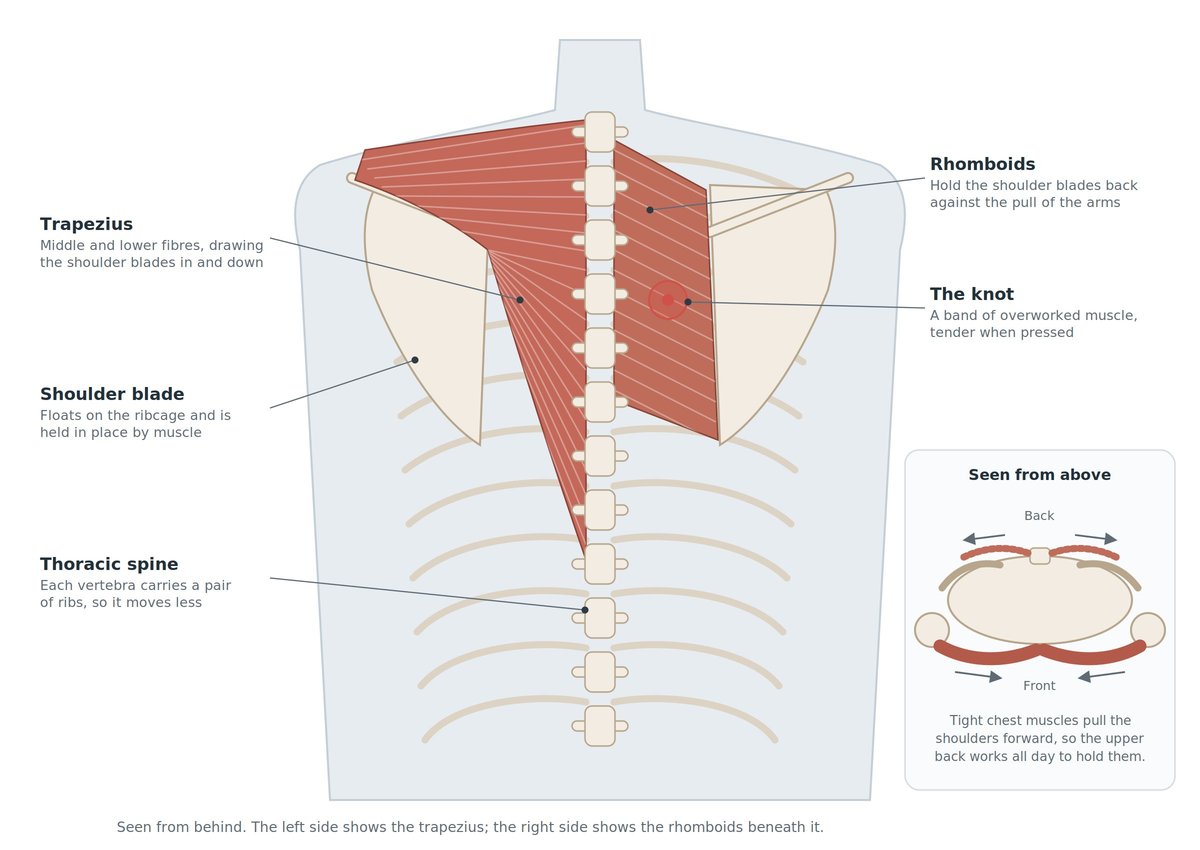
Knot is the word nearly everyone uses, and it is a good description of the sensation. It is not, however, a literal knot in a muscle fibre. What people are usually pointing at is a band of muscle that has been working without a break, has tightened, and has become tender to press. If you run your fingers along it you can often feel a firmer strip within the muscle, and pressing it reproduces the ache you came in with.
The upper back is built differently from the lower back, and that difference matters. Each of the ribs attaches to a vertebra here, and the whole section is supported by the ribcage, which makes it strong and relatively stiff. There is far less movement available in the upper back than most people assume. What it does do constantly is provide the base that the shoulder blades move on, which is where almost all upper back trouble comes from.
The shoulder blade does not have a fixed joint holding it in place. It floats on the back of the ribcage and is positioned almost entirely by muscle. Several muscles run between the shoulder blade and the spine, and those are the ones that sit exactly where the knot is felt. When your arms are forward for a long time, whether that is typing, driving or holding a phone, those muscles have to work continuously to hold the shoulder blades in position against the pull of the arms. They are not designed for that, and they fatigue.
A muscle that has been working continuously does not simply relax when you finally stop. It stays tight, becomes tender, and often develops small local areas of heightened sensitivity that are painful when pressed. That is the knot you can feel, and it is why pressing into it produces the same discomfort you have been carrying around, sometimes referring to somewhere else entirely.
This is also why the problem tends to return. Easing the knot makes it feel better, but if the arms go back to being held forward for the same number of hours, the muscle is asked to do the same thing again and tightens again. That is not a reason not to treat it, but it is worth knowing what you are dealing with.
How people describe it
What it feels like
The descriptions people give are unusually consistent, and most of them use the same word.
The most common is the knot itself. People say there is a spot between their shoulder blades, usually on one side, that feels like a hard lump. It is tender when pressed, it is often described as though something needs to be released or clicked, and it can be surprisingly precise. People frequently arrive having already found it themselves and able to put a finger straight on it.
The second is the ache that spreads. The knot itself is local, but the discomfort around it is not. People describe a band of aching across the whole upper back, tightness that reaches up into the neck, and a feeling that the shoulders are being pulled forward. Some find the ache refers into the shoulder blade itself or down towards the ribs, which is why pressing on the knot sometimes produces a sensation somewhere else entirely.
The third is the build through the day. It is rarely there in the morning. It comes on over hours, is worst in the late afternoon, and eases when you move around or lie down. Many people notice it improves at the weekend and returns on the first day back at work, which is a useful clue about what is causing it.
The fourth is the stiffness that comes with it. The upper back does not have much movement to lose, but people commonly describe feeling rigid through the shoulders, difficulty getting comfortable in a chair, and a sense of the whole upper body being locked together. Turning to look behind you while driving, or reaching across to the passenger seat, often brings it on.
What people rarely describe is the pain being severe. Upper back knots are usually more of a persistent nuisance than anything dramatic, and they tend to be worse in their effect on concentration and mood than in their intensity. That is worth saying, because a complaint that is not severe is easy to dismiss as not worth treating, and it does not have to be that way.
Causes
Why it happens
Almost every case comes down to the same thing: the arms being held forward, for hours, without enough movement to break it up. Below are the four situations we see most.
Desk and screen work
The most common cause by a distance, and the reason it is worse than it used to be. Typing, using a mouse and reading a screen all hold the arms forward, which means the muscles between the shoulder blades are working continuously to keep the shoulder blades in position. A laptop makes it worse, because the low screen pulls the head forward as well. Home working set up on a kitchen table or a sofa is where we see the most stubborn cases, not because the furniture is bad but because the day becomes far more static than it was in an office.
Driving
Holding a steering wheel puts the arms forward for the whole journey, and the shoulders with them. Long commutes, driving jobs and stop start traffic all add up. People who drive for a living often describe the knot being worse on one side, which is usually the side they use more, and noticeably worse at the end of a long day. The seat position matters too, because reaching for the wheel from too far back keeps the arms extended rather than relaxed.
Carrying and holding
Carrying a bag on one shoulder, holding a child on one hip, wearing a heavy rucksack or repeatedly lifting boxes all load the upper back and the muscles between the shoulder blades. Wearing a bag on one shoulder keeps that shoulder raised and the upper back working continuously to compensate. Where the load is only ever on one side, the knot develops on one side, and often the shoulder on that side sits slightly higher than the other.
Training and sport
Rowing, swimming, cycling and any sport that holds the arms forward or that involves repeated pulling will load these muscles heavily. This is not a problem in itself, and trained muscles handle it well. What tends to cause trouble is a sudden change in volume, a new exercise, or a position held for a long time rather than worked. Cyclists are a common case, because the position on the bike holds the arms forward for hours at a stretch.
The honest picture
How massage may help, and what it cannot do
What it cannot do
Massage will not make a knot disappear permanently, and it cannot change the reason the muscle tightened in the first place. This is the one complaint where that gap matters most, because the cause is usually a position you hold for eight hours a day. If nothing about that changes, the muscle will tighten again, and regular appointments treat the result rather than the cause. Massage is also not the right answer for upper back pain that came on suddenly and severely, that followed a fall, or that comes with numbness, weakness or fever.
What it may help with
What it can do, it does well. This is one of the most satisfying things to treat, because the tightness is muscular and it is genuinely reachable. Working into the band of muscle between the shoulder blade and the spine, and into the shoulder blade itself, usually produces a noticeable change within a session. People commonly describe the area feeling looser, the ache easing, and being able to move their shoulders more freely straight afterwards.
It is also worth working beyond the knot, which is often not where the trouble started. The muscles at the front of the chest shorten when the arms are held forward, and tight chest muscles pull the shoulder blades out of position, which is what keeps the back muscles working. Treatment that only works on the painful spot tends to give relief that fades. Working the chest and the front of the shoulders as well is what makes it hold longer.
Where treatment is most valuable is alongside a change to the thing causing it. Loosening the muscle makes it much easier to sit differently, and sitting differently is what stops it coming back. Where someone cannot change their working position, the honest value of treatment is regular relief rather than a resolution, and we would rather say that than imply otherwise.
Working the knot itself
The band of muscle between the shoulder blade and the spine is reachable, and it responds well.
Opening the front
Tight chest muscles hold the shoulder blades forward, and treating them makes relief last longer.
Making change easier
A looser upper back makes it far easier to sit differently for the rest of the week.
What to expect here
What treatment looks like at the practice
The assessment is short and practical. We will ask where the knot is and how long it has been there, what your working day looks like, how much you drive and whether you carry anything regularly on one side. We will check how freely your shoulder blades move, whether one shoulder sits higher than the other, and whether the muscles at the front of your chest are tight, because that is usually part of the picture. If anything you describe suggests something other than muscular tightness, we will say so.
The treatment works on the upper back, the shoulder blades, the chest and the neck. This is one area where firmer pressure is usually appropriate, because the tightness is in muscle that has been working hard and it generally responds well to being worked properly. We will work through the band of muscle either side of the spine and into the shoulder blade itself, then open the chest and the front of the shoulders. The pressure is adjusted to what you can take, and you should tell us if it is too much.
You will also get a small number of practical changes to make between appointments. That normally covers raising and bringing your screen closer, changing position regularly rather than holding one good posture, adjusting your car seat if you drive, and switching the shoulder you carry a bag on. We keep it to two or three things rather than a list, because the changes that actually happen are the ones you can remember.
This page is reviewed by senior therapist Richard Clarke. The treatment most often used is deep tissue massage, which works into the deeper layers of muscle and connective tissue. The upper back tolerates firm work well, which makes this a treatment where the deeper approach genuinely suits the problem.
Important
When it is not massage, and you need medical help
Muscular upper back pain is common and not dangerous. There are occasions when upper back pain means something else, and those mean you should not be booking a massage. If any of the following apply, seek medical help rather than an appointment.
Pain that came on suddenly and severely
Severe upper back pain that appeared abruptly, particularly between the shoulder blades, needs urgent medical assessment. This is not a presentation to treat.
Pain with chest pain, breathlessness or sweating
Upper back pain alongside chest pain, shortness of breath, nausea or cold sweating can indicate a heart problem. Call 999. This is particularly important in anyone with a history of heart disease or diabetes.
Pain after a fall or an accident
Significant trauma, a fall from height, or a road accident needs medical assessment before any soft tissue work is considered.
Numbness, tingling or weakness in the arms or legs
Symptoms travelling away from the back, or any weakness or clumsiness in the hands, suggest a nerve or the spinal cord is involved and need urgent assessment.
Fever, night sweats or unexplained weight loss
Upper back pain alongside any of these needs investigation rather than treatment.
Pain that wakes you at night, or pain that is getting steadily worse
Muscular upper back pain varies with what you are doing and eases when you rest. Pain that is constant, worsening, or that wakes you from sleep is a different picture.
A history of cancer, or a weakened immune system
New upper back pain in these circumstances needs medical assessment rather than soft tissue work.
What to do
- Call 999 if you have upper back pain together with chest pain, shortness of breath, nausea or cold sweating.
- Call NHS 111 for urgent advice if the pain came on suddenly and severely, or if you are unsure how serious something is.
- See your GP for pain that is getting steadily worse, pain that wakes you at night, or any numbness, tingling or weakness in the arms or legs.
Where none of those apply, and your upper back follows the pattern described on this page, massage is a reasonable thing to try. If we assess you and conclude that your pain needs medical investigation or a different kind of help, we will say so plainly and refer you on. That is a normal part of the job and not a disappointment.
Questions
Questions we get asked
Is it really a knot?
It is a good description of the sensation but not a literal knot in the muscle. What you are usually feeling is a band of muscle that has been working continuously, has tightened, and has become tender to press. You can often feel a firmer strip within the muscle, and pressing it reproduces the ache you came in with. The word is accurate enough that we use it ourselves.
Why does pressing it hurt somewhere else?
This is common and it surprises people. Tightened muscle in the upper back can refer discomfort into the shoulder blade, across the ribs or up towards the neck, so pressing on the spot can produce a sensation in another place entirely. It is one of the reasons the knot can be so hard to describe, and it is a normal feature of how these muscles behave rather than a sign of anything sinister.
Can I get rid of it myself with a ball or a massager?
A tennis ball against a wall or a foam roller can give real relief, and there is nothing wrong with using them. What they tend to do is ease the symptom rather than resolve it, because the muscle is only tight because of what your arms were doing for the rest of the day. They are a reasonable thing to use between appointments, and less effective as a sole solution if the working position is unchanged.
Will it keep coming back?
Often yes, if the cause has not changed. The muscle tightens because it has been working continuously, so if the arms go back to being held forward for the same number of hours, it will tighten again. That is not a reason not to treat it, because relief is worth having and a looser upper back makes it easier to sit differently. It is a reason to address both rather than only one.
How often should I have treatment?
It depends on whether you can change what is causing it. Where the working position can be adjusted, a small number of appointments is often enough to get on top of it and keep it there. Where the position cannot change much, treatment tends to become something you return to periodically rather than a course with an end. We will give you an honest view at your first appointment rather than suggesting a package.
Should I stop using heat or ice?
Heat is generally more useful for this kind of muscular tightness, and a hot bath or a heat pack before doing some gentle movement often helps. Ice is more useful for something that is acutely inflamed or swollen, which a tight upper back usually is not. Neither is a substitute for addressing the position that caused it, but neither will do you any harm either.
Can it be caused by my chest muscles?
Partly, yes, and this is the part people least expect. Holding your arms forward shortens the muscles at the front of the chest, and tight chest muscles pull the shoulder blades forward and out of position. That is what keeps the muscles between the shoulder blades working continuously. It is why treatment that only works on the painful spot tends to give relief that fades, and why we work the chest as part of the treatment.
How long will it take to settle?
Most people notice a change after the first session, and the upper back usually responds quickly because the tightness is muscular and reachable. How long the change holds depends on how much you are able to change about your working day. Where the posture can be adjusted, a small number of appointments is often enough. Where it cannot, you should expect to need treatment periodically.
Where the tightness reaches up into the neck and across the tops of the shoulders, neck and shoulder pain is the page for that, and desk and posture related pain covers the working day that usually causes it. You can also see the full list of conditions we help with.
Areas we cover
Where we treat upper back pain
The knot between the shoulder blades is one of the most common things we treat, and it brings people in from every town we cover. These are the areas we cover in detail.
Clients travel to us from all over the surrounding area, from the city and from the towns and villages around it. If you are not sure whether we cover where you are, ring us and ask.
Main areas we cover
Also covered
Skewen, Birchgrove, Clydach, Glais, Trebanos, Rhos, Neath Abbey, Cadoxton, Cimla, Briton Ferry, Gorseinon, Gowerton, Fforestfach, Loughor, Pontardawe, Pontarddulais, Killay, Ammanford, Burry Port.
Ready to book your session?
Choose a time that suits you, or call us and we will find one that works.