
Conditions we help with
Massage for arthritis pain and stiffness
If your hips or knees ache, feel stiff and take a while to get going, the muscular tension around those joints is often a big part of how they feel. This page explains what soft tissue work can reasonably do about that, and what it cannot.
- Published in the British Journal of Sports Medicine
- Practising since 2007
- Level 4 SMA therapists
- Treated Olympic and Commonwealth athletes
The short answer
Can massage help arthritis pain?
Massage does not treat arthritis. What it may do is ease the muscular tightness that builds up around an arthritic hip or knee, which can help you feel more comfortable and make it easier to keep moving. Staying active is the single most useful thing you can do for an arthritic joint, and treatment is best understood as something that supports that rather than something that changes the joint. A joint that is hot, swollen, red or suddenly much worse needs medical assessment rather than massage.
Where it tends to help
The muscular tightness around an arthritic hip or knee, which is often a large part of how stiff and uncomfortable the joint feels.
When to see a GP first
Pain that came on suddenly and severely, pain after a fall, or pain with numbness, weakness or fever needs a medical opinion before a treatment table.
What is going on
Why an arthritic hip or knee feels the way it does
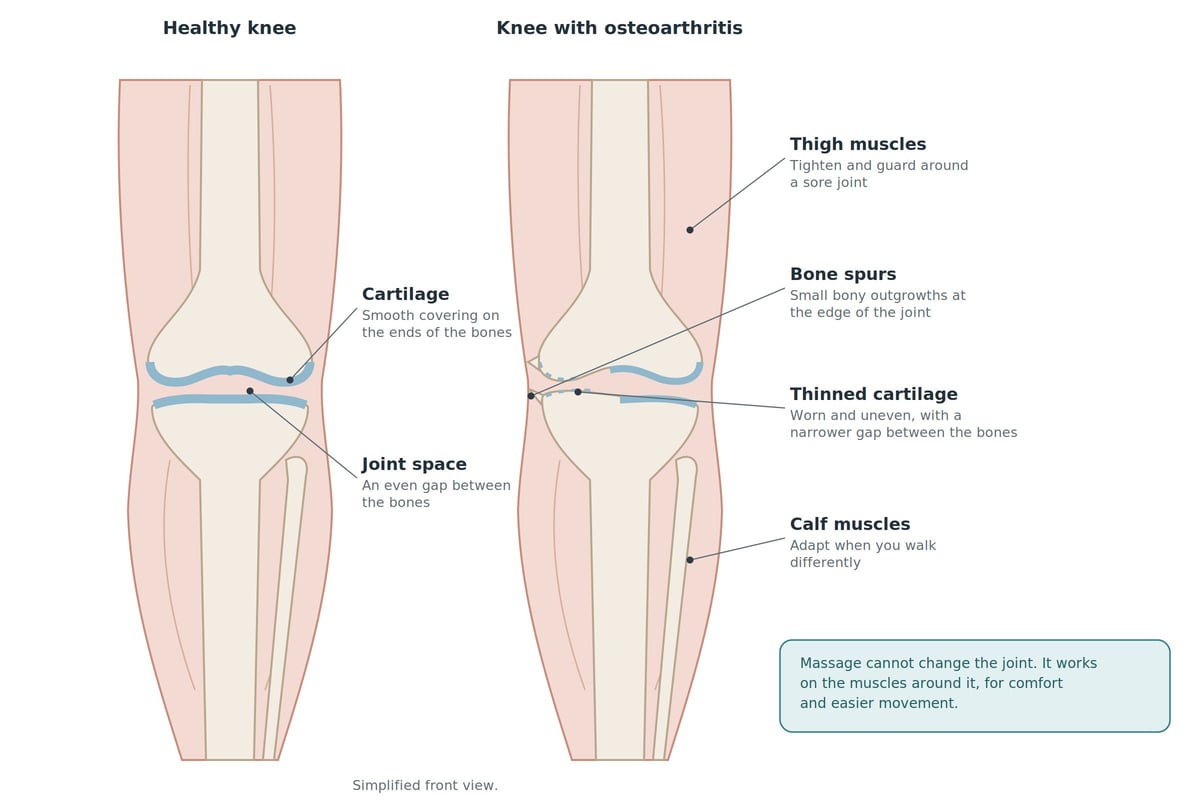
Osteoarthritis is a condition of the joint itself. The protective cartilage that covers the ends of the bones gradually changes, and the joint can become painful, stiff and, in some cases, visibly altered in shape. It is common in the hip and the knee, and it becomes more likely with age.
What matters for this page is the distinction between the joint and everything around it. Osteoarthritis is not a muscular condition, and nothing we do can change the cartilage or reverse the joint changes. But an arthritic joint does not exist on its own. It sits inside a set of muscles, and those muscles respond to the joint in predictable ways.
When a hip or knee is painful, the muscles around it tighten and guard. You also start moving differently, favouring the joint, taking shorter steps, avoiding stairs and turning more carefully. Those compensations change which muscles are working and which have stopped. Over months and years, the muscles around the joint become tight in some places and weak in others, and the rest of the leg, the other side and even the lower back adapt to the new pattern.
That muscular layer is where a great deal of the stiffness and much of the discomfort actually sits, and it is the layer we can work with. It is also why people often describe their knee as feeling tight rather than purely painful, and why the whole leg can ache when only one joint is affected. Easing that tightness will not change your arthritis, but it can make the joint feel easier to live with, and that is worth having.
How people describe it
What it feels like
The hip and the knee behave differently, and it helps to know which one you are dealing with. Both are described in recognisable ways.
A knee with osteoarthritis usually makes itself known through stairs and through getting up from a chair. People describe a grating or grinding sensation, a joint that feels tight and swollen, and pain that is worse going down steps than going up. Kneeling and squatting become increasingly difficult, and many people find the knee is stiff after sitting for a while and needs a few steps before it feels usable. The discomfort is often described as being around and behind the kneecap rather than in one sharp spot.
A hip is often less obvious in the early stages, and it can be felt somewhere other than the hip itself. People commonly describe pain in the groin, the front of the thigh or the buttock, and it occasionally shows up as pain in the knee, which surprises people. Putting socks and shoes on becomes awkward. Getting in and out of a car becomes a manoeuvre rather than a movement. Many people notice they are walking differently before they notice the hip hurting, and that a leg that used to swing freely now turns out slightly.
What both have in common is the stiffness that follows rest. The joints are usually at their worst after sitting, after driving, or first thing in the morning, and they ease with movement. This is worth understanding, because it is the opposite of what most people expect, and it is also the reason activity helps rather than harms. The joint that is moved tends to feel better than the joint that is rested, even though resting feels more appealing on a sore day.
Alongside the joint, people nearly always describe muscular tightness. The thigh, the calf, the buttock and the lower back all commonly feel tight, and the whole leg can ache by the end of a day. That is the muscular consequence of moving differently rather than the arthritis itself, and it is the part that responds to soft tissue work.
The honest picture
Comfort, mobility and staying active
What it cannot do
Massage does not treat arthritis. It cannot regrow cartilage, slow the condition down, or change the structure of your hip or knee. It will not stop the joint from progressing, and it is not a substitute for the things that genuinely help, which are staying active, keeping your strength up, and whatever medical management your GP recommends. If anyone tells you that massage can treat or reverse arthritis, that is not accurate, and it is not what we will tell you.
What it may help with
What it can do is work on the muscular tightness around the joint. Those muscles have been compensating for a long time, tightening to protect the joint and adapting to a walking pattern that has changed. Easing them often makes the joint feel less tight and the whole leg less heavy, which is a comfort benefit rather than a treatment for the arthritis.
The more useful thing it may do is help you keep moving. If a session leaves you feeling looser and more comfortable, and that makes it easier to go for a walk, use the stairs, or keep up with the strength work that actually helps an arthritic joint, then treatment has done something worthwhile. The activity is what makes the difference over the long term. We are there to help you keep doing it.
It is also worth saying that comfort is a legitimate goal in its own right. Living with a stiff, aching joint is tiring, and feeling more comfortable for a while is not a trivial outcome just because it does not change the underlying condition. We would rather be honest with you about the size of the benefit than pretend it is larger than it is.
Easing tight muscles
Muscles around an arthritic joint tighten and compensate, and that tightness is treatable.
Feeling more comfortable
Less muscular tension often means a joint that feels less tight and a leg that feels lighter.
Keeping you moving
Activity is what helps an arthritic joint most. Comfort makes it easier to sustain.
What to expect here
What treatment looks like at the practice
The assessment starts by establishing what has actually been diagnosed and how the joint behaves day to day. We will ask whether the arthritis has been confirmed by a GP or a specialist, which joint is affected, what you can and cannot do at the moment, and how much you are currently moving. We will also ask whether there has been any recent change, because a joint that has become suddenly worse is a reason to go back to your GP rather than to book treatment. If we think your joint needs medical review, we will say so before we start.
The treatment works on the muscles around the joint and through the rest of the leg. For a knee that usually means the thigh, the calf and the muscles behind the knee. For a hip it usually means the buttock, the hip muscles, the thigh and often the lower back, because the whole chain has been adapting to a changed walking pattern. The pressure is moderate, and we will adjust it to what the joint and the surrounding tissue will tolerate on the day. Sore joints do not benefit from being forced.
You will get guidance on staying active between appointments, which is the part that matters most. That normally covers keeping up whatever walking you can manage, how to approach the stairs so they are less punishing, some simple strengthening for the muscles that support the joint, and the difference between the discomfort of using a stiff joint and the pain of doing it damage. That distinction is worth understanding, because it is the main thing that stops people staying active.
This page is reviewed by senior therapist Richard Clarke. The treatment most often used is relaxing massage, which is gentler than deep tissue work and better suited to a joint that is tender. It is available as a half body or full body treatment. Where the muscles of the thigh, hip and lower back have tightened considerably, firmer work is sometimes used on those areas.
Where this fits
The things that help most, in order
Massage is a small part of managing an arthritic hip or knee, and it is worth being clear about that. Here is the honest order.
Your GP, for diagnosis and options
If your joint has not been properly assessed, that comes first. There are other causes of hip and knee pain that present similarly, and knowing what you are dealing with changes everything that follows. Your GP can also discuss the options that exist, which include pain relief, physiotherapy, referrals and, in some cases, joint replacement surgery. We cannot advise on any of that, and we would not try to. It is also your GP you should return to if a joint becomes hot, swollen or suddenly worse.
Staying active and keeping your strength
This is the single most useful thing you can do, and it is the message that has changed most in recent years. Arthritic joints do better with movement, not less. Walking, swimming and cycling are all commonly recommended, and strength work for the muscles around the joint matters because those muscles take load off the joint itself. The aim is to find activity you can sustain rather than to do a great deal in one go. Our page on returning to exercise over 40 covers building this up sensibly.
Soft tissue work, for comfort and mobility
This is where we come in. Easing the muscular tightness around the joint can make it more comfortable and make moving easier, which in turn supports the thing that matters most. It does not change the arthritis and it is not a treatment for it. If you came to us expecting the joint itself to improve, you would be disappointed, and we would rather set that expectation now.
Important
When a joint needs a GP, not a massage
Long standing osteoarthritis is not an emergency, and the aching and stiffness it causes are what this page is about. What matters is recognising when a joint has changed, because a joint that has become hot, swollen or suddenly worse is not the same situation and is not something to treat. If any of the following apply, see your GP before booking with us.
A joint that is hot, red or swollen
This is the most important one. Heat, redness and swelling in a joint, particularly with fever or feeling unwell, needs urgent medical assessment the same day. It can indicate infection, which is a medical emergency and must not be treated with massage.
A joint that has suddenly become much worse
Osteoarthritis usually changes gradually. A sudden significant worsening, especially with no obvious cause, needs medical assessment rather than treatment.
Pain that has changed in character
If the pain has become sharp, constant, or is now waking you at night when it did not before, that is a change worth having looked at.
Locking, giving way or a joint that cannot bear weight
A knee or hip that locks, gives way unexpectedly, or will not take your weight needs assessment before any soft tissue work.
Numbness, tingling or weakness in the leg
Symptoms that travel down the leg suggest a nerve is involved and need assessing rather than treating.
Unexplained weight loss, fever, or feeling generally unwell
Any of these alongside joint pain needs investigation rather than treatment.
You have never had the joint properly assessed
This is the most common reason, and the least alarming. Several conditions present like hip or knee arthritis, and knowing which you have changes what helps. It is also worth asking what options exist, because there is more available now than many people realise.
What to do
- Call 999 or go to A&E if a joint is hot, red and swollen and you feel unwell or have a fever. This needs urgent assessment and is not something to wait on.
- Call NHS 111 for urgent advice if you are unsure how serious something is, or if symptoms are worsening quickly.
- See your GP if the joint has suddenly worsened, if the pain has changed, if it locks or gives way, or if it has never been properly assessed.
Where none of those apply, and your joint is behaving as it usually does, massage is a reasonable thing to try for the comfort and mobility benefits described above. If we assess you and conclude that your joint needs medical investigation or a different kind of help, we will say so plainly and refer you on. That is a normal part of the job and not a disappointment.
Questions
Questions we get asked
Can massage treat arthritis?
No. Arthritis is a condition of the joint, and massage cannot change the joint or slow the condition down. What massage can do is ease the muscular tightness that builds around an arthritic hip or knee, which may make the joint feel more comfortable and make moving easier. If anyone tells you massage treats or reverses arthritis, that is not accurate.
Is it safe to have a massage on an arthritic joint?
Yes, with the right approach, and the work is done on the muscles around the joint rather than on the joint itself. The pressure is moderate and adjusted to what feels tolerable on the day. The important exception is a joint that is hot, swollen, red or suddenly much worse, which needs medical assessment rather than massage. Tell us if anything has changed since your last appointment.
Will massage make my arthritis worse?
There is no reason to think appropriate soft tissue work makes osteoarthritis worse, because it does not load the joint or change its structure. What can make things worse is forcing a sore joint through range or working too firmly on tissue that is inflamed. We avoid both. If a session leaves you more sore than usual, tell us, because that usually means the pressure needs adjusting rather than that treatment is not for you.
Should I keep exercising?
Yes, and this is the most important answer on this page. Arthritic joints do better with movement, not less, and staying active is the single most useful thing you can do. Walking, swimming and cycling are commonly recommended, and strength work for the muscles around the joint helps take load off the joint itself. Build up gradually and start from where you actually are rather than where you were five years ago.
Will I know if I am doing damage?
This is the question that stops most people staying active, so it is worth answering properly. The discomfort of using a stiff joint is usually a normal response to activity that the joint is not used to, and it tends to settle within a day or two. Pain that is sharp, that persists and worsens over days, or that is accompanied by swelling is a different matter and worth checking. If you cannot tell the difference, ask your GP or ask us at an appointment.
Can massage delay the need for a hip or knee replacement?
We would not claim that, and nobody honestly can. Whether you need a joint replacement depends on the joint itself and how much it is affecting your life, which is a conversation for you and your doctor or specialist. What soft tissue work may do is help you stay comfortable enough to remain active while that decision is being made, and staying active is generally considered helpful.
My hip arthritis shows up as knee pain. Is that normal?
Yes, and it catches people out. Hip problems commonly refer pain into the groin, the front of the thigh, the buttock or the knee rather than being felt in the hip itself. This is why hip arthritis sometimes goes undiagnosed for a while. It also means that if you are having treatment for a knee that has not been assessed, it is worth having the hip looked at too.
How often should I have treatment?
It varies with how much the joint is troubling you and what else you are doing. Some people find a small number of appointments helpful when things flare up, and some come periodically to keep on top of the muscular tightness. What we would not do is suggest an open ended course with the implication it is treating the arthritis.
If you are building activity back up around a joint that has been stiff, returning to exercise over 40 covers that. Where joint aching began around the menopause, joint pain during menopause is the page for that. You can also see the full list of conditions we help with.
Areas we cover
Where we treat arthritis pain and stiffness
Arthritic hips and knees bring clients in from across South Wales, usually for comfort and mobility rather than a cure. These are the areas we cover in detail.
Clients travel to us from all over the surrounding area, from the city and from the towns and villages around it. If you are not sure whether we cover where you are, ring us and ask.
Main areas we cover
Also covered
Skewen, Birchgrove, Clydach, Glais, Trebanos, Rhos, Neath Abbey, Cadoxton, Cimla, Briton Ferry, Gorseinon, Gowerton, Fforestfach, Loughor, Pontardawe, Pontarddulais, Killay, Ammanford, Burry Port.
Ready to book your session?
Choose a time that suits you, or call us and we will find one that works.