Conditions we help with
Massage for sciatica
Many people who come to us with leg pain are told they have sciatica, but the picture is often more specific than that. Here is what may help, and what needs a GP instead.
- Published in the British Journal of Sports Medicine
- Practising since 2007
- Level 4 SMA therapists
- Treated Olympic and Commonwealth athletes
The short answer
Can massage help sciatica?
Massage may help with sciatica and similar leg pain by easing the tight muscle tissue around the lower back, hip and buttock, which can reduce the pressure and irritation that produces the pain. It is not a treatment for the underlying nerve compression itself, and it is not suitable for everyone. Many clients find it eases the muscular component alongside whatever else they are doing.
Where it tends to help
The muscular component in the lower back, buttock and hip, which is where soft tissue work is most useful and most clearly felt.
When to see a GP first
Pain that came on suddenly and severely, pain after a fall, or pain with numbness, weakness or fever needs a medical opinion before a treatment table.
The anatomy, in plain English
What sciatica actually is
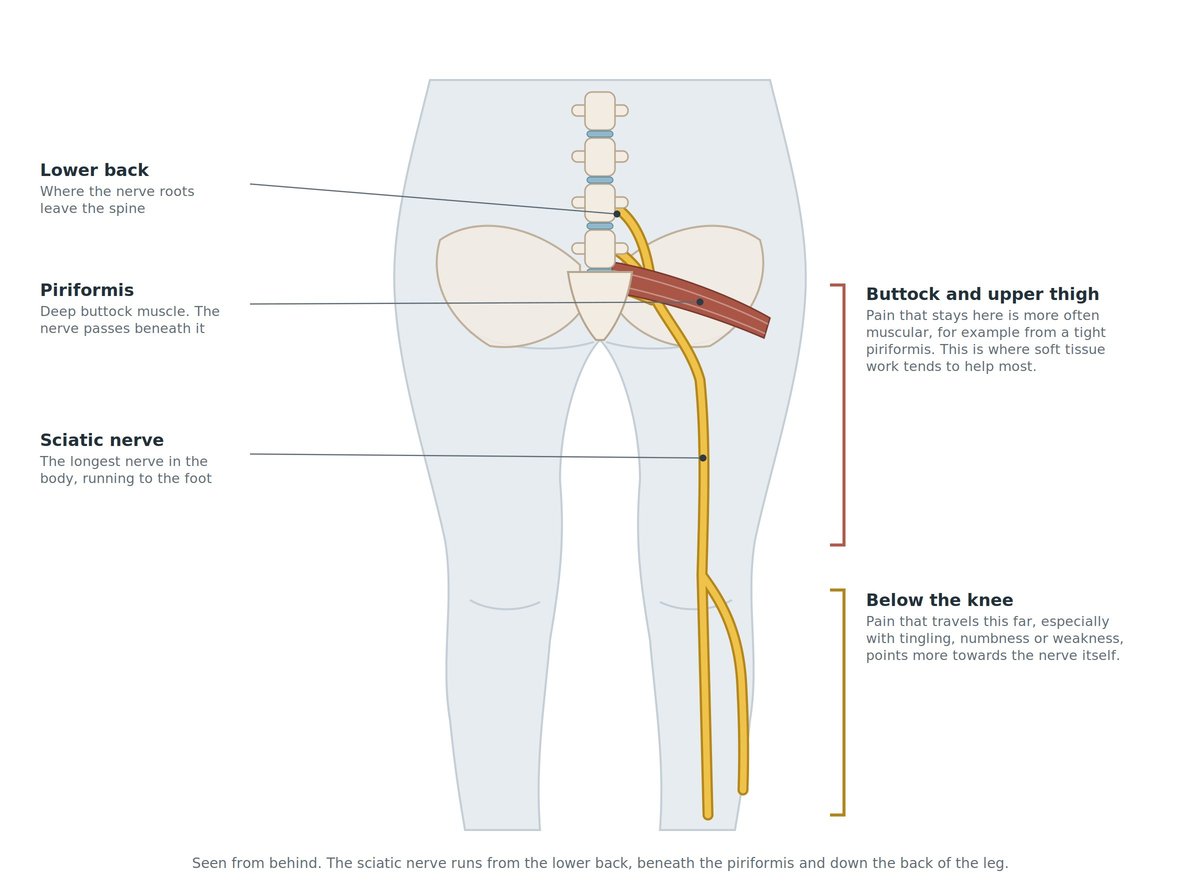
The sciatic nerve is the longest nerve in the body. It starts in the lower back, travels through the buttock and runs down the back of the leg as far as the foot. When something irritates or compresses that nerve, the pain shows up somewhere along its path rather than at the site of the problem. That is why people feel it in the leg when the cause is in the back.
True sciatica means the nerve root itself is being compressed, usually where it exits the spine. The classic sign is pain that runs down the back of the thigh and often below the knee, and it frequently comes with tingling, numbness or weakness in the leg. That pattern matters, because it points to the nerve rather than to muscle.
There is a second and much more common picture that gets called sciatica but is not the same thing. Tightness in the deep muscles of the buttock, most often the piriformis, can produce aching or pain in the buttock and down the back of the thigh without any true nerve root compression. This is referred pain from muscle, and it behaves differently, responds differently, and is where soft tissue work tends to be most useful.
How people describe it
What it feels like
Clients rarely arrive with a clinical description. They arrive with a sentence that has been repeated to a few people already and not quite believed.
The phrase we hear more than any other is some version of the pain running down the back of the thigh. Often it is described as a line, a strip or a band rather than a general ache. Some people run a hand down the back of the leg to show exactly where it goes, because it follows a path rather than sitting in one spot.
Alongside that, the descriptions that come up again and again are: a deep ache in one buttock that never quite settles, a feeling like the leg is being pulled or dragged, pins and needles or a tingling patch on the calf or into the foot, and a heaviness in the leg that makes it feel slower than the other one. A few describe the leg going cold, or a patch of skin that feels numb when they touch it.
What people often add is that it is worse in certain positions. Sitting for a long time is a common one, particularly a low soft sofa or a car seat. Some find the morning is the worst part, with the leg stiff and sore until they get moving. Others find that bending forward, sneezing or coughing catches it sharply. It is worth telling us about all of these, because the pattern is part of how we work out what is going on.
Causes
Why it happens
The causes split roughly into two groups, and it is worth knowing which one you sound like, because it changes what is likely to help.
Causes that involve the nerve itself
A disc in the lower back can bulge or press on a nerve root. This is the most familiar cause and often the most dramatic. It can follow a moment of bending or lifting, sometimes with a twist, and the pain in the leg is usually sharper and more clearly defined than a general ache. Narrowing of the spaces in the spine can also press on nerves, and this tends to come on more gradually with age.
Causes that involve muscle
Tightness in the deep muscles of the buttock can produce very similar symptoms without any nerve compression at all. This is the group we see most often in a treatment room, and the group that soft tissue work is best suited to.
It is also the group most closely linked to how people live and work. Long hours sitting at a desk keeps the glutes and hip muscles in a shortened position for most of the day. Driving does the same, with the added pressure of sitting with one leg forward for hours at a time. Trades that involve repeated bending, lifting or working in awkward positions load the lower back and hip continuously. Any of these can leave the deep buttock muscles tight and the surrounding tissue irritated.
Sport contributes too, in a different way. Running, cycling, football and gym work that leans heavily on one leg can tighten the hip and buttock muscles unevenly, and a sudden increase in training volume or a change of surface is a common trigger. Very often it is a combination: a desk job during the week plus a weekend of training, with the body never getting the chance to settle out of either position.
The honest picture
How massage may help, and what it cannot do
What it cannot do
It is worth being direct about this. Massage does not repair a disc, and it does not decompress a nerve. If your pain is coming from true nerve root compression, soft tissue work will not resolve that, and no amount of deep pressure to the back will change the underlying cause. Anyone telling you otherwise is overstating what hands can do.
What it may help with
What it can do is work on the muscular side of the problem. Where the deep muscles of the buttock and hip are tight and guarded, that tightness can pull on surrounding structures and add its own layer of pain to whatever else is going on. Many clients find that easing that muscular tension reduces the overall discomfort and makes moving less guarded.
There is a practical point here about the two pictures described above. If your symptoms come from muscle rather than the nerve, soft tissue work is often the most useful thing on offer. If they come from true nerve compression, massage may still help with the muscular guarding around it, but it is supporting your recovery rather than driving it. A qualified therapist will tell you which situation you are in, and that judgement is the difference between clinical work and an hour of pleasant rubbing.
Easing guarding
Tight, protective muscle tension around the lower back and hip is what soft tissue work targets most directly.
Reducing muscular tension
Many clients find the deep buttock muscles are part of the problem, and they respond well to focused work.
Keeping you moving
Moving less tends to make things stiffer. Treatment can help make gentle activity more comfortable.
What to expect here
What treatment looks like at the practice
Every appointment starts with an assessment. We will ask where the pain runs, what makes it worse and what eases it, how long it has been going on, and whether you have any numbness, tingling or weakness. We will also ask about your work, your training and how much of the day you spend sitting, because those details usually point to where the problem started.
The treatment itself tends to work on the lower back, the buttock and the hip rather than the leg where the pain is felt. That is deliberate. Working the calf or the thigh because that is where it hurts would be treating the messenger rather than the message. Techniques are usually slow and sustained rather than quick, because the deep muscles involved need time to release rather than pressure applied repeatedly over the top of them.
You will also get guidance on what to do between appointments. That usually includes gentle movement, which may feel counterintuitive when something is sore, and some specific stretches or positions that take the pressure off the area. Staying in one position for long periods is usually the thing to avoid.
This page is reviewed by senior therapist Richard Clarke, who usually handles clients presenting with this pattern of pain. The treatment used is deep tissue massage, a whole body treatment that works into the deeper layers of muscle and connective tissue.
Important
When it is not massage, and you need medical help
Most leg and back pain is not an emergency. There are, however, a small number of symptoms that mean you should not be booking a massage at all. If any of the following apply to you, seek medical help rather than booking an appointment.
Numbness around the groin or saddle area
Loss of feeling or altered sensation between the legs, around the genitals, or in the area that would touch a saddle. This needs urgent medical assessment, the same day.
Changes to bladder or bowel control
Difficulty passing urine, not being able to tell when you need to go, or loss of bowel control. This also needs urgent assessment, the same day.
Numbness or weakness in both legs
Symptoms affecting both legs together, particularly weakness or heaviness, rather than one side.
What to do
- Call 999 or go to A&E if you have lost control of your bladder or bowel, or have numbness around the groin and saddle area combined with weakness in both legs.
- Call NHS 111 for urgent advice if you are unsure how serious something is, or if symptoms are getting worse quickly.
- See your GP for persistent symptoms, for weakness that is not improving, or if the pain has been getting steadily worse over weeks.
Even where none of those apply, massage is not always the right answer. If we assess you and conclude that your symptoms sit beyond what soft tissue work can reasonably help with, we will tell you plainly and refer you on rather than taking your money for sessions that will not help. That is a normal part of the job, not a disappointment.
Questions
Questions we get asked
How do I know if it is true sciatica or a muscle problem?
You cannot always tell on your own, and it is one of the reasons an assessment is worth having. A useful clue is how far down the leg the pain goes. Pain that stays in the buttock and upper thigh, and eases with movement or pressure, is more often muscular. Pain that runs below the knee, especially with tingling, numbness or weakness, points more towards the nerve. A therapist can assess the pattern, but a GP can arrange imaging if it is needed.
Can you feel it coming on, and can massage stop it?
Many clients recognise the early stage: a buttock that feels tight and a bit achy, usually after a long week of sitting or a jump in training. Some find that treatment at that point settles things before they get worse. That is not a guarantee, and it will not prevent every episode, but dealing with tightness early is generally more straightforward than dealing with pain that has already settled in.
Is it safe to have massage if my leg is numb?
It depends on the cause. A small patch of altered sensation in the calf or foot that comes and goes is common with muscular referred pain, and treatment is usually fine. Numbness around the groin or saddle area, or numbness affecting both legs, is a different matter entirely and needs medical assessment before anything else. Tell us about any numbness at your assessment so we can make that judgement properly.
Will you work on my leg, since that is where it hurts?
Usually the focus is the lower back, buttock and hip rather than the leg itself, because that is where the cause tends to sit. Where the leg is involved it is normally to check how the tissue is behaving and to work on any secondary tightness, rather than working directly on painful, irritated nerve tissue.
How many sessions will I need?
It genuinely depends on what is causing it and how long it has been going on. Recent muscular tightness often settles over a small number of appointments. Longer standing problems, or those with a nerve component, usually take longer and tend to be managed alongside what your GP or physiotherapist recommends. We will give you an honest view after the first appointment rather than a number in advance.
Is it worth having treatment if it is true sciatica?
Often yes, as a support rather than a cure. Where the nerve is compressed, the muscular guarding around the lower back and hip can add to your discomfort, and easing that may make moving more comfortable while the underlying issue settles. We will be clear with you about which part of your problem we can help with and which part we cannot.
You can also read our page on lower back pain, which covers the other half of the picture.
Where the symptoms have built up from sitting, driving or a working day in one position, desk and posture related pain is worth reading. If your training has changed recently, or you have started exercising again, returning to exercise over 40 covers why the body responds the way it does. You can also see the full list of conditions we help with.
Areas we cover
Where we treat sciatica
Sciatica is one of the problems we see from across South Wales, and referred leg pain is a common reason people travel in to us. These are the areas we cover in detail.
Clients travel to us from all over the surrounding area, from the city and from the towns and villages around it. If you are not sure whether we cover where you are, ring us and ask.
Main areas we cover
Also covered
Skewen, Birchgrove, Clydach, Glais, Trebanos, Rhos, Neath Abbey, Cadoxton, Cimla, Briton Ferry, Gorseinon, Gowerton, Fforestfach, Loughor, Pontardawe, Pontarddulais, Killay, Ammanford, Burry Port.
Ready to book your session?
Choose a time that suits you, or call us and we will find one that works.