Conditions we help with
Sports injury recovery
Recovering from an injury is a long game, and it changes shape as it goes. What helps in the first week is not what helps in the last month, and soft tissue work has a different job at each stage. This page sets out where it fits.
- Published in the British Journal of Sports Medicine
- Practising since 2007
- Level 4 SMA therapists
- Treated Olympic and Commonwealth athletes
The short answer
How does massage fit into sports injury recovery?
Massage is one part of a recovery process rather than a treatment that heals an injury on its own. In the early days it can help with pain and with the tightness that builds around a joint that is guarding. Through the middle of a rehabilitation it helps keep the surrounding tissue working well while you rebuild strength. Towards the end it helps you prepare for returning to full training. The strength and loading work you do is what actually repairs the injury, and any recovery plan that does not include it will stall. An injury that has not been properly diagnosed, or that is not improving, needs medical assessment rather than massage.
Where it tends to help
The muscular tightness and guarding that builds up around an injury, and keeping the rest of the body working while one part recovers.
When to see a GP first
An injury that has not been diagnosed, a suspected fracture, or pain with numbness, weakness or swelling needs a medical opinion before a treatment table.
The process, in plain English
What recovery actually involves
Injured tissue heals in a predictable sequence. First comes an inflammatory phase, where the body clears the damage and lays down the initial repair. Then a repair phase, where new tissue is built. Finally a remodelling phase, where that tissue is reorganised and strengthened according to the demands placed on it. The last phase is the longest and it is the one most people rush.
That final phase is where things usually go wrong. The tissue that forms early in healing is not as strong or as well organised as the tissue it replaced. It becomes capable only when it is progressively loaded, which is a process measured in weeks and months rather than days. Where someone returns to full training as soon as the pain has gone, the tissue has not finished adapting, and the injury recurs. This is why so many people describe the same injury coming back two or three times.
Alongside the injured part, the rest of the body adapts too. Muscles around the area tighten to protect it, which is useful for a while and unhelpful afterwards. Other muscles take over work they were not doing before. Movement patterns change, and they tend to stay changed even once the tissue has healed. A shoulder injury can leave you with a tight upper back months later. A knee injury changes how you walk, which shows up in the hip and the lower back.
There is also the part that is not physical. Recovering from an injury takes a toll on confidence, and the fear of doing damage again keeps people from loading tissue that is ready to be loaded. That hesitation is genuine and it is extremely common. Where someone is stuck, it is often as much about rebuilding trust in the body as it is about the tissue itself.
What this all means is that recovery is a process with stages, and each stage asks something different. Understanding which stage you are in changes what helps, and it is the first thing we will work out with you.
Stage by stage
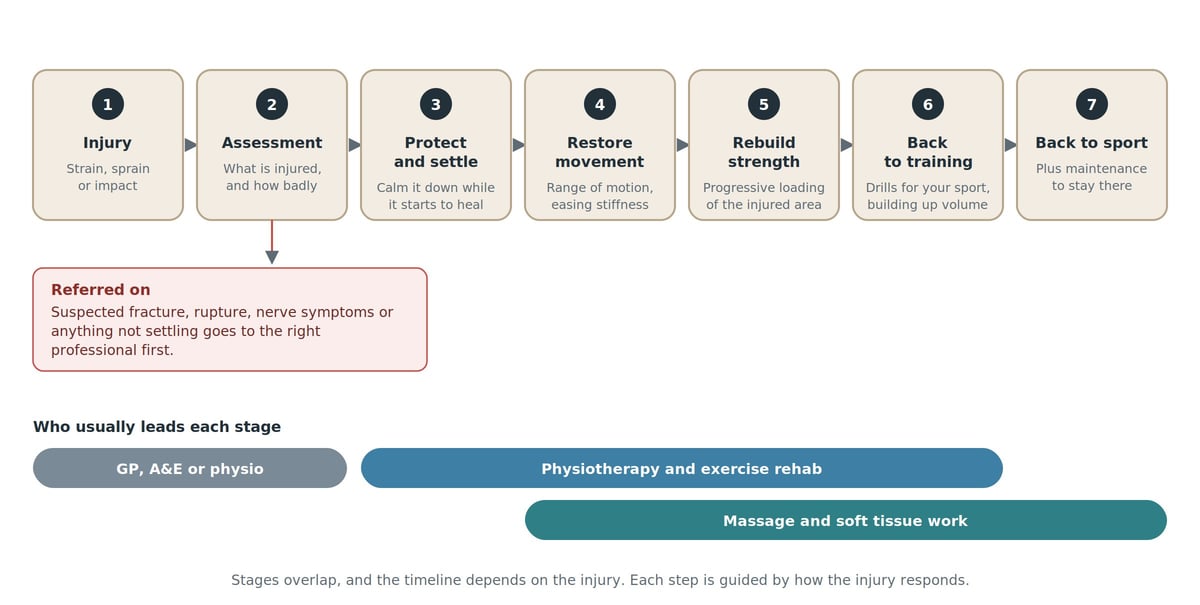
Where soft tissue work fits at each stage
What treatment can do changes as you move through recovery. Working on a fresh injury is a different job from working on one that is nearly ready to return to sport.
Restore movement
Once the injury has been assessed and the early settling has done its work, soft tissue work starts to add value. Gentle work around the area eases the guarding that builds up around anything painful, and helps keep the surrounding tissue from stiffening while the injury settles. Treatment at this stage is supporting, not leading.
Rebuild strength
The longest stage, and the one where the strength work lives. Treatment here helps keep the muscles that are working harder than they should from becoming a problem of their own, and it makes the rehabilitation itself easier to do. Where someone is favouring one side, the opposite hip, the back and the other limb all take extra load, and they often become tight and sore. Easing that is the main contribution massage can make here.
Back to training and back to sport
As the rehab moves towards returning to sport, treatment shifts to making sure everything is ready rather than making anything feel better. Patterns adopted during the injury often persist, and a session that loosens them out before a return is genuinely useful. Periodic treatment alongside a bit of ongoing strength work is a reasonable way to manage the risk of recurrence once training has resumed.
The honest picture
How massage may help, and what it cannot do
What it cannot do
Massage does not heal an injury. The tissue repair happens through the body's own healing process, and the part that makes the healed tissue strong is progressive loading. No hands on technique replaces that, and anyone offering to repair a torn muscle or a damaged ligament with a course of massage is overstating what is possible.
It also cannot make up for an injury that has never been properly assessed. Where someone has been managing a problem for months without a diagnosis, the priority is finding out what is actually wrong. Treating something on a guess wastes the time you have, and it delays the thing that would help.
The other thing it cannot do is shorten recovery. The timelines are set by biology, and the tissue remodels at the rate it remodels. What treatment can influence is how comfortable those weeks are and how well you are able to do the work that recovery requires.
What it may help with
Treatment helps with the parts of recovery that are muscular rather than structural. Where an injury has caused the muscles around it to tighten and guard, easing that makes the area more comfortable and allows a fuller range of movement. Where the rest of the body has taken on extra work, treating those areas stops them becoming a second problem on top of the first.
Perhaps the most valuable thing treatment does during rehabilitation is make the exercise possible. Strength work on a joint that is stiff and sore is miserable, and it is one of the main reasons people abandon a programme. Where treatment leaves the area looser and easier to move, the exercises get done, and the exercises are what repairs the injury. That is a supporting role, and it is a genuinely important one.
Treatment also helps with confidence. Where someone has been afraid of a movement since an injury, feeling that the area can be handled without pain is worth something. It is not a substitute for the graded exposure that rebuilds trust properly, but it can be the step that makes it possible to start.
Easing the guarding
Muscles tighten around an injury. Easing them makes the area more comfortable and freer.
Keeping the rest working
Favouring an injury loads other areas. Treating those stops a second problem developing.
Making exercise possible
The strength work repairs the injury. Treatment helps you get through it.
Where this fits
How this sits alongside physiotherapy and medical care
Recovering from a significant injury usually involves more than one person, and it is worth being clear about who does what. We are not physiotherapists and we do not diagnose. Where a rehabilitation programme has been set, our job is to support it rather than replace it or contradict it.
In practice the division is straightforward. The diagnosis and the rehabilitation plan belong with your GP, a physiotherapist or a consultant. The strengthening and loading programme belongs with you, and with whoever is supervising it. The soft tissue work is ours, and it fits around those rather than competing with them. Where you already have a physiotherapist, we are happy to work alongside them and to follow whatever approach they have set.
If you come to us and we think you need a diagnosis you do not have, we will say so and suggest you get one before we start. That is not a way of turning you away. It is the fastest route to getting better, and treating an undiagnosed injury is the sort of thing that wastes months.
This is also where the practice's background matters. Richard Clarke has provided pitch-side support across many seasons of professional rugby and football, which means working with injured athletes at the moment it happens and through the months that follow. He has an honours degree in sport and exercise science and research on sports massage published in two international medical journals. That background shapes how injuries are managed here, and it is set out in full on his page.
What to expect here
What treatment looks like at the practice
The assessment starts with what happened and where you are now. We will ask what the injury is and how it was diagnosed, when it happened, what you have been able to do since, and what your current plan is. We will also ask what you are aiming at, because the answer is different for someone returning to a Sunday five-a-side and someone training for a marathon. The target shapes the timescale and the work.
From there we will look at how the area moves and how you use it, including the compensations you may have developed without noticing. Most people arrive aware of the injury and unaware of everything that has changed around it, which is usually where a good part of the treatment lies.
The treatment itself depends entirely on the stage. Early on it is gentle and focused on the surrounding muscles rather than the injured tissue. Through the middle it is broader, covering the areas that are taking extra load. Later on it is firmer and directed at any restriction that would load the healed area unevenly when you return to training.
You will also get an honest view on timescales. Recovery estimates are genuinely uncertain, and anyone who gives you a precise date is guessing. What we can do is describe the stages, tell you what progress at each one looks like, and be clear about what would mean it is not going to plan. Where something is not improving as it should, that is a reason to go back to whoever diagnosed it rather than to keep treating.
This page is reviewed by senior therapist Richard Clarke, whose background includes pitch-side work across many seasons of professional rugby and football. The treatment used is deep tissue massage, with the pressure adapted to the stage of recovery. Where the area is fresh or still guarded, relaxing massage is used instead so that nothing is provoked. If you have not been to the practice before, our page on your first visit explains what happens when you arrive.
Important
When it is not massage, and you need medical help
Most sports injuries are not emergencies. There are patterns that need assessing before any treatment is appropriate, and a small number that need urgent attention. If any of the following apply, seek medical help rather than booking with us.
The injury has not been diagnosed
This is the most common reason, and the most important. A fracture, a ligament tear and a muscle strain can all present with similar pain, and they are managed completely differently. Treating an undiagnosed injury risks making it worse and delays the thing that would help.
You heard or felt a snap at the time of injury
A snap or a pop, particularly with immediate swelling, suggests a significant structural injury. That needs assessment and imaging rather than soft tissue work.
You cannot bear weight or use the limb
Being unable to put weight through a leg, or to use an arm through a normal range, needs prompt assessment rather than treatment.
There is significant swelling or bruising that is worsening
Rapidly increasing swelling, or bruising that continues to spread over days, needs medical assessment.
There is numbness, tingling or weakness
Symptoms suggesting nerve involvement need assessing rather than treating. Loss of sensation or strength after an injury is not something to work on.
A joint has changed shape or looks deformed
Any obvious change in the shape of a joint, particularly after an impact, needs urgent assessment the same day.
The pain is not improving as expected
Injuries usually follow a pattern of gradual improvement. Pain that is unchanged or worsening after a reasonable period should go back to whoever assessed it rather than be treated.
It followed a head injury or you were knocked out
Any loss of consciousness, confusion, headache or vomiting after a head impact needs urgent medical assessment. Return to sport after a head injury follows a specific medical pathway and is not something to manage with massage.
What to do
- Call 999 after a head injury with loss of consciousness, confusion, repeated vomiting, or a worsening headache, or if a joint looks deformed.
- Go to A&E or call 111 if you cannot bear weight, if there was a snap with immediate swelling, or if you are unsure how serious the injury is.
- See your GP or a physiotherapist if the injury has not been properly diagnosed, or if it is not improving as you would expect.
Where none of those apply, and your injury has been assessed and is at a stage where soft tissue work is appropriate, we are glad to help. If we assess you and conclude that something needs medical investigation or a different kind of help, we will say so plainly and refer you on. That is a normal part of the job and not a disappointment.
Questions
Questions we get asked
Should I have massage straight after an injury?
Usually not into the injured tissue itself, and not before the injury has been assessed. A fracture, a ligament tear and a muscle strain can all feel similar, and they are managed differently, so the first step is finding out what you are dealing with. What can help early on is gentle work on the muscles around the area that have tightened up in response to the pain, once someone has confirmed it is safe. Where the injury has not been looked at, that comes first.
Can massage heal a torn muscle?
No. The tear heals through the body's own repair process, and the tissue becomes strong through progressive loading over the weeks that follow. Nothing done on a treatment table substitutes for that. What massage can do is ease the tightness around the area, keep the surrounding tissue from stiffening while you recover, and make it more comfortable to do the exercise that actually repairs the injury.
How long does recovery take?
It depends entirely on what the injury is, and anyone giving you a precise number of weeks early on is guessing. What is more useful is understanding the stages and what progress at each one looks like. Soft tissue injuries commonly take weeks, and returning to full training usually takes longer than the pain lasts, because the tissue needs to be loaded progressively to become strong. Rushing that final stage is the most common reason injuries recur.
Why does my injury keep coming back?
Almost always because training resumed as soon as the pain settled, before the tissue had finished adapting to load. The tissue that forms early in healing is not as strong or as well organised as what it replaced, and it only becomes capable when progressively loaded. Where someone goes back to their full programme the moment it stops hurting, the tissue is not ready. The other common reason is that the movement pattern you adopted while injured was never corrected.
Do I need to see a physiotherapist as well?
For anything significant, probably yes, at least for the diagnosis and the rehabilitation plan. We are not physiotherapists and we do not diagnose, and a proper plan matters more than the treatment does for most injuries. Where you already have one, we are happy to work alongside them and follow whatever approach they have set. Our role is the soft tissue side rather than the rehabilitation programme itself.
What is the difference between this and sports massage?
Sports massage is the treatment used, and this page is about how it fits into recovering from an injury. The techniques overlap considerably. What differs is the purpose. Sports massage in general is often about maintaining healthy tissue, preparing for events or helping with recovery from training. Injury recovery is about working around tissue that is healing, at a stage where some approaches would be counterproductive, which is why the timing and the pressure matter so much more.
Can I keep training while I recover?
Often yes, and it is usually better than stopping entirely, provided the training does not load the injured tissue. What that looks like depends on the injury. Where it is a leg, swimming or upper body work might be fine. Where it is a shoulder, running might be unaffected. Keeping the rest of the body working maintains fitness and keeps the habit going, and it is part of nearly every recovery plan we see. It should be agreed with whoever assessed the injury rather than guessed at.
How often should I have treatment while recovering?
It varies with the stage. Early on, when there is a lot of guarding and tightness to manage, treatment tends to be closer together. Through the long middle stage, every few weeks is often enough, because the strength work is doing the main job. As you approach returning to sport there is usually a bit more treatment to make sure everything is ready. We will give you an honest view rather than booking you into a standing appointment.
Injury recovery touches most of the other pages here. Calf strains are a common one to recover from, and Achilles pain follows a similar path. Where the injury was to a shoulder, rotator cuff pain covers that picture. Where you are returning to activity after a long break, returning to exercise over 40 is worth reading. You can also see the full list of conditions we help with.
Areas we cover
Where we treat sports injuries
Clients come to us from across the area at every stage of recovery, from the first weeks through to returning to full training. These are the areas we cover in detail.
Clients travel to us from all over the surrounding area, from the city and from the towns and villages around it. If you are not sure whether we cover where you are, ring us and ask.
Main areas we cover
Also covered
Skewen, Birchgrove, Clydach, Glais, Trebanos, Rhos, Neath Abbey, Cadoxton, Cimla, Briton Ferry, Gorseinon, Gowerton, Fforestfach, Loughor, Pontardawe, Pontarddulais, Killay, Ammanford, Burry Port.
Ready to book your session?
Choose a time that suits you, or call us and we will find one that works.