Conditions we help with
Massage for hip pain
Hip pain is one of the more confusing things to work out, because what people call hip pain is often coming from the buttock, the lower back or the thigh rather than the joint itself. Most of it turns out to be muscular, which is good news for what treatment can do.
- Published in the British Journal of Sports Medicine
- Practising since 2007
- Level 4 SMA therapists
- Treated Olympic and Commonwealth athletes
The short answer
Can massage help hip pain?
Hip pain usually comes from the muscles and connective tissue around the joint rather than from the joint itself, which is why soft tissue work so often helps. The buttock muscles, the deep rotators, the front of the hip and the outer thigh all refer pain into the area people call the hip. Massage can ease the tightness in those muscles, which often reduces the pain and improves how freely you move. It cannot change the joint itself, so pain from within the hip joint, or pain that followed a fall, needs medical assessment rather than a massage appointment.
Where it tends to help
Tightness and aching in the buttock, groin and outer thigh that has built up with training, desk work or a change in activity.
When to see a GP first
Pain after a fall, pain you cannot put weight on, or pain with numbness, weakness or fever needs a medical opinion before a treatment table.
The anatomy, in plain English
Why the hip is more complicated than it looks
The hip joint is a ball and socket, and it is one of the most stable joints in the body. The socket is deep, the ligaments are strong, and the joint is wrapped in some of the largest and most powerful muscles you have. It is designed to carry load and to keep carrying it for a lifetime.
What makes hip pain confusing is the geography. The word hip covers a wide area, and where you feel the pain is often not where the problem is. Pain felt in the buttock is usually coming from the gluteal muscles or the deep rotators rather than from the joint. Pain felt at the front of the hip and into the groin is more likely to involve the hip flexors or the joint itself. Pain on the outer thigh, where people often say they have bursitis, is frequently a gluteal or IT band problem instead.
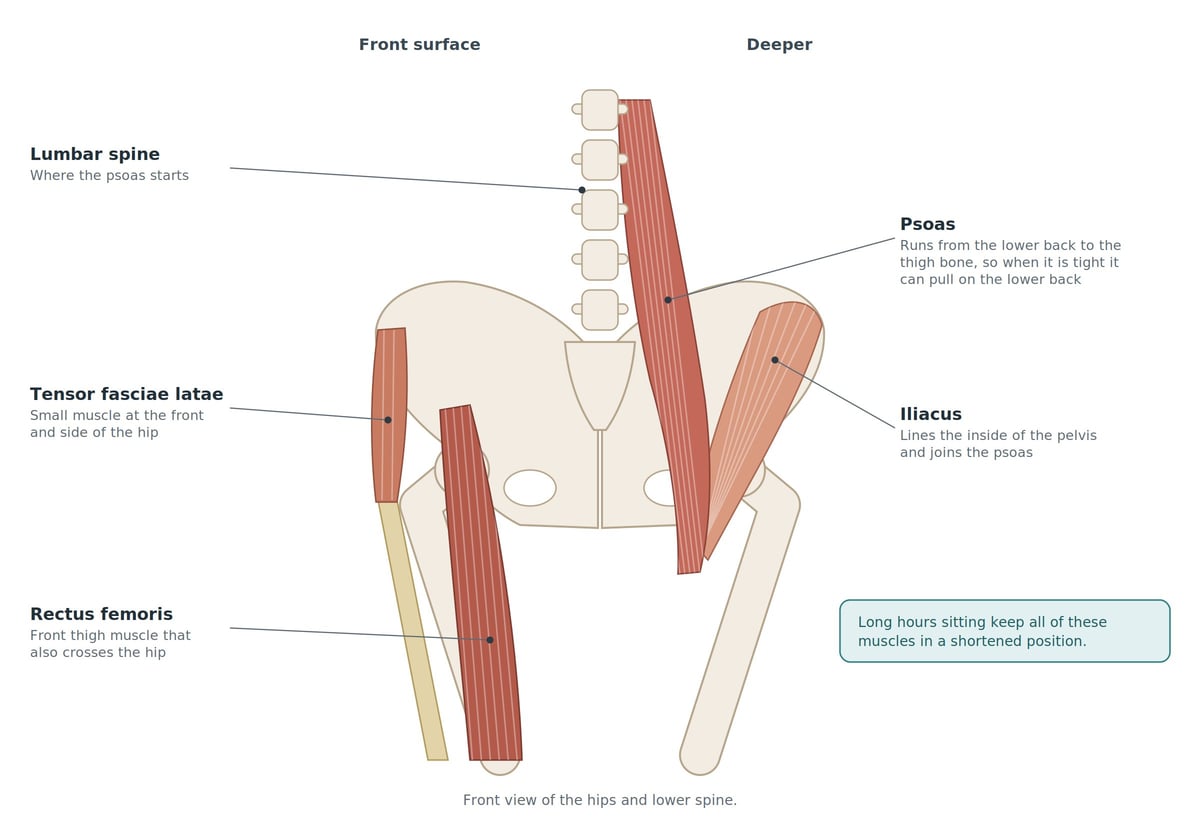
The muscles involved are large and they do several jobs at once. The gluteals extend the hip and stabilise you when you stand on one leg. The deep rotators, including piriformis, control the rotation of the leg. The hip flexors at the front lift the knee and are shortened by long periods of sitting. Because they are used in almost every movement, they are prone to becoming tight, and a tight muscle in this area changes how you walk, how you run and how you stand.
There is also a practical point about the lower back. The hip and the lumbar spine share muscles and nerve supply, and problems in one often present as pain in the other. Many people who come in with hip pain have a lower back component as well, sometimes without realising it, and working only on the hip misses half the picture. That is why we always look at both.
What this means is that hip pain is usually a muscular problem with a postural or load component behind it, rather than a structural problem in the joint. That is a good thing, because muscular problems are the ones soft tissue work can genuinely influence.
Working out where it is
Where your pain sits, and what that usually means
Where you feel the pain is one of the most useful things you can tell us. It is a guide rather than a diagnosis, and more than one area is often involved at once.
The buttock
This is the most common place to feel what people call hip pain, and it is usually muscular rather than coming from the joint. The gluteal muscles and the deep rotators are the usual suspects, and piriformis is the one that most often causes sharp pain with sitting, driving or crossing the legs. Where the pain travels down the back of the leg, the sciatic nerve may be involved, which is a slightly different picture and worth reading about separately.
The front of the hip and the groin
Pain at the front of the hip or in the groin often involves the hip flexors, which run from the lower spine and pelvis down to the thigh. They shorten with long periods of sitting and with certain types of training, and a shortened hip flexor pulls the pelvis forward and changes how the whole area works. Pain right in the groin that feels deep is more likely to involve the joint itself, and that is worth having assessed.
The outer thigh and side of the hip
Pain on the outside of the hip, particularly when lying on that side at night, is often described as bursitis. In practice it is more often the gluteal muscles or the band of tissue that runs down the outer thigh. It is common in runners and in people who sleep on their side, and it usually responds well to soft tissue work alongside some strengthening.
The lower back and the top of the buttock
Pain that sits across the lower back and the top of the buttock is frequently coming from the lower back rather than the hip, even when people are certain it is their hip. The two areas share muscles and nerve supply, and pain from one commonly appears in the other. Where the pain follows a band across the back of the pelvis, that pattern is worth mentioning at assessment.
Into the thigh and knee
Pain that travels down the thigh, or that is felt at the knee rather than the hip, can still originate in the hip. The nerve supply to the hip joint also covers the knee, which is why some hip problems present as knee pain and nothing else. This is one of the reasons knee pain in older adults is often assessed with the hip in mind.
Where the pain travels down the leg, follows a clear line and comes with pins and needles or numbness, that points towards a nerve rather than a muscle. Where it is a deep ache right in the groin and the hip feels stiff, that is more likely to be the joint. Both are worth describing in detail when you ring us, and either may need assessing before treatment.
Causes
Why it happens
Where the problem is muscular, the cause is usually a change in what you have been asking of the area, or a pattern you have been in for years. Below are the four we see most.
Sitting for long hours
This is the single biggest contributor we see. Long periods of sitting shorten the hip flexors at the front and leave the gluteal muscles switched off and weak at the back. That combination changes how the pelvis sits, which changes how you walk, and it loads the muscles around the hip unevenly. People often notice their hip is worst after a long drive or a day of meetings, and that is not a coincidence.
A change in training or activity
A new running programme, hill work, more time on the bike, a sudden return to the gym or a job that has become more physical. The muscles around the hip are powerful and they take a lot of load, but they still need the increase to be gradual. Where training went up sharply, the hip is one of the first places to complain.
Standing and walking on one side
Occupations that involve standing on one leg, leaning to one side or carrying weight on one hip load the gluteal muscles asymmetrically. Over months and years, that creates a difference between the two sides that shows up as tightness, aching and sometimes referred pain down the leg. This is common in tradespeople, in people who carry young children, and in anyone whose work involves standing at a bench.
Age and the natural changes that come with it
Gluteal strength declines with age, and the muscles around the hip lose some of their capacity to tolerate load. At the same time, changes inside the joint itself become more common. That does not mean hip pain is inevitable or that nothing can be done. It does mean that strength work becomes more valuable rather than less as you get older, and that pain coming from inside the joint needs to be told apart from pain in the muscles around it.
The honest picture
How massage may help, and what it cannot do
What it cannot do
Massage cannot change the hip joint. Where the joint surface has worn, or where the pain is coming from inside the joint itself, no amount of work on the muscles around it will alter that. It also will not fix a problem that is entirely maintained by a position you hold for eight hours a day, because treatment addresses the muscle rather than the position. And it cannot make a weak gluteal muscle strong. That takes exercise, and no hands on treatment replaces it.
It is also worth saying what we would not do. The hip sits deep beneath several thick layers of muscle, and aggressive work straight into a painful joint is both ineffective and unpleasant. Where the joint itself is irritable, treatment focuses on the muscular layers above and around it rather than pushing into the area that hurts.
What it may help with
Where the cause is muscular, which is the majority of cases, treatment can do a great deal. Easing tight gluteals, hip flexors and outer thigh muscles reduces the pain those muscles generate in their own right, and it changes how freely the hip moves. People commonly notice they can walk further, sit for longer or sleep on that side again without the ache.
Treatment also helps the areas that have taken over. Where the hip has been sore, people change how they walk and how they stand, which loads the lower back, the knee and sometimes the other hip. Those areas are often uncomfortable by the time someone comes in, and they respond well to being included in the treatment rather than ignored.
The most useful thing we can do is often to get you moving well enough to do the strengthening work that changes things over the long term. Gluteal strength is the single most valuable thing for a hip that hurts, and it is not something a treatment table can provide. What treatment can do is make the area comfortable enough that the exercise becomes possible, which is often the difference between a plan that works and one you give up on.
Easing tight muscles
Tight gluteals, hip flexors and outer thigh muscles generate pain of their own.
Restoring free movement
Less tightness means the hip can move further before it starts to complain.
Making exercise possible
Strength work is what changes a hip long term. Treatment helps you get to it.
What to expect here
What treatment looks like at the practice
The assessment starts with where the pain sits and what makes it worse, because that tells us a great deal. We will ask whether it is worse with sitting, walking, lying on that side or first thing in the morning, whether anything travels down the leg, and how long it has been going on. We will also look at how the hip moves and how you walk, because the pattern you have adopted around the pain is often part of what is maintaining it.
If what you describe points towards the joint itself rather than the muscles around it, or towards the lower back, we will say so and suggest the right person to see. That is a straightforward judgement and there is nothing to be gained by treating something that needs assessing.
The treatment itself covers the gluteals, the deep rotators, the hip flexors at the front, the outer thigh and the lower back. We treat the whole area rather than only the spot that hurts, because the muscles involved work together and the tightness rarely sits in one of them alone. Most people find the work firmer than they expected, because these are large muscles built to take load, though the pressure is adjusted to what you can tolerate.
You will also get guidance on what to do between appointments, and this matters as much as the treatment. That normally covers a small number of strengthening exercises for the gluteals, how to break up long periods of sitting, and how to build activity back up without provoking the area. We keep the list short deliberately, because a handful of things you actually do is worth more than a long programme you abandon.
This page is reviewed by senior therapist Richard Clarke. The treatment used is deep tissue massage, which works into the deeper layers of the gluteal and hip muscles. Where the area is acutely sore or the joint itself is irritable, gentler work is used instead. If you have not been to the practice before, our page on your first visit explains what happens when you arrive.
Important
When it is not massage, and you need medical help
Most hip pain is muscular and not serious. There are patterns that need assessing rather than treating, and a few that need prompt attention. If any of the following apply, see your GP rather than booking with us.
The pain followed a fall or an impact
A hip that became painful after a fall, particularly in an older adult, needs assessment before anything else. A fracture is a possibility and it will not be found on a treatment table.
You cannot put weight on the leg
Being unable to bear weight, or being unable to walk without significant pain, needs urgent assessment rather than treatment.
The pain is locked in the groin and the hip feels stiff
Pain felt deep in the groin, together with stiffness and difficulty getting shoes and socks on, is more likely to involve the joint itself and needs investigating.
There is numbness, tingling or weakness in the leg
Symptoms that travel down the leg with altered sensation suggest a nerve is involved and need assessing rather than treating.
The hip is hot, red, swollen or you feel unwell
A hot, swollen joint together with fever or feeling generally unwell needs urgent medical attention the same day.
Pain that is severe at night and does not ease with rest
Muscular pain settles when you take the load off. Pain that behaves the opposite way, and particularly pain that wakes you, needs investigating.
You have a history of cancer or unexplained weight loss
New hip or thigh pain in these circumstances needs investigation rather than treatment.
It has been going on for months and nothing has changed it
This is the most common reason, and the least alarming. Where rest, stretching and the usual approaches have not helped, it is worth having the diagnosis looked at properly rather than assumed.
What to do
- Call 999 or go to A&E if the pain followed a fall and you cannot bear weight, or if the hip is hot, red and swollen and you feel unwell.
- Call NHS 111 for urgent advice if you are unsure how serious something is, or if symptoms are worsening quickly.
- See your GP if the pain is deep in the groin with stiffness, if there is numbness or weakness in the leg, or if it is not settling with the usual approaches.
Where none of those apply, and your hip pain fits the muscular pattern described on this page, massage is a reasonable thing to try. If we assess you and conclude that your hip needs medical investigation or a different kind of help, we will say so plainly and refer you on. That is a normal part of the job and not a disappointment.
Questions
Questions we get asked
How do I know if my hip pain is muscular or the joint?
Where you feel it is the best guide. Pain in the buttock or the outer thigh, which changes with activity and eases with rest, is usually muscular. Pain felt deep in the groin, together with stiffness and difficulty putting shoes and socks on, is more likely to involve the joint. Muscular pain usually eases when you take the load off and often moves around. If the pain is in the groin and the hip feels stiff rather than sore, that is worth having assessed before booking a massage.
Why does my hip hurt when I sit for a long time?
Long sitting shortens the hip flexors at the front and leaves the gluteals at the back switched off. It also puts direct pressure on the deep rotator muscles, which is why some people get a sharp pain in the buttock after an hour in a car. It is one of the most common patterns we see, and it usually responds well to treatment combined with breaking up long periods of sitting.
Is it bursitis?
Possibly, though the outer hip pain people describe as bursitis is more often coming from the gluteal muscles or the band of tissue down the outer thigh. Bursitis of the hip does occur and it is a real condition, but distinguishing between the possibilities is not something you can do from the pain alone. It is worth noting that the two are managed in broadly similar ways, which is why the distinction matters less than it might seem.
Should I stretch it or strengthen it?
Usually both, but strengthening tends to matter more in the long run. A hip that hurts is often supported by muscles that have become weak as well as tight, and stretching a weak muscle does not solve much on its own. The most useful approach is usually to ease the tightness with treatment and then build the strength with a small amount of exercise you can genuinely keep up with.
Can a hip problem cause pain in my knee?
Yes, and it is more common than people expect. The nerve supply to the hip joint also covers the knee, so problems in the hip are sometimes felt only at the knee with nothing at the hip at all. This is why knee pain in older adults is usually assessed with the hip in mind, and why we will ask about your knee even if you came in about something else.
How many sessions will I need?
It depends on how long the pattern has been there and how much of it is maintained by what you do day to day. Where the pain is recent and tied to a change in activity, a small number of appointments often gets it moving in the right direction. Where it has built up over years, treatment tends to be part of managing it alongside the strengthening work rather than a short course.
Will it come back?
It can, and the usual reason is that the tightness was addressed but the strength and the daily pattern were not. Where someone returns to the same eight hours of sitting and the same weak gluteals, the same problem tends to reappear. The clients who get lasting change are the ones who combine treatment with a small amount of strength work they actually keep up.
Do you treat hips after a hip replacement?
We can, once you are past the initial recovery period and your surgeon or physiotherapist is happy with your progress. After a replacement the muscles around the hip are often tight and the walking pattern has changed, and soft tissue work can help with both. We will ask about your surgery and your current restrictions at assessment, and where anything is unclear we will suggest checking with your surgical team first.
Where the pain sits deep in the buttock and travels down the leg, piriformis syndrome covers that picture. If the pain is mainly in the lower back rather than the hip, see lower back pain. Where the pain travels down the leg with tingling or numbness, sciatica and referred leg pain is worth reading. You can also see the full list of conditions we help with.
Areas we cover
Where we treat hip pain
Hip pain brings clients in from across the area, often after months of working around it. These are the areas we cover in detail.
Clients travel to us from all over the surrounding area, from the city and from the towns and villages around it. If you are not sure whether we cover where you are, ring us and ask.
Main areas we cover
Also covered
Skewen, Birchgrove, Clydach, Glais, Trebanos, Rhos, Neath Abbey, Cadoxton, Cimla, Briton Ferry, Gorseinon, Gowerton, Fforestfach, Loughor, Pontardawe, Pontarddulais, Killay, Ammanford, Burry Port.
Ready to book your session?
Choose a time that suits you, or call us and we will find one that works.