

Conditions we help with
Massage for neck and shoulder pain
Neck and shoulder pain is the second biggest group of clients we see, and it is overwhelmingly a modern desk and phone problem. The good news is that the muscles involved respond well to treatment, and the habits that cause it are things you can change.
- Published in the British Journal of Sports Medicine
- Practising since 2007
- Level 4 SMA therapists
- Treated Olympic and Commonwealth athletes
The short answer
Can massage help neck and shoulder pain?
Massage may help neck and shoulder pain by easing the tight, overworked muscles that build up from hours at a screen, long drives and carrying weight on one side. It is not a treatment for the joints of the neck, for a trapped nerve that needs investigating, or for pain that comes with numbness or weakness in the arm. Many clients find that soft tissue work loosens the area enough to turn their head comfortably again and takes the edge off the ache at the end of the day.
Where it tends to help
Tightness that builds from screens, driving or carrying on one side, where the muscle has been working for hours without a break.
When to see a GP first
Pain that came on suddenly and severely, pain after a fall, or pain with numbness, weakness or fever needs a medical opinion before a treatment table.
The anatomy, in plain English
Why the neck and shoulders hurt together
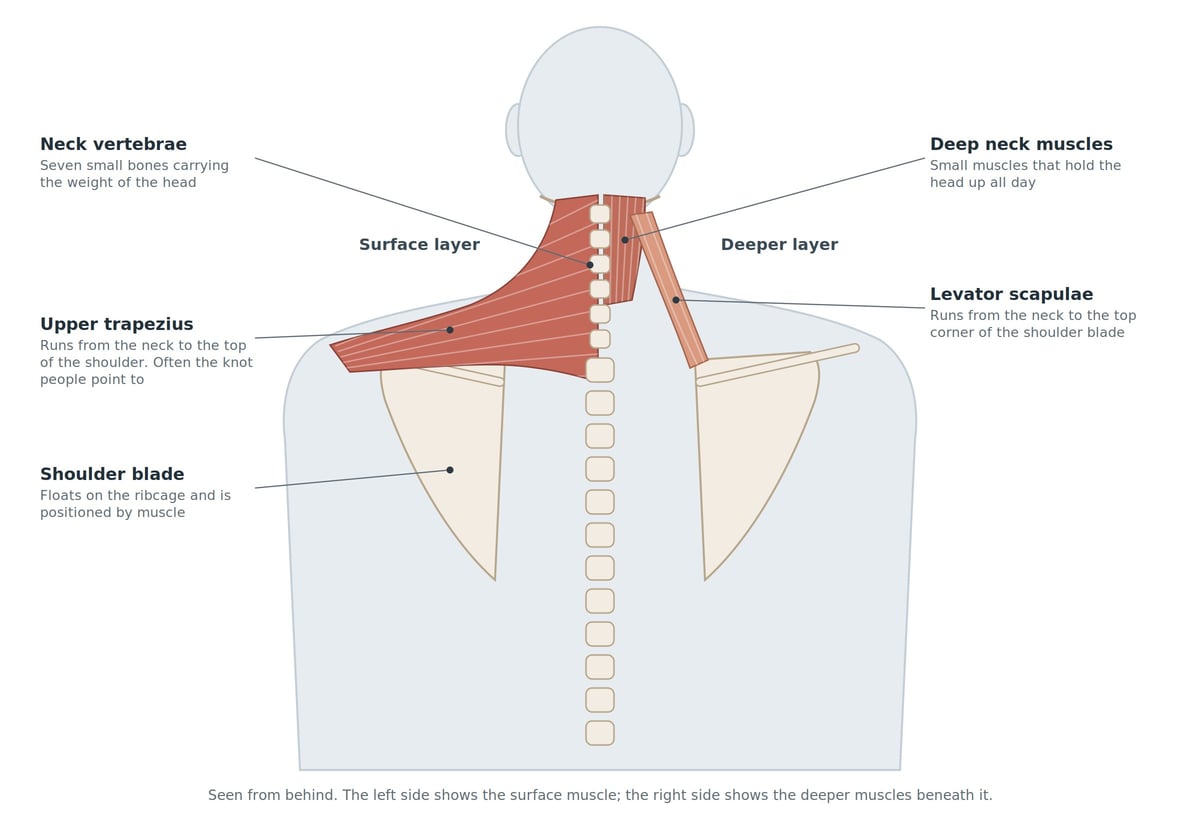
The neck and the shoulders are not two separate areas that happen to be near each other. They are one working unit held together by a set of muscles that run from the base of the skull out to the shoulder blade and down across the upper back.
The shoulder blade does not have a fixed joint holding it in place. It floats on the ribcage and is positioned almost entirely by muscle. That is why it can drift, and why one shoulder can sit higher than the other without you ever noticing. The upper fibres of the trapezius run from the neck to the shoulder blade, so when the shoulder blade is held in a raised or forward position, that muscle is working all day. The levator scapulae runs from the neck to the top corner of the shoulder blade and does the same job in a slightly different direction. Both of these are the muscles people are pointing at when they say the top of their shoulder feels like a knot.
Underneath them sit the deep muscles at the back of the neck, which are small but constantly active. They hold the head up, and the head is heavy. The further forward the head sits, the more leverage those small muscles have to work against, and the more they have to strain to hold the same position. This is why a posture that looks only mildly forward can produce a great deal of neck tension over a working day.
When the head sits forward, the chest muscles at the front shorten and the muscles between the shoulder blades lengthen and weaken. That combination pulls the whole shoulder girdle forward and inward, which is the rounded position most people settle into at a desk. It is a self reinforcing loop, because the shortened chest muscles make it harder to get back to upright, and the rounded position keeps the back muscles stretched and less able to pull you there.
None of this is a structural fault. It is an adaptation to what you ask of the body most often, and adaptation is a thing that can go the other way.
How people describe it
What it feels like
The accounts people give of neck and shoulder pain fall into a few recognisable shapes, and which one you have usually points at what is driving it.
The most common is the heavy shoulder. People say it feels as though someone is pressing down on the top of the shoulder, or that one shoulder carries more weight than the other. It builds through the working day rather than being there at breakfast, and it is usually worst in the late afternoon and evening. It often eases overnight and comes back a few hours into the next day, which makes it easy to dismiss as tiredness rather than anything worth treating.
The second is the stiff neck that will not turn. People reach for a mirror when reversing the car and find they cannot get their head far enough round. Checking a blind spot, looking up at a screen on a wall, or turning to speak to someone beside you all become awkward rather than painful in the ordinary sense. Some describe a feeling that the neck needs to crack, and a temporary relief when it does.
The third is the ache that spreads into the shoulder blade. The discomfort sits between the spine and the shoulder blade, sometimes described as a knot that never fully releases. It is often worst on one side and worse after a long drive or a long stretch at a screen without moving. This is the pattern people most often describe as their shoulders being up around their ears.
The fourth is the one that travels. Pain or pins and needles running down the arm, sometimes into the hand, suggests something different from muscular tension, and it needs assessing before it is treated. If that describes you, mention it when you ring us rather than assuming a massage is the right starting point.
Alongside the pain, people commonly mention headaches that start at the back of the head, a feeling of tightness at the base of the skull, difficulty finding a comfortable position to sleep in, and aching in the arms after a day of holding a phone or a mouse. Where the head pain is the main complaint rather than the neck, that is a slightly different picture and worth reading our page on tension headaches.
Causes
Why it happens
Very little neck and shoulder pain comes from a single event. It builds, usually over months, from positions and loads that are individually unremarkable and collectively a lot. Below are the four patterns we see most.
Screen posture
The problem is rarely the chair on its own. It is that a screen sitting too low or too far away pulls the head forward and down, and that position is then held for hours. Every centimetre the head moves forward adds load to the muscles at the back of the neck, so a laptop used flat on a desk for a full working day is a great deal of sustained strain. A second screen placed off to one side does a similar thing in a different direction, because the neck spends the day rotated. The fix is usually less about buying furniture and more about raising the screen, bringing it closer, and changing position regularly rather than holding any one posture perfectly.
Phone posture
Looking down at a phone held at chest height bends the neck further than most people realise, and the amount of time spent that way adds up far beyond what anyone would guess. The habit matters more than the device. Scrolling in bed with the head propped forward, reading on a phone during a commute and taking calls with the phone wedged between ear and shoulder all load the same small muscles repeatedly. The wedged phone is worth calling out on its own, because holding the shoulder raised for the length of a call is one of the most direct causes of one sided shoulder tightness we see.
Carrying bags
A bag worn on one shoulder keeps that shoulder raised and the neck tilted away from the weight all day, and the body does not correct for it evenly. A heavy handbag, a laptop bag, a rucksack worn on one strap, or a tool bag carried in the same hand every working day will produce tightness that is noticeably worse on one side. The pattern usually shows up as a shoulder sitting higher than the other and a neck that turns more easily to one side than the other. Switching sides, or moving to a bag worn across the body or on both shoulders, often makes a difference within a few weeks.
Sleeping position
You spend a third of your life in one position, and it is the one position you cannot correct while you are in it. Sleeping on your front forces the neck to stay rotated for hours, which is the worst of the common options. A pillow that is too high pushes the neck into flexion, and one that is too flat lets the head drop away from the spine, and either can leave you waking with a stiff neck that eases over the morning. Side sleepers generally do best with a pillow that fills the gap between the neck and the mattress so the head stays level with the spine, while back sleepers usually need less height rather than more.
The honest picture
How massage may help, and what it cannot do
What it cannot do
Massage does not change the structure of your neck, and it cannot undo a posture that you return to for eight hours every day. It will not resolve pain that is coming from a nerve being compressed, and it is not a treatment for the joints of the neck. If your pain runs down the arm, comes with numbness or weakness in the hand, or follows an accident, that needs assessing before anything is done about it.
What it may help with
What it can do is work on the muscular layer, which is where most of the day to day tension actually sits. The upper trapezius, the levator scapulae and the deep muscles at the back of the neck are all reachable, and they are all muscles that respond to sustained, patient work rather than quick pressure. Easing them usually means the head turns more freely and the end of day ache is less heavy.
It also addresses the front of the picture. Because the chest muscles shorten as the shoulders round forward, treatment that only works on the back of the shoulders tends to be short lived. Opening the chest and the front of the shoulder gives the muscles between the shoulder blades a chance to do their job again, which is what allows the shoulder to sit back where it belongs rather than being held there by effort.
Where the pattern has been in place for a long time, the honest value of treatment is often in combination with the changes you make between appointments. Many clients find that a looser neck makes it easier to sit differently, and that the two together hold far longer than either on its own.
Releasing the top of the shoulder
The upper trapezius and levator scapulae are the muscles doing most of the holding, and the ones people point at.
Opening the chest
Tight chest muscles pull the shoulders forward. Freeing them lets the shoulder blades sit back naturally.
Restoring rotation
A neck that turns fully again makes driving, working and sleeping noticeably less awkward.
What to expect here
What treatment looks like at the practice
The assessment for neck and shoulder pain is mostly a conversation about your day. We will ask what you do for work and how much of it is spent at a screen, whether you drive and for how long, which side you carry a bag on, how you sleep and which pillow you use, and whether anything has changed recently such as a new job, a new desk or a new phone. We will also check how far your neck turns in each direction, whether one shoulder sits higher than the other, and whether anything you describe travels down the arm. Those questions are usually what tell us which of the four patterns above is driving it.
The treatment covers the neck, the shoulders, the upper back and the chest. Working only on the knot people can feel is rarely enough on its own, because the tightness at the top of the shoulder is often a symptom of what is happening in front of it and below it. We will usually work through the chest and the front of the shoulders as well, and then into the upper back and the neck itself. The pressure is firm where the tissue can take it and gentler around the neck, which is not an area to be forced.
You will also get guidance on what to do between appointments. That normally covers raising your screen and bringing it closer, changing position through the day rather than holding one good posture, taking calls without wedging the phone, switching the shoulder you carry a bag on, and some simple movements to keep the neck and upper back moving. Where the cause is a working setup, changing it matters more than anything we can do on the table.
This page is reviewed by senior therapist Richard Clarke, who usually handles clients presenting with neck and shoulder pain. The treatment most often used is deep tissue massage, a whole body treatment that works into the deeper layers of muscle and connective tissue. Where the tension is more about stress than load, or where deep pressure is not what you want on the day, relaxing massage is a gentler alternative that still works on the same area.
Important
When it is not massage, and you need medical help
Most neck and shoulder pain is muscular and settles with treatment and some changes to your day. There are occasions when it is something else, and those occasions mean you should not be booking a massage. If any of the following apply, seek medical help rather than an appointment.
Pain, numbness or pins and needles down the arm
Symptoms travelling from the neck into the arm, particularly with numbness, tingling or weakness in the hand or fingers, suggest a nerve is involved and need assessing before treatment.
Weakness or clumsiness in the hand
Dropping things, difficulty with buttons or a hand that feels less reliable than it did. This needs medical assessment rather than soft tissue work.
A neck problem after an accident or a fall
Any significant impact, a fall, or a whiplash type injury needs medical assessment before any soft tissue work is considered.
Severe headache with a stiff neck and fever
A sudden severe headache together with neck stiffness, fever, rash or feeling generally very unwell needs urgent medical attention the same day.
Unexplained weight loss, night pain or a history of cancer
Neck pain that wakes you at night, comes alongside unexplained weight loss, or follows a previous cancer diagnosis needs investigation rather than treatment.
Difficulty swallowing, speaking or breathing
These are not muscular symptoms and need urgent assessment. Call 999 if breathing is affected.
What to do
- Call 999 or go to A&E if you have difficulty breathing or swallowing, or a sudden severe headache with neck stiffness and a fever.
- Call NHS 111 for urgent advice if you are unsure how serious something is, or if symptoms are worsening quickly.
- See your GP for persistent pain, for pain that is getting steadily worse, or if you have any of the symptoms in the list above that are not severe enough to need urgent care.
Where none of those apply, massage may still not be the right answer for you. If we assess you and conclude that your neck needs medical investigation or a different kind of help, we will say so plainly and refer you on. That is a normal part of the job and not a disappointment.
Questions
Questions we get asked
Is my posture the reason my neck hurts?
Partly, but probably not in the way you have been told. There is no single correct posture, and sitting perfectly upright for eight hours is not the answer. What causes trouble is holding any one position for a long time without moving. The useful fix is to change position often, set the screen up so your head is not pushed forward, and move regularly. A good posture you cannot hold is less useful than a reasonable one with regular breaks.
How long will it take to feel better?
Most people notice a difference in how freely the neck moves after the first session, though that often eases back over the following days. How long the change holds depends on how long the pattern has been there and what you are able to change between appointments. We will give you an honest view after assessing you rather than before, and we will not promise a number of weeks.
Will one session be enough?
Rarely for a long standing pattern. A single session can loosen the area and give real relief, but if the working position or the bag or the pillow has not changed, the tightness will usually rebuild. Where the cause is recent and simple, one or two appointments is sometimes all that is needed.
Can I have treatment if I have a trapped nerve?
It depends on what is causing it and how it presents, and that is not something to guess at. If you have pain, numbness or pins and needles running down the arm, mention it when you ring us. We may still be able to help with the surrounding muscular tension, but we will want to know about it first, and some cases need to be assessed by a GP or a physiotherapist before any treatment.
Should I stop using my phone or working at a screen?
No, and that would be impractical advice. The aim is to change how long you hold each position rather than to give anything up. Raising a phone closer to eye level, taking calls on speaker or with a headset rather than wedged against your ear, and standing up every half hour all make a bigger difference than most people expect, and none of them require you to stop what you are doing.
Which pillow should I use?
There is no single right pillow, because it depends on how you sleep. Side sleepers generally need a pillow that fills the gap between the neck and the mattress so the head stays level with the spine. Back sleepers usually need less height, not more. Front sleepers have the hardest job, because the neck stays rotated for hours. If you wake with a stiff neck regularly, it is worth looking at the pillow before anything else.
Will a massage make my neck crack?
Sometimes treatment is followed by a release that feels like a crack, and sometimes it is not. We do not perform manipulation of the neck, and you should be wary of anyone who does so without a proper assessment. What we do is work on the muscles around the neck and shoulders, and the improved movement that follows is usually enough on its own.
My shoulders sit unevenly. Can that be corrected?
Uneven shoulders are extremely common and usually come down to what you carry, which side you sleep on and how you sit. Soft tissue work can ease the tightness that holds one shoulder higher, and changing the bag you carry or the way you sleep helps it stay that way. What we would not claim is that we can realign your skeleton, because that is not what is happening.
If your headaches are the main complaint rather than the neck itself, read our page on tension headaches. You can also read more about what we treat under desk and posture related pain and upper back pain. Where the pain is specific to lifting your arm rather than a general tightness, and you can still move the shoulder in most directions, see rotator cuff pain instead, as the picture is different. You can also see the full list of conditions we help with.
Areas we cover
Where we treat neck and shoulder pain
Neck and shoulder pain is our second biggest group of clients, and it brings people in from right across South Wales. These are the areas we cover in detail.
Clients travel to us from all over the surrounding area, from the city and from the towns and villages around it. If you are not sure whether we cover where you are, ring us and ask.
Main areas we cover
Also covered
Skewen, Birchgrove, Clydach, Glais, Trebanos, Rhos, Neath Abbey, Cadoxton, Cimla, Briton Ferry, Gorseinon, Gowerton, Fforestfach, Loughor, Pontardawe, Pontarddulais, Killay, Ammanford, Burry Port.
Ready to book your session?
Choose a time that suits you, or call us and we will find one that works.