Conditions we help with
Massage for DOMS
The soreness that arrives the day after a hard session and peaks two days later is not an injury and it is not damage. It is the muscle adapting to something it has not done before, and knowing what it is changes what you should do about it.
- Published in the British Journal of Sports Medicine
- Practising since 2007
- Level 4 SMA therapists
- Treated Olympic and Commonwealth athletes
The short answer
Does massage help DOMS?
DOMS stands for delayed onset muscle soreness. It is the aching stiffness that appears in the day or two after unfamiliar or intense exercise and usually peaks around 24 to 72 hours later. It is a normal response to training and not a sign of injury. Massage can make the soreness considerably more comfortable and is most useful on the first day and the day after, but it does not speed up recovery or make you stronger. The evidence for that is weak and we would rather say so. Soreness that is sharp and immediate, that is one sided, or that comes with swelling, bruising or dark urine needs medical assessment rather than a massage appointment.
Where it tends to help
The dull, generalised ache and stiffness a day or two after hard or unfamiliar training, and the tightness that comes with it.
When to see a GP first
Sharp or immediate pain, swelling, bruising, one sided pain, or very dark urine after exercise needs a medical opinion rather than treatment.
The physiology, in plain English
Why the soreness arrives late
When you ask a muscle to do more than it is used to, the fibres sustain large numbers of very small disruptions where they attach to one another. This is called mechanical microtrauma, and it is not an injury in any meaningful sense. It is the stimulus that tells the muscle to rebuild itself stronger. It happens particularly with movements that involve lengthening the muscle under load, which is why running downhill, lowering a weight slowly and a first session back after time off all produce it so reliably.
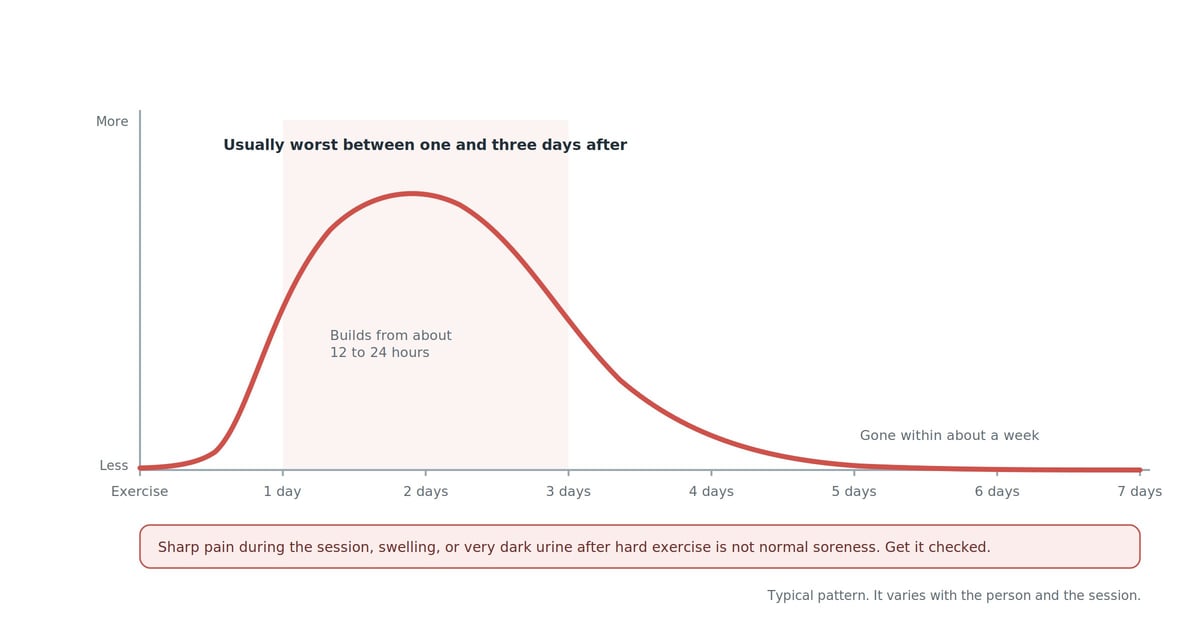
What follows is an inflammatory response, and the delay is the whole point. The chemical signalling and the movement of fluid into the tissue takes time to build, which is why you feel nothing immediately and a great deal the following day. The pattern is shown below, peaking between one and three days after the session and settling within about a week. People who have not come across the term before often assume they have damaged something, because the worst of it arrives so long after the work.
It is worth being clear about what DOMS is not. It is not lactic acid. Lactic acid is cleared from the muscle within an hour or so of exercise ending and has nothing to do with why you are sore two days later. The feeling of burning during hard exercise is a different process entirely, and the two are constantly confused even in gyms and on training courses.
The other thing worth knowing is the repeated bout effect. Once a muscle has been through a particular kind of load, it becomes substantially more resistant to soreness from the same thing. A second session of the same training a week or two later produces far less soreness than the first, and after a few exposures it may produce almost none. This is not because you have become tougher. It is a genuine protective adaptation in the tissue.
That adaptation is also why DOMS is a poor training guide. Its absence does not mean a session was wasted, and its presence does not mean a session was effective. Plenty of productive training produces no soreness at all, and plenty of soreness follows sessions that add nothing to your fitness. What it does tell you is that you asked the muscle to do something unfamiliar, which is useful information and no more than that.
How people describe it
What it feels like
The descriptions people give of DOMS are consistent, and they are quite different from how an injury feels.
The first is that it is general and spread out rather than in one spot. People say the whole of both thighs ache, or the whole of the calves, or the chest and arms together. There is no single point they can press, and the discomfort covers a broad area rather than being localised. That is one of the clearest differences between DOMS and a strain.
The second is the stiffness that eases as you move. People describe being unable to get going first thing, then finding the muscles loosen after ten minutes of gentle activity, and then stiffening up again after sitting still. It is a pattern that feels odd and unfamiliar, and it often makes people worry that something is wrong. It is entirely typical.
The third is the tenderness to touch. Pressing into the affected muscle is uncomfortable in a broad, diffuse way, and the muscle feels firm and tired. People often notice it most in the movements they would normally not think about: sitting down onto a low chair, walking downstairs, reaching for something on a shelf, or lowering themselves onto the toilet.
The fourth is the timing, which is what catches people out. It is not there straight after the session. It arrives the next day, often worse on the second day, and it fades over the days after that. Some people find the second day is the worst and describe an almost comical inability to move normally, which is characteristic and short lived.
What people do not usually describe is sharp pain, a moment when something went, or pain that is significantly worse on one side than the other. Any of those points at something other than DOMS, and the distinction is covered below.
The honest picture
How massage may help, and what it cannot do
What it cannot do
Massage does not speed up recovery from DOMS. This is one of the few places where we would actively talk you out of an expectation rather than encourage one. The evidence on whether massage reduces the duration of soreness or improves performance in the days after is weak and inconsistent. Anyone claiming to flush lactic acid out of a muscle is describing something that is not happening, because the lactic acid was gone hours after you finished training.
It also cannot prevent soreness happening in the first place. There are people who book a massage immediately after a hard session hoping to avoid it, and that is not how it works. The tissue response is already underway, and nothing done on a treatment table stops it. Where a massage after a race or a long event genuinely helps, it is usually because it feels good and helps you rest, and those are perfectly good reasons.
What it may help with
What massage can do is make you more comfortable, and for something that lasts a few days that is not a small thing. Working gently through sore muscles reduces the feeling of tightness, eases the general ache, and often improves how freely you can move. Many people describe the muscle feeling more like itself afterwards rather than tight and foreign.
The timing matters more than on most of our pages. Working firmly into muscles that are already sore and inflamed tends to make them worse rather than better, so a treatment during the peak of DOMS should be gentle. Where someone wants a firm deep tissue session, it is usually better to wait until the soreness has settled, which is typically three to four days after the session that caused it.
There is also a legitimate place for treatment before an event rather than after. Where the goal is to feel loose and rested going into a race or a competition, a treatment in the days beforehand is a reasonable thing to do and many athletes use it. What we would avoid is any firm work in the final day or two, because the muscle needs to be recovered rather than worked on when it matters.
Easing the ache
Gentle work reduces the feeling of tightness and makes sore muscles more comfortable.
Timing it right
Gentle during the peak. Firm work is better saved until the soreness has settled.
Before an event
A loosening treatment in the days before competition is useful. Not the day before.
What to do about it
What actually helps, and what does not
Because massage and most recovery products do less than people hope, it is worth being straight about where the real answers lie. The honest position is that DOMS mostly resolves on its own, and the things that genuinely help are unglamorous.
What does help
- Gentle movement. Walking, easy cycling or swimming at low intensity increases blood flow and eases the stiffness. It will not speed the recovery, but it makes the days pass more comfortably.
- Sleep. The tissue repair happens while you sleep, and a poor night genuinely makes the following day worse. This is the single most effective thing on the list.
- Eating and drinking enough. Protein and fluid support the repair process, and being under fuelled makes everything feel worse.
- Building up gradually. Soreness is largely a function of how much the load increased. Keep the increases modest and the problem becomes far smaller.
What matters less than people think
- Ice baths and cold water. Some people find them helpful for feeling better. The evidence that they speed recovery is weak, and there is some suggestion that regular use may blunt the training adaptation you were after.
- Stretching. It is generally accepted that stretching before or after training does not prevent DOMS and does not treat it.
- Massage. Genuinely helpful for comfort, and not a recovery tool. Worth having, for the right reason.
- Painkillers as a routine. Taking anti inflammatories routinely after every session may interfere with the adaptation the training was meant to produce. If you need them regularly, that is worth a conversation with your GP or pharmacist.
What to expect here
What treatment looks like at the practice
The assessment here is mostly about making sure the soreness is DOMS rather than something else, and then agreeing what you want from the session. We will ask what training you did, when the soreness started, where it is and whether it is the same on both sides. If any of that points towards a strain rather than ordinary soreness, we will say so and treat it differently.
Where it is DOMS, the treatment is lighter than our usual deep tissue work. The muscles are inflamed and tender and they do not respond well to being pressed hard, so the pressure is broad and gentle rather than deep and focused. That is not a lesser treatment. It is the right one for tissue in that state, and working firmly into it would leave you more uncomfortable rather than less.
The session normally covers the muscle groups that are sore, plus the areas around them that are carrying the load. Where someone has run a long distance, the calves, hamstrings and gluteals are usually all involved, and the lower back is often tight as well. We will work through the whole pattern rather than only the part that hurts most.
If what you want is a firmer session, the honest advice is to book it once the soreness has settled, which is usually three to four days after the training that caused it. Coming in during the peak and asking for deep pressure tends to be a poor use of an appointment for both of us, and we would rather tell you that than take the booking.
This page is reviewed by senior therapist Richard Clarke. During the peak of soreness the treatment used is relaxing massage, which uses broader, gentler pressure that suits tissue in that state. Where the soreness has settled and you want the tightness worked out, deep tissue massage is the right choice instead. If you have not been to the practice before, our page on your first visit explains what happens when you arrive.
Important
When it is not DOMS, and you need medical help
Soreness after training is normal and nothing to worry about. There are a small number of situations that look similar and are not ordinary soreness, and one of them is a medical emergency. If any of the following apply, seek medical help rather than booking with us.
Very dark, cola coloured urine after intense exercise
This can be a sign of rhabdomyolysis, where muscle breakdown has overwhelmed the kidneys. It needs emergency assessment the same day. It is rare, and it is more common after extreme or unaccustomed exertion, particularly in hot conditions.
Severe swelling or a muscle that feels hard and tight
A muscle that has become visibly swollen, tense and painful, particularly with numbness or a pale appearance, needs urgent medical assessment.
Pain that came on suddenly with a sharp moment
DOMS does not begin with a moment when something went. A sudden sharp pain, particularly with a snap or a feeling of being hit, suggests a strain or a tear and needs assessing.
Pain that is much worse on one side
DOMS after a normal training session is generally similar on both sides. Marked one sided pain, particularly with bruising, suggests a localised injury rather than general soreness.
Bruising
DOMS does not cause bruising. Bruising after exercise suggests a tear of muscle fibres or a bleed, and it needs assessment rather than massage.
You cannot use the muscle at all
Being unable to bear weight, lift the arm or use the muscle through a normal range is not typical of DOMS and needs assessing.
Soreness that is not settling after a week
DOMS improves steadily over a few days. Pain that is unchanged or worsening a week later is not ordinary soreness and should be looked at.
You are taking a statin and have new muscle pain
Muscle pain in people taking statins should be raised with a GP or pharmacist, particularly where it is severe or came on after starting or changing the dose.
What to do
- Call 999 or go to A&E if your urine is very dark or cola coloured after intense exercise, or if a muscle is severely swollen, hard and painful.
- Call NHS 111 for urgent advice if you are unsure how serious something is, or if symptoms are worsening quickly.
- See your GP if the pain is one sided, if there is bruising, if you cannot use the muscle normally, or if the soreness is not settling.
Where none of those apply, and the soreness follows the pattern described on this page, massage is a reasonable thing to try. If we assess you and conclude that what you have is not ordinary soreness, we will say so plainly and refer you on. That is a normal part of the job and not a disappointment.
Questions
Questions we get asked
Is DOMS a sign that my training worked?
Not really, and it is worth letting go of that idea. Soreness means you asked the muscle to do something unfamiliar, which is useful information but not a measure of quality. Plenty of effective training produces no soreness at all because the body has adapted to it, and plenty of soreness follows sessions that add nothing. The pattern of your training over weeks and months is a far better guide than how you feel the next day.
Can massage prevent DOMS?
No. The tissue response starts during the exercise itself, and nothing done afterwards stops it developing. Where massage genuinely helps is in making the sore days more comfortable, which is a real benefit when you are stiff and aching. The repeated bout effect, which is the adaptation that makes a second similar session much less sore, is what actually reduces it, and that happens through training rather than through treatment.
Should I train again while I am still sore?
Usually yes, at a reduced intensity, and this is often better than resting completely. Gentle activity increases blood flow and eases the stiffness, and it keeps the habit going. What we would avoid is another hard session of the same kind while you are still significantly sore, because the tissue is still recovering and you would be adding load to a muscle that has not finished adapting. Light movement on the sore days, then back to normal as it settles, is a sensible pattern.
Why is the second day worse than the first?
Because the inflammatory response takes time to build. The chemical signalling and the fluid movement into the tissue peak somewhere between 24 and 72 hours after the session, which is why the first day often feels manageable and the second is worse. It is a normal part of the process and not a sign that something has gone wrong. For most people it eases from the third day onwards.
Is it lactic acid?
No, and this is one of the most persistent myths in training. Lactic acid is cleared from the muscle within roughly an hour of exercise ending, so it cannot be causing soreness two days later. The burning you feel during hard exercise is a different process. Anyone offering to flush lactic acid out of your muscles with massage or a recovery tool is describing something that is not happening.
Does stretching help DOMS?
The general view is that it does not, either before or after training. Stretching does not prevent soreness developing, and it does not shorten how long it lasts. Some people find it feels good while they are doing it, which is a perfectly reasonable reason to do it, but it is not treating the soreness. If you are stretching into a sore muscle hard hoping to speed things up, you are more likely to aggravate it.
Why did I not get sore this time when I did before?
That is the repeated bout effect, and it is a genuine adaptation. Once a muscle has been through a particular kind of load, it becomes substantially more resistant to soreness from the same thing for weeks afterwards. A second session of the same training produces far less soreness than the first. It does not mean you have become fitter exactly. It means the tissue has protected itself against that specific demand.
When should I book a massage after a race?
It depends what you want from it. If the goal is to feel more comfortable during the sore days, a gentle treatment a day or two afterwards works well, and this is the most common reason people book. If you want a firmer deep tissue session to work out tightness, waiting three to four days until the soreness has settled is the better choice. For a big event, many people also book a loosening treatment in the week before, and we would avoid anything firm in the final day or two.
Where the pain is sharper and one sided rather than a general ache, that is more likely to be a strain, which is a different thing. If the soreness comes with tight, tender bands rather than a general ache, see muscle knots. Where the goal is returning to training properly after a break, returning to exercise over 40 is worth reading. You can also see the full list of conditions we help with.
Areas we cover
Where we treat post exercise soreness
Clients come to us from across the area after races, long rides and first sessions back. These are the areas we cover in detail.
Clients travel to us from all over the surrounding area, from the city and from the towns and villages around it. If you are not sure whether we cover where you are, ring us and ask.
Main areas we cover
Also covered
Skewen, Birchgrove, Clydach, Glais, Trebanos, Rhos, Neath Abbey, Cadoxton, Cimla, Briton Ferry, Gorseinon, Gowerton, Fforestfach, Loughor, Pontardawe, Pontarddulais, Killay, Ammanford, Burry Port.
Ready to book your session?
Choose a time that suits you, or call us and we will find one that works.