
Conditions we help with
Massage for piriformis syndrome
Deep pain in the buttock that travels down the back of the leg is usually blamed on the sciatic nerve. Very often the piriformis muscle is the culprit, and it is one of the more satisfying things to treat because it responds so well to direct work.
- Published in the British Journal of Sports Medicine
- Practising since 2007
- Level 4 SMA therapists
- Treated Olympic and Commonwealth athletes
The short answer
Can massage help piriformis syndrome?
The piriformis is a small muscle deep in the buttock that runs from the lower spine to the top of the thigh bone. The sciatic nerve passes right beside it, and in some people straight through it. When the muscle tightens or goes into spasm, it can press on the nerve and produce a deep ache in the buttock with pain running down the back of the leg that feels very much like sciatica. Massage is one of the better treatments for it, because the muscle is small, reachable and responds well to direct work. Pain that is getting worse, comes with numbness or weakness, or that followed an injury needs medical assessment rather than a massage appointment.
Where it tends to help
Deep buttock pain that is worse with sitting, driving or crossing the legs, and that eases when the muscle is worked directly.
When to see a GP first
Pain with numbness, weakness, loss of bladder or bowel control, or pain that followed a fall needs a medical opinion before a treatment table.
The anatomy, in plain English
A small muscle in an awkward place
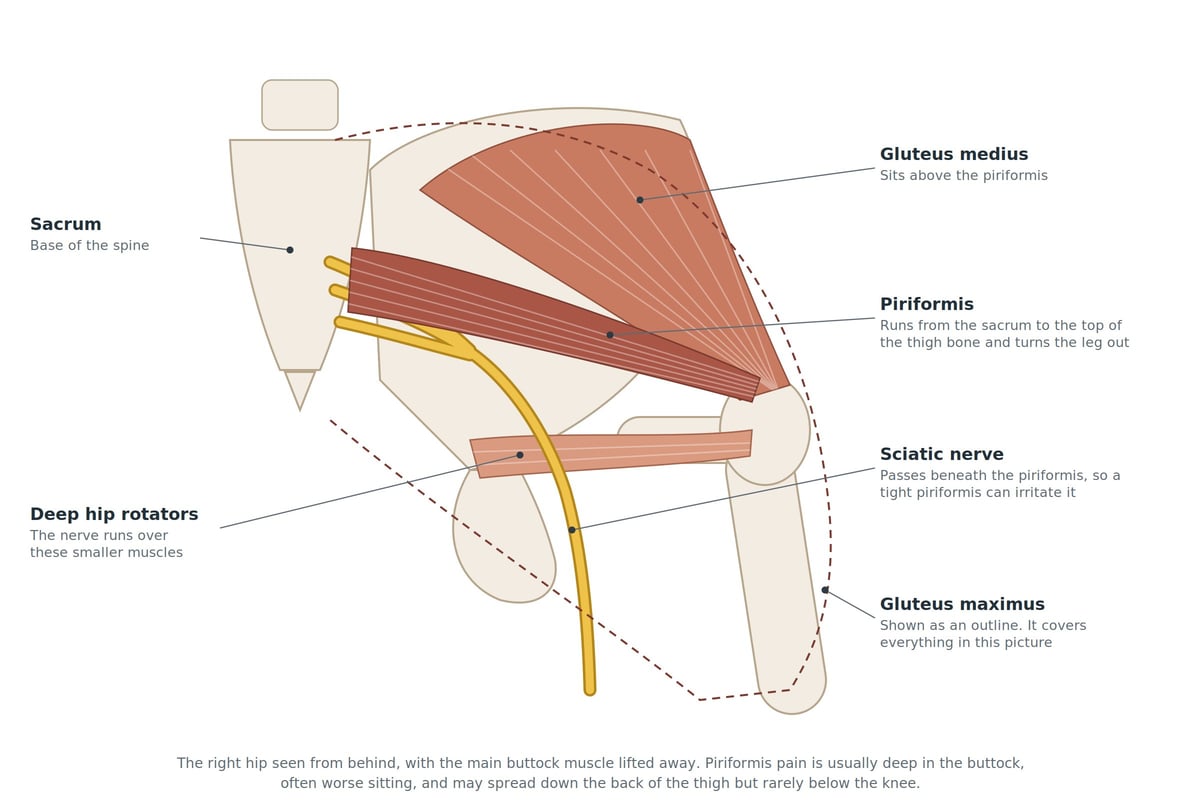
The piriformis is a narrow muscle that sits deep in the buttock, underneath the large gluteal muscles. It runs from the lower part of the spine, through the pelvis and out to the top of the thigh bone. Its job is to rotate the leg outwards and to help steady the hip when you are standing on one leg. It is not a large muscle, but it is in a position where it matters.
The reason it causes so much trouble is the sciatic nerve. That nerve, the largest in the body, runs from the lower back down the back of the leg. On its way out of the pelvis it passes directly underneath or beside the piriformis. In a meaningful proportion of people, the nerve actually passes straight through the muscle rather than beside it. That anatomical variation explains why some people are far more prone to this than others.
When the piriformis tightens, goes into spasm or becomes irritated, it can compress the nerve against the structures around it. The result is a deep, aching pain in the buttock, often on one side, which may travel down the back of the thigh and sometimes as far as the calf. Because the pain pattern overlaps so heavily with sciatica, the two are constantly confused, both by the people who have them and sometimes by the clinicians treating them.
There is a useful difference to know about. In true sciatica the problem usually starts at the spine, where a disc or a narrowed opening presses on a nerve root. In piriformis syndrome the spine is not the problem at all. The nerve is being irritated further down its course, in the buttock. That distinction matters because it changes what treatment should focus on.
The name syndrome is used rather than a single condition because the diagnosis is made largely on the pattern of symptoms. There is no simple test that confirms it, and it is often arrived at by ruling out other explanations. That is worth being honest about, because it means an assessment matters more here than on some other pages.
An important distinction
Piriformis syndrome or sciatica
These two produce very similar pain, and people often arrive having been told they have one when they have the other. The table below sets out how they are usually told apart, but it is a guide rather than a diagnosis. The honest position is that working out which you have is part of what an assessment is for, and both can respond well to treatment.
It is also common to have both at once, and it is common for the two to be difficult to separate. What matters more than the label is whether there is anything about your symptoms that needs medical assessment, which is covered further down this page.
Causes
Why it happens
The piriformis tightens in response to what the hip is being asked to do, or to what it is not being asked to do. Below are the patterns we see most.
Sitting for long hours
This is the most common contributor. The piriformis sits directly under the weight of the body when you sit, and it sits in a shortened position. Hours of driving, desk work or long meetings compress and shorten it. Many people notice the pain is worst after a long journey and settles once they are moving again, which is a strong clue that this is the mechanism.
A sudden increase in running or walking
The piriformis works hard during running, particularly on uneven ground, on hills or when you change direction. Where training has stepped up quickly, or where you have started running on cambered roads, the muscle can become overloaded. Trail running and sports involving a lot of lateral movement are particular triggers.
Weak gluteal muscles
This is the one people least expect, and it is often the most important. When the larger gluteal muscles are weak, the smaller piriformis has to take on work it was not designed for, and it tightens and fatigues as a result. This is why strengthening the glutes is part of nearly every successful treatment plan, and why treatment alone often gives temporary relief rather than a lasting one.
Direct pressure or a fall onto the buttock
Falling onto the buttock, sitting on a hard surface for long periods, or carrying a wallet in a back pocket can all irritate the muscle directly. The wallet in the back pocket is a genuinely common cause and it is easily overlooked, because people do not connect the two. Where the pain is consistently one sided, this is worth ruling out.
The honest picture
How massage may help, and what it cannot do
What it cannot do
Massage will not change the anatomy. If the sciatic nerve passes through the piriformis in your case, no amount of treatment will change that, and it means you are likely to be someone who is prone to this recurring. What treatment can do is keep the muscle as relaxed and as well conditioned as it can be, which is a great deal more useful than it sounds.
It also will not fix a spine problem that is presenting as leg pain. Where the pain is actually coming from a disc or from narrowing in the lower back, working on the buttock will not address it. That is one of the reasons we ask about the lower back even when you have come in about your hip, and it is a reason to be assessed rather than self diagnose.
What it may help with
This is one of the conditions where direct treatment works particularly well. The piriformis is small compared with the muscles around it, and once the overlying gluteal layers have been worked through, it can be reached and treated specifically. Releasing a muscle that is in spasm often produces immediate and noticeable relief, and many people feel the difference before they have left the room.
Treatment also addresses what the tight muscle has done to everything around it. A piriformis in spasm changes how you walk, how you sit and how you sleep, and the compensating muscles in the lower back, the opposite hip and the thigh become tight and sore in their own right. Treating only the one muscle and ignoring the rest tends to give a shorter lived result.
What matters most in the longer term is the strength work. Where the gluteal muscles are weak, the piriformis will tighten again as soon as it is asked to take the same load. Treatment can resolve the episode and make the area comfortable, but keeping it that way usually means building up the larger muscles so the small one is not doing their job. We will give you a short, specific set of exercises rather than a long programme.
Releasing the muscle
A piriformis in spasm responds well to direct work, and relief is often immediate.
Easing the compensation
A tight buttock changes how you walk and sit, loading the back and the other hip.
Backing it with strength
Strong gluteals mean the small muscle is not carrying work it was not built for.
What to expect here
What treatment looks like at the practice
The assessment sets out to work out whether this is the piriformis, the spine or something else, because the treatment differs. We will ask where the pain sits and where it travels, what makes it worse and what makes it better, whether sitting or driving aggravates it, whether the lower back is involved at all, and whether there is any numbness, tingling or weakness in the leg. We will also look at how the hip moves and how you walk.
If what you describe points towards the spine, or if there is anything that needs medical assessment, we will say so rather than going ahead. That is a straightforward judgement.
Where the picture fits, the treatment covers the gluteal muscles first and then works more specifically into the piriformis. That order matters, because the piriformis is buried under the larger muscles and it cannot be reached properly until the layers above it have relaxed. The work is firm, because these are deep muscles and light pressure does not reach them, though the pressure is always adjusted to what you can genuinely tolerate.
We will also treat the lower back, the opposite hip and the back of the thigh, because these are the areas that tighten up in response. People are often surprised that we spend time on the other side, until they notice that it has been aching too.
You will get guidance for between appointments, and this is where the lasting change comes from. That normally covers a small number of gluteal strengthening exercises, how to break up long periods of sitting, whether your driving position or your wallet is contributing, and how to build activity back up without provoking it. We will be honest that treating the episode is the quicker part and that keeping it away takes some consistency.
This page is reviewed by senior therapist Richard Clarke. The treatment used is deep tissue massage, which works through the gluteal layers to reach the piriformis itself. Where the area is acutely painful, gentler work is used at first and firmer pressure is introduced as it settles. If you have not been to the practice before, our page on your first visit explains what happens when you arrive.
Important
When it is not massage, and you need medical help
Buttock and leg pain is usually not serious, and this condition is not dangerous. There are patterns that need prompt assessment, and a small number that need urgent attention. If any of the following apply, seek medical help rather than booking with us.
Loss of bladder or bowel control, or numbness around the groin
This is a medical emergency and needs immediate assessment. Call 999 or go to A and E straight away, and do not wait to see whether it improves.
Weakness in the leg that is getting worse
Progressive weakness, particularly if you are catching your foot or struggling to lift it, needs urgent assessment rather than treatment.
Numbness or tingling that is constant rather than occasional
Altered sensation that does not come and go suggests the nerve is being significantly affected, and it needs assessing.
Pain that started after a fall or a significant injury
Pain in the buttock or hip that followed an impact needs assessment before treatment, because the cause may be structural.
Pain that is severe, constant and getting worse
Pain with a clear downward trend that is not settling needs investigating rather than treating.
Pain in both legs rather than one
Symptoms affecting both legs, particularly where they are spreading, need medical assessment.
You have a history of cancer or unexplained weight loss
New pain in the hip or thigh in these circumstances needs investigation rather than treatment.
The pain is not settling and you have not been assessed
This is the most common reason and the least alarming. Where the usual approaches have not helped, it is worth having it looked at properly, because the piriformis and the spine are easily confused and they are managed differently.
What to do
- Call 999 immediately if there is loss of bladder or bowel control, numbness around the groin, or weakness in both legs.
- Call NHS 111 for urgent advice if you are unsure how serious something is, or if symptoms are worsening quickly.
- See your GP if the pain followed an injury, if there is weakness or constant numbness in the leg, or if it is not settling with the usual approaches.
Where none of those apply, and your pain fits the pattern described on this page, massage is a reasonable thing to try and often a very effective one. If we assess you and conclude that your symptoms need medical investigation or a different kind of help, we will say so plainly and refer you on. That is a normal part of the job and not a disappointment.
Questions
Questions we get asked
How do I know if it is my piriformis or sciatica?
The best guide is where the pain starts and what sets it off. Piriformis pain usually starts deep in the buttock and that is often the worst part of it. It is brought on by sitting, driving or crossing the legs, and it usually travels down the back of the thigh rather than into the foot. Sciatica more often starts in the lower back, is brought on by bending or coughing, and frequently reaches the foot. The two can occur together, and working out which is which is part of what an assessment is for.
Why is it worse when I sit or drive?
When you sit, the piriformis is under the weight of the body and in a shortened position at the same time. Hours of that compress and tighten the muscle, and it is why long journeys are such a common trigger. Many people find their symptoms are worst in the car and settle once they are up and moving again, which is itself a good clue. Breaking up long periods of sitting is one of the more useful things you can do.
How long does it take to settle?
Often faster than many of the conditions we treat, because the muscle responds well to direct work. Many people notice a clear improvement after one or two sessions, and a typical episode settles over a few weeks. The part that takes longer is the strengthening, which is what stops it coming back. Where the pain has been there for many years without proper treatment, it takes correspondingly longer.
Will it keep coming back?
It can, particularly where the gluteal muscles are weak or where your daily routine keeps the muscle under pressure. In some people the nerve passes through the muscle rather than beside it, which makes them more prone to it, and there is nothing that changes that anatomy. The good news is that keeping the gluteals strong and breaking up long periods of sitting makes a very large difference to how often it returns.
Do I need to strengthen my glutes, or just have treatment?
Both, and the strength work is the part that keeps it away. Treatment resolves the episode and makes the area comfortable, and often quite quickly. What it does not do is change how much load the small muscle is carrying. Where the larger gluteal muscles are weak, the piriformis takes on work it was not designed for and tightens again. A short set of exercises you actually do is worth more than a long programme.
Could a wallet in my back pocket be causing this?
It genuinely can, and it is more common than people expect. Sitting on a wallet puts direct pressure on the piriformis and the structures around it, and it is consistently one sided because the wallet is. If your pain is always on the same side and you keep a wallet in that back pocket, that is a simple thing to rule out before looking for anything more complicated.
Is a deep massage going to be painful?
It can be intense, and we would rather say so than pretend otherwise. The piriformis sits deep beneath the gluteal muscles, so reaching it means working through the layers above, and that feels firm. A muscle in spasm is tender to press. The pressure is always adjusted to what you can honestly tolerate, and there is no benefit in gritting your teeth through something that leaves you sore for days afterwards.
Can I keep exercising while it settles?
Usually yes, with some adjustment. Complete rest tends to make the muscle tighter and the glutes weaker, which is the direction you do not want. What normally works better is reducing the volume and intensity of what aggravates it, avoiding long periods of sitting and cambered roads, and building back gradually as it settles. If the pain is severe or getting worse with activity, that changes the picture and is worth an assessment first.
The piriformis is one of several muscles that produce pain around the hip, so that page covers the wider picture. Where the pain is coming from the lower back rather than the buttock, see lower back pain. If you are working out whether it is the piriformis or a disc, our page on sciatica and referred leg pain is worth reading. You can also see the full list of conditions we help with.
Areas we cover
Where we treat piriformis syndrome
Deep buttock pain brings clients in from across the area, often after months of assuming it is sciatica. These are the areas we cover in detail.
Clients travel to us from all over the surrounding area, from the city and from the towns and villages around it. If you are not sure whether we cover where you are, ring us and ask.
Main areas we cover
Also covered
Skewen, Birchgrove, Clydach, Glais, Trebanos, Rhos, Neath Abbey, Cadoxton, Cimla, Briton Ferry, Gorseinon, Gowerton, Fforestfach, Loughor, Pontardawe, Pontarddulais, Killay, Ammanford, Burry Port.
Ready to book your session?
Choose a time that suits you, or call us and we will find one that works.