
Conditions we help with
Massage for desk and posture pain
The aches that build up from a working day rarely stay in one place. They show up in the neck, the shoulders, the lower back and the head, often together, and they usually have more to do with how long you stay in a position than with the position itself.
- Published in the British Journal of Sports Medicine
- Practising since 2007
- Level 4 SMA therapists
- Treated Olympic and Commonwealth athletes
The short answer
Can massage help desk and posture pain?
Massage may help the aches that come from desk work, home working, laptop use and driving by easing the muscles that have been held in one position for too long. Most of these problems are not caused by a bad posture but by holding any posture for hours without moving, and changing position regularly matters more than finding a perfect setup. Treatment can ease the tension that has built up, and the practical changes below are what stop it returning.
Where it tends to help
Aches that build through the working day, or that settle overnight and return once you are back at the desk, usually respond well once the muscles that have been held still are worked through.
When to see a GP first
Pain that came on suddenly and severely, pain after a fall, or pain with numbness, weakness or fever needs a medical opinion before a treatment table.
The anatomy, in plain English
Why one position causes pain in so many places
It is worth starting with the thing most posture advice gets wrong. There is no single correct way to sit. The human body is not built to hold any one position for hours, and the damage is done by duration rather than by angle. Someone sitting imperfectly who shifts around all day will usually fare better than someone sitting in textbook alignment without moving.
What happens when you stay still is that a small number of muscle groups take the whole load continuously while their neighbours switch off. The muscles that hold the head up and the shoulders back work without a break, and they fatigue. The muscles that would normally support the lower back stop contributing because they are not being asked to, and they weaken over time. The tissue that is held shortened adapts to being shortened, and the tissue that is held stretched adapts to being stretched.
This is why the symptoms do not stay in one place. If you sit with your head forward all day, the small muscles at the back of the neck take the strain, and that produces neck ache and often a headache. If your shoulders round forward, the chest muscles shorten and the muscles between the shoulder blades are left stretched and unable to work properly, which produces the ache between the shoulder blades. If your hips stay flexed in a chair for eight hours, the hip muscles shorten and the lower back picks up work it was not designed to do continuously, which produces lower back pain.
None of this happens overnight, and none of it is a structural fault. It is an adaptation to a pattern, and adaptation goes both ways. That is genuinely good news, because it means the changes are reversible with time.
How people describe it
What it feels like
The most useful thing about this group of problems is the shape they follow. Almost everyone describes the same rhythm.
It is not there when you wake up. The first hour or two of the day are usually fine, which is what makes people dismiss it as tiredness rather than anything worth addressing. It builds through the morning, eases if you get up and move around, and comes back more quickly once you sit down again. By late afternoon it is at its worst, and by the evening it has often settled into a dull ache that follows you home.
The second recognisable feature is that it moves around. People describe a bad neck one week, a sore upper back the next, and a lower back that started complaining after a change of chair. It is unusual for one spot to hurt continuously for months, and the way it migrates is itself a sign that the cause is the day rather than the spot.
The third is the weekend pattern. Many people notice their symptoms improve when they are away from the desk and return on the first day back, or that a week off resolves things almost entirely. That is reassuring, because it points at something reversible, and it also tells you the fix is going to be in your working day rather than in your body.
Alongside the pain, people commonly mention a stiff neck in the morning, tension headaches that build through the afternoon, aching between the shoulder blades, tightness across the top of the shoulders, lower back stiffness after sitting, and a feeling of general fatigue in the upper body by the end of the day. Where the headache is the main complaint, see our page on tension headaches for that side of it.
Causes
Why it happens
There are three working patterns behind almost every case we see, and most people fall into more than one of them.
Home working
The kitchen table and the sofa are where we see the worst of it. A kitchen table is usually too high to type at comfortably and too low to sit at properly, so people end up perched forward with their shoulders raised. A sofa removes any support for the lower back and forces the hips into a position they cannot hold for long. The harder problem with home working is that the boundaries have gone. There is no walk to the train, no meeting room to walk to, and no colleague stopping at your desk, so the day becomes far more static than it was in an office. Many people describe sitting for three or four hours without getting up, which simply did not happen before.
Laptop use
A laptop is a compromise between a screen and a keyboard, and the compromise is made at the neck. You cannot have the screen at eye level and the keyboard at hand level at the same time, so one of them has to give. Almost everyone sacrifices the neck, because otherwise their arms are up in the air. Used that way for a full working day, the head sits forward of the shoulders for hours, and the muscles at the back of the neck are left holding a weight they are not positioned to hold. Using a laptop on your lap is worse again, because the knees come up and the lower back rounds at the same time.
Driving jobs
If you drive for a living, the working day is spent in a seated position with the head forward, the shoulders slightly raised and the position fixed. Add vibrations through the seat, the repeated action of a clutch pedal, and stop start traffic, and you have hours of the same posture with one side working harder than the other. Drivers are among the most consistent responders to treatment, and they are also the group where the problem is hardest to fix, because the seat is the workplace. Adjusting the seat properly, moving when you stop and using the vehicle as well as you can make a real difference, even if it cannot be perfect.
The one thing that matters more than your setup
If you take nothing else from this page, take this. Changing position regularly is more important than finding the perfect posture. A setup that is comfortable and that you stay in for four hours without moving will cause more trouble than a mediocre setup you shift around in. The practical test is simple: if you have not changed position in the last thirty minutes, that is the problem, whatever your chair is doing.
Practical changes
Setting up your desk properly
You do not need to buy anything to make a difference, and most of what follows can be done in ten minutes with things you already have. Work down the list and fix the cheapest things first. If you are using a laptop at a kitchen table, the screen and the seat are the two that matter most.
Screen height first
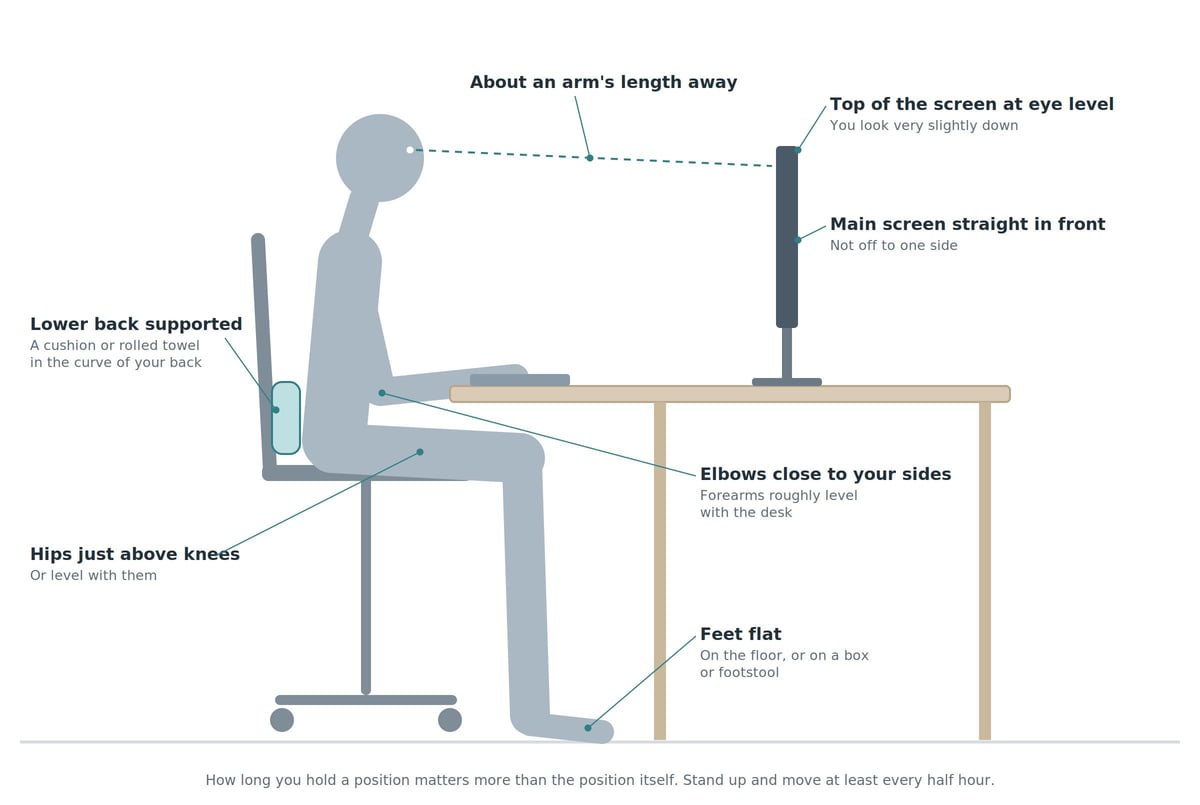
The top of the screen should sit roughly at eye level, so you are looking very slightly down rather than up or straight ahead. On a laptop this means raising the machine and using a separate keyboard and mouse. A stack of books or a box does the job. If you only fix one thing on this page, fix this one, because the head forward position is what produces most neck pain and most tension headaches.
Get the screen close enough
If the screen is too far away you will lean toward it without noticing, which undoes the work of raising it. Roughly an arm's length is a reasonable starting point. If you find yourself squinting or leaning in, either bring it closer or make the text bigger, and do not accept a setup where you are straining to read.
A second screen placement
If you use two screens and one is off to the side, your neck spends the day rotating in one direction. Put the screen you use most directly in front of you and the other one angled in beside it, as close to the centre as you can manage. If you use a laptop with an external monitor, make the monitor the primary screen rather than the laptop.
Elbows and wrists
Your forearms should sit roughly level with the desk and your elbows close to your sides rather than out in front. If your shoulders are raised to reach the keyboard, the keyboard is too high, and that raised shoulder position is one of the most direct causes of upper shoulder tightness we see. A cushion or an adjustable chair height usually solves it.
Support the lower back
Your lower back needs something to lean into rather than being held up by your own muscles all day. A small cushion or a rolled towel in the curve of the lower back does most of what an expensive lumbar support does. The aim is to have your back supported so the muscles can relax, not to sit rigidly upright.
Feet and hips
Your feet should rest flat, either on the floor or on something solid, and your hips should be roughly level with or slightly above your knees. If your chair is too high and your feet dangle, the weight gets taken by your thighs and the lower back compensates. A box, a footstool or a ream of paper under the desk fixes it.
Move more often than you think
Stand up at least every half hour, even for a minute. The most effective version of this is to attach it to something that already happens, such as standing up during every phone call, walking to refill a glass, or taking the long way to the kitchen. Movement breaks do more good than any piece of equipment on this list, and they cost nothing.
For drivers specifically
Set the seat so your hips are slightly higher than your knees where the vehicle allows, bring the seat base forward enough to support the backs of your thighs, and adjust the steering wheel so your arms are relaxed rather than stretched. Take the opportunity to get out and move whenever you stop, because in a driving job the breaks are the only part of the day you can change. Where the seat height is fixed, a cushion can help.
The honest picture
How massage may help, and what it cannot do
What it cannot do
Massage does not change your posture, and it will not fix a working day that keeps recreating the problem. If you spend eight hours in the same position and have an appointment once a month, the appointment treats the result rather than the cause. It also cannot undo the weakness that develops in muscles that have switched off, because that comes back through using them. Anyone promising to correct your posture with massage is overstating what is possible.
What it may help with
What it can do is ease the muscular tension that has built up. The muscles that have been working without a break are exactly the ones that respond to treatment, and easing them tends to bring fairly quick relief, because the tightness is recent rather than structural. This is one of the more rewarding groups to treat for that reason.
It also addresses the pattern rather than a single spot. Because the neck, shoulders, upper back and lower back are all part of the same working day, treating only where it hurts tends to produce relief that does not last. Working through the whole chain is what makes the difference hold.
Where treatment is most valuable is alongside the changes in the section above. Loosening tight muscles makes it easier to sit differently, and sitting differently stops the tightness coming back. Neither one works as well on its own, and if you were going to choose only one, the changes to your day will do more over a year than regular appointments.
Easing what has been held
Muscles that have worked continuously for hours are the ones that respond most readily to treatment.
Working the whole chain
Neck, shoulders, upper back and lower back are one problem, so they are treated as one.
Making change easier
A looser back and neck make it far easier to sit differently for the rest of the week.
What to expect here
What treatment looks like at the practice
The assessment is mostly a conversation about your working day. We will ask what your setup looks like, how many hours you sit without moving, whether you use a laptop or a desktop, how much you drive and in what kind of vehicle, and where your symptoms show up first. We will also ask about your training and your sleep, because those influence how quickly you recover. What usually emerges is that the pain is in one place and the cause is somewhere else entirely.
The treatment covers the areas that have been affected rather than the one that hurts most. Neck, shoulders, upper back and lower back usually all need some work, because they have all been part of the same pattern. Where the lower back is involved, the hips and glutes are treated as well. The pressure is firm, because this is usually muscular tightness rather than anything acutely inflamed, and most people find they can take more than they expected.
You will also get a short, specific set of changes to make between appointments, drawn from the setup section above. We try to keep this to two or three things rather than a list of twenty, because the changes that actually happen are the ones you can remember. Which two or three we pick depends on what we find and on what your working day allows.
This page is reviewed by senior therapist Richard Clarke. The treatment most often used is sports massage, a targeted half body treatment that works on the specific areas causing trouble. Where the whole of the back and neck is involved, a full body treatment is sometimes more appropriate, and we will agree that with you at the first appointment.
Important
When it is not massage, and you need medical help
The aches described on this page are common and not dangerous. What matters is being able to tell them apart from the things that are, because the pattern is easy to assume. If any of the following apply, seek medical help rather than an appointment.
Pain, numbness or pins and needles down the arm or leg
Symptoms that travel away from the back or neck suggest a nerve is involved and need assessing before treatment. Numbness around the groin or saddle area, or changes to bladder or bowel control, need urgent assessment the same day.
A back or neck problem after an accident or a fall
Any significant impact, a fall, or a whiplash type injury needs medical assessment before any soft tissue work is considered.
Unexplained weight loss, fever or pain that wakes you at night
Aches that wake you from sleep, come alongside a fever, or with unexplained weight loss need investigation rather than treatment.
A sudden severe headache, or a headache with other symptoms
A headache that came on suddenly and severely, or one with fever, a stiff neck, confusion, weakness or vision changes, needs urgent medical assessment. See our page on tension headaches for the full list.
Weakness or clumsiness in the hands
Dropping things or a hand that feels less reliable than it did suggests a nerve is involved and needs medical assessment.
Pain that is steadily getting worse rather than fluctuating
The aches on this page come and go with your working pattern. Pain that is worsening over weeks, or that no longer varies with what you are doing, is a different picture and needs investigating.
What to do
- Call 999 or go to A&E if you have lost control of your bladder or bowel, have numbness around the groin, or a sudden severe headache.
- Call NHS 111 for urgent advice if you are unsure how serious something is, or if symptoms are worsening quickly.
- See your GP for persistent pain, for pain that is getting steadily worse, or if you have any of the symptoms in the list above that are not severe enough to need urgent care.
If none of those apply, and your symptoms follow the pattern of building through the working day and easing when you are away from it, massage is a reasonable thing to try. If we assess you and conclude that your symptoms need medical investigation or a different kind of help, we will say so plainly and refer you on. That is a normal part of the job and not a disappointment.
Questions
Questions we get asked
Do I need a standing desk?
Not necessarily, and a standing desk you stand at for eight hours instead of sitting is not an improvement. What helps is changing position, and a sit stand desk is useful for that reason rather than because standing is better than sitting. If you do get one, alternate every thirty to forty five minutes rather than standing all morning. If you do not want to spend the money, getting up and moving regularly achieves much the same thing for nothing.
Is my posture causing permanent damage?
No. The discomfort you get from a working day is muscular and it eases when the pattern changes, which is why it improves at weekends and on holiday. What has happened is an adaptation to a repeated position, not damage. That is genuinely good news, because adaptations go both ways given time. The exception is where symptoms suggest a nerve is involved, which is why the red flags list above matters.
How long before I notice a difference?
Most people notice a change in how loose the area feels straight after treatment, and how long that holds depends on what you change between appointments. If you sit the same way for the same number of hours, the tightness will rebuild at roughly the same rate. Where people make a couple of setup changes, the difference usually becomes clear over a few weeks rather than a few days.
Can you fix my posture?
We would not claim to, and you should be wary of anyone who does. Posture is a habit, not a position, and it is held by muscles that need to be used differently over time rather than manipulated once. What we can do is ease the tightness so it is more comfortable to sit differently, and give you specific changes to make. The lasting change comes from the changes rather than the treatment.
Should I stop working while it settles?
Almost never. For most people the answer is to change how you work rather than to stop, because stopping does not address the cause and the muscles decondition while you are away. Where the pain is severe enough that you cannot work comfortably, that is a conversation with your GP, and we would want you assessed rather than simply signed off.
I work from home. Is that making it worse?
It often is, and usually for two reasons. The first is the setup, because kitchen tables and sofas rarely support the lower back or put the screen at a sensible height. The second is the loss of incidental movement, because there is no commute and no walking between meetings, so the day becomes far more static than it used to be. Both are fixable, and neither requires a return to an office.
Does any of this mean I should not exercise?
No, and the opposite is more usually true. Strength work that targets the upper back and the muscles around the shoulder blades is one of the most useful things you can do for this pattern, because it addresses the muscles that have switched off. Whatever you enjoy doing is worth keeping up. If you are unsure where to start, ask us at an appointment and we will suggest something simple.
How often should I have treatment?
It depends on how long the pattern has been there and how much you are able to change. Where the cause is a new working arrangement and you can adjust it, a small number of appointments is often enough. Where the working day is fixed and cannot be changed much, treatment tends to become something you return to periodically rather than a course with a defined end.
This page covers the working day as a whole. Where the problem is concentrated in the neck and shoulders, in the lower back, or shows up mainly as headaches, those pages go into more detail. You can also see the full list of conditions we help with.
Areas we cover
Where we treat desk and posture pain
Desk and driving aches affect people in every town we cover, from city centre offices to the trades. These are the areas we cover in detail.
Clients travel to us from all over the surrounding area, from the city and from the towns and villages around it. If you are not sure whether we cover where you are, ring us and ask.
Main areas we cover
Also covered
Skewen, Birchgrove, Clydach, Glais, Trebanos, Rhos, Neath Abbey, Cadoxton, Cimla, Briton Ferry, Gorseinon, Gowerton, Fforestfach, Loughor, Pontardawe, Pontarddulais, Killay, Ammanford, Burry Port.
Ready to book your session?
Choose a time that suits you, or call us and we will find one that works.