Conditions we help with
Massage for muscle knots
Almost everyone can find one. That tender band in the shoulder, the spot in the back that makes you flinch, the lump in the calf that never quite goes. Knots are not imaginary, they are just not quite what the name suggests.
- Published in the British Journal of Sports Medicine
- Practising since 2007
- Level 4 SMA therapists
- Treated Olympic and Commonwealth athletes
The short answer
Can massage get rid of muscle knots?
A muscle knot is a small area of muscle that stays tight when the rest of the muscle relaxes. It feels like a firm band or a lump under the skin, it is tender when pressed, and pressing it often sends pain somewhere else entirely. Massage is one of the most effective things for them. Working directly into the knot, and into the muscles that feed it, usually releases the tight band and eases the referred pain. Knots that keep returning in the same place are usually being recreated by a position or a load, so treatment works best alongside addressing what causes them.
Where it tends to help
Firm, tender bands in the shoulders, upper back, lower back, calves and thighs that feel tight and refer pain when pressed.
When to see a GP first
A lump that is new, hard, growing, or that does not feel like muscle needs a medical opinion before a massage appointment.
The anatomy, in plain English
What a knot actually is
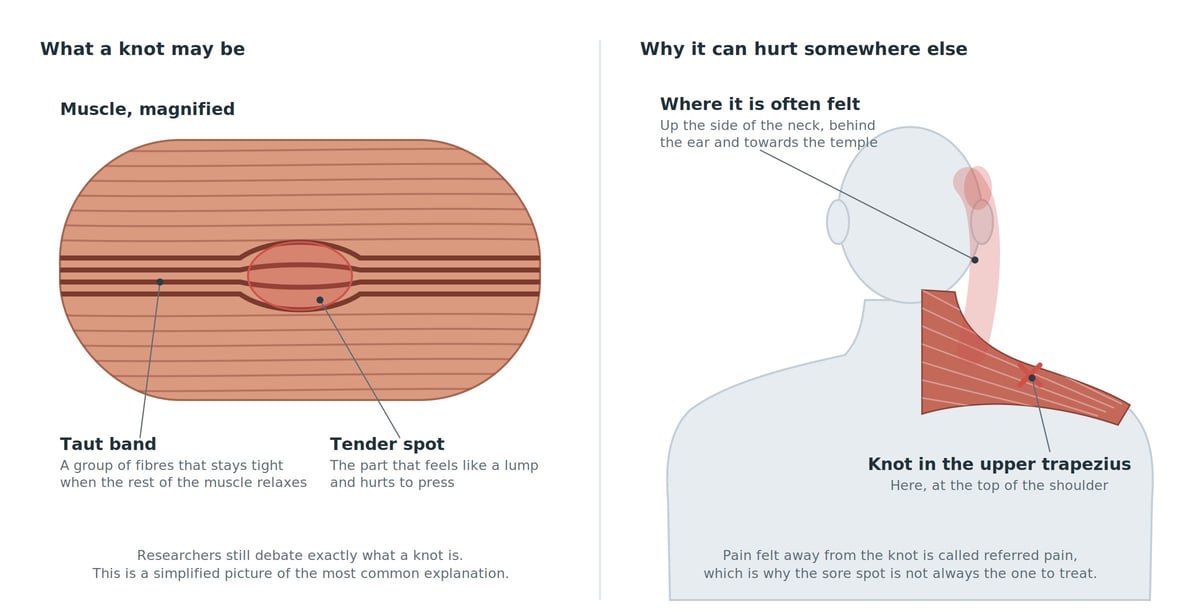
A knot is not a knot in the way a knot in a rope is. Nothing is tangled and nothing is tied. What is actually happening is that a small bundle of muscle fibres has stayed contracted while the fibres around it have relaxed. In clinical writing this is called a trigger point, and it describes a spot within a band of muscle that is persistently tight and tender.
The band is the part people can feel. If you run your fingers across the muscle, you will find a ridge that feels firmer than the tissue either side, and somewhere along it there is a point that is distinctly sorer than the rest. That point is the tender spot shown on the left of the diagram, and pressing it produces a familiar, recognisable ache rather than a vague discomfort, which is how you know you have found the right place.
The pain being felt away from the knot is called referred pain, and it happens because the nerve supply to those areas overlaps. The upper trapezius is the clearest example, because a knot at the top of the shoulder is commonly felt up the side of the neck rather than in the shoulder itself. The pattern differs by muscle, and it is why people so often arrive convinced the problem is in one place when the cause is somewhere else entirely.
There is a reason a knot persists rather than relaxing on its own. When muscle fibres stay contracted, the small blood vessels running through that area are squeezed, so the tissue gets less circulation than it should. The chemical by products of muscle work are cleared more slowly, and the local environment keeps the fibres irritated. That is the loop that keeps a knot in place for weeks or months, and it is why they so rarely resolve simply by waiting.
It is worth being honest about one thing. The research on trigger points is not settled, and there is disagreement about how best to describe what is happening at tissue level. What is not in dispute is that people have these tender bands, that pressing them produces predictable referred pain, and that they respond well to treatment. That is what matters practically.
How people describe it
What it feels like
People describe knots in a handful of consistent ways, and the descriptions usually tell us where they are before we have looked.
The first is a band or a ridge. People say they can feel a cord under the skin, and that running a hand across it finds a line that is firmer than everything around it. This is most obvious in the shoulders and upper back, where the muscles are close to the surface, and in the calves, where people often describe a rope running down the back of the leg.
The second is the spot that makes you flinch. Pressing it produces a sharp, familiar ache, sometimes with a sensation that radiates away from the point being pressed. People often describe it as a good pain, because it feels like the right place rather than a random sore spot. That recognition is a useful signal, and it is one of the things that distinguishes a trigger point from general tenderness.
The third is the referred pattern. Someone will come in with a headache and find the cause in their upper back. Someone with pain down the arm will find it in the shoulder. Someone with aching in the thigh will find it in the buttock. The pain is genuinely felt where they say it is, which is what makes the referral so confusing and why people so often chase the wrong area for months.
Alongside the pain, people commonly describe stiffness that is worse in the morning or after sitting, a restricted feeling in the affected area, and a sense that the muscle never fully lets go. Some notice the knot is worse after a stressful period without any change in physical activity. Some notice the opposite and can tie it directly to a change in what they have been doing. Both patterns are common.
Causes
Why they form
A knot forms where a muscle has been asked to hold a position or carry a load for longer than it can comfortably manage. Below are the patterns we see most.
Holding one position for hours
This is the most common cause by a distance. Sitting at a screen with the head forward, holding a phone between ear and shoulder, driving with the shoulders raised, or standing at a bench leaning to one side. The muscle is not working hard, it is working continuously, and that is what produces the persistent contraction. The knots that form this way are usually in the neck, shoulders and upper back.
Repetitive movement at work or in sport
Any movement performed many times a day builds tightness in the muscles that perform it. Rowing, cycling, running, swimming, lifting, painting and decorating, hairdressing and working at a keyboard all produce characteristic patterns. The muscle groups involved are predictable for each activity, and the knots appear in the same places in the same people.
Stress and tension
Stress produces genuine muscle tension, not imagined tension. The shoulders rise, the jaw clenches, and the muscles of the upper back and neck stay switched on for hours at a time. People often find their knots are worst during a demanding period at work, and it is worth knowing that this is a physical response rather than something you are doing wrong. Treating the muscle helps, and noticing when it happens helps more.
A previous injury that never fully settled
After an injury, the muscles around the area often stay guarded long after the tissue has healed. The guarding is protective at first and unnecessary later, but it does not always switch off on its own. That is why people find knots sitting in and around an old injury years later, and why the surrounding muscles rather than the original site are often the ones that need treating.
Weakness somewhere nearby
This is the cause people least expect. Where a muscle is weak, others take over its work, and those others tighten under the extra load. Knots in the upper back often sit above weak shoulder blade muscles. Knots in the calf often sit above weak gluteals. Treating only the knot gives relief that does not last, which is why we look at what the muscle is compensating for.
The honest picture
How massage may help, and what it cannot do
What it cannot do
Massage cannot stop a knot coming back if the thing creating it has not changed. Where someone returns to eight hours of the same position and the same weak muscles, the same knot reappears, often within a few weeks. That is not a failure of the treatment. It is simply that treatment addresses the result rather than the cause.
It also cannot make a weak muscle strong, and it cannot replace the strength work that stops a muscle being overloaded in the first place. If a knot keeps returning in the same place, there is usually a reason, and the reason is more often a strength or position issue than anything the muscle itself is doing wrong.
What it may help with
This is one of the things massage does best. Working directly into a taut band, using sustained pressure on the trigger point and then working through the muscle as a whole, reliably releases the tightness. Many people feel the band soften during the session, and the referred pain often reduces along with it. Where a knot has been present for years, it may take more than one session, but the direction of travel is usually obvious quickly.
Treatment also addresses the muscles around the knot, which matters more than people expect. A trigger point rarely sits alone. The fibres either side of it are working harder to compensate, and the muscles further up and down the chain are usually tight as well. Treating only the tender spot gives shorter lived relief than treating the whole pattern.
The other thing treatment does is show you where the problem actually lives. When someone comes in with a headache and we spend most of the session on their upper back, that is useful information. It explains why the headache keeps returning and it points at what needs to change. People often say afterwards that knowing where it comes from is as valuable as the treatment itself.
Releasing the band
Direct work on the trigger point softens the taut band and eases the referred pain.
Treating the pattern
A knot rarely sits alone. The muscles feeding it need working too for lasting relief.
Showing you the cause
Finding where the pain actually comes from explains why it keeps returning.
What to expect here
What treatment looks like at the practice
The assessment starts with finding where the pain is coming from rather than where it is felt. We will ask where you notice it, what makes it worse and better, what you spend your day doing and how you train. Then we will feel for the taut bands and the tender points, and check whether pressing one reproduces the pain you came in with. When it does, that confirms the connection, and it is usually quite clear.
The treatment works in layers. The muscle as a whole is warmed and loosened first, then focused pressure is applied to the trigger point itself, held for long enough for the fibres to release rather than jabbed at. That sustained pressure is the part that matters. Once the knot has released, we work through the surrounding tissue and the muscles feeding into it, because leaving those tight tends to bring the knot straight back.
You should expect some discomfort during this, and we will tell you honestly when we have found the spot, because you will already know. The pressure is adjusted to what you can genuinely tolerate. Working so hard that you brace against it is counterproductive, because a muscle that is guarding cannot release. It is worth saying that the day after treatment, the area often feels bruised or tired for a day or two, which is normal and settles.
You will also get guidance on what to do between appointments, and where knots keep returning this is the part that makes the difference. That normally covers changing position more often through the day rather than sitting differently, a small number of strengthening exercises where weakness is part of the picture, and how much activity to keep up while it settles. We keep the list short, because a few things you actually do beat a long programme you abandon.
This page is reviewed by senior therapist Richard Clarke. The treatment used is deep tissue massage, which reaches the deeper layers where knots tend to sit. The sustained pressure used on a trigger point is sometimes described as trigger point release, and it is used alongside broader work on the muscle rather than on its own. If you have not been to the practice before, our page on your first visit explains what happens when you arrive.
Important
When it is not a knot, and you need medical help
The great majority of tender bands in muscle are exactly what they feel like. There are a small number of things that can feel similar and are not muscular at all, and those need checking rather than treating.
A lump that does not feel like muscle
A new lump that is hard rather than firm, that is fixed in place, that is growing, or that feels different from the muscle around it needs medical assessment rather than massage.
A lump that has changed size or shape
Any change in a lump you have had for a while, particularly if it is getting bigger, needs investigating.
Pain with numbness, tingling or weakness
Symptoms that travel with altered sensation or reduced strength suggest a nerve is involved. Some knots refer pain, but they do not cause numbness or weakness, and that difference matters.
A hot, red, swollen or warm area over the muscle
These are not features of a muscle knot and need prompt medical assessment. A hot swollen area in a limb can be a serious problem.
Pain that is severe at night and does not ease with rest
Muscular pain settles when you take the load off. Pain that behaves the opposite way, and particularly pain that wakes you, needs investigating.
Unexplained weight loss, fever or feeling generally unwell
Muscular aches alongside any of these need medical assessment rather than treatment.
A history of cancer
New pain, particularly in the back or thigh, in someone with a history of cancer needs medical assessment rather than soft tissue work.
What to do
- Call 999 or go to A&E if an area of muscle is hot, red and swollen and you feel unwell or have a fever.
- Call NHS 111 for urgent advice if you are unsure how serious something is, or if symptoms are worsening quickly.
- See your GP if you find a lump that does not feel like muscle, if there is numbness or weakness, or if the pain is not settling.
Where none of those apply, and what you have is a tender band in a muscle, massage is a reasonable thing to try and usually a very effective one. If we assess you and find something that does not feel like muscle, we will say so plainly and refer you on. That is a normal part of the job and not a disappointment.
Questions
Questions we get asked
Are muscle knots real, or are they something people imagine?
They are real, and they can be felt. What is out of date is the idea that a knot is a tangle of fibres. What is actually there is a band of muscle in which a small group of fibres has stayed contracted while the rest has relaxed. You can feel the taut band under the skin, it is tender to press, and pressing it produces a predictable ache. The debate in the research is about how best to describe it, not about whether it exists.
Why does pressing a knot hurt somewhere else?
This is referred pain, and it happens because the nerve supply to different areas overlaps. The nerves from a trigger point and the nerves from the area where you feel the pain meet in the same place in the spinal cord, and the brain cannot always tell which one is complaining. It is the same mechanism that makes a heart problem present as arm pain, and it is why so many people spend months treating the wrong area.
How long does it take to get rid of a knot?
A knot that has been there for a few weeks often releases within one or two sessions. One that has been present for years takes longer, and it may need several appointments before it stops coming back. The knot itself is usually the quicker part. What takes longer is addressing whatever keeps recreating it, which is normally a position, a load or a weakness.
Why do my knots keep coming back in the same place?
Because something is still producing them. A knot that returns in the same spot every few weeks is usually being recreated by a position you hold for hours, a movement you repeat all day, or a muscle nearby that is weak and passing its work on. Treating the knot is still worth doing, but if it keeps returning it is worth looking at the cause rather than only the symptom.
Should I press my own knots?
Gentle pressure with a hand, a ball against a wall or a foam roller can help, and it is a reasonable thing to do between appointments. What tends to be counterproductive is pressing hard into a knot repeatedly, because a muscle that is guarding against pressure cannot release. If you find yourself digging into the same spot every day without change, that is usually a sign that something else needs addressing instead.
Is it normal to feel sore after treatment?
Yes, and it is common. Working into a tight band releases the tissue, and the area often feels bruised or tired for a day or two afterwards, much like after hard exercise. It usually settles within forty eight hours. Drinking water and keeping gently active helps. If the soreness is severe, lasts longer than a few days, or is worse than the pain you came in with, tell us rather than waiting it out.
Can knots cause headaches or arm pain?
Yes, and it is one of the most common things we see. Trigger points in the upper back and shoulders refer pain into the head, down the arm and around the shoulder blade with considerable regularity. Where someone has been treating a headache or an arm problem for months without success, finding the source in the upper back often explains it. If there is numbness, tingling or weakness alongside the pain, that is different and needs assessing.
How often should I have treatment?
For an active knot, close together at first and then spaced out. Two or three sessions a couple of weeks apart often resolves an episode, after which many people come every four to eight weeks to keep on top of it, or stop altogether if the underlying cause has been addressed. We would rather see you less often and have you leave with something to work on than book you into a standing weekly appointment.
Where the tightness sits in the neck and shoulders and refers into the head, tension headaches covers that picture. Where it follows the working day, see desk and posture related pain. If the tightness sits in the upper back between the shoulder blades, upper back pain is worth reading. You can also see the full list of conditions we help with.
Areas we cover
Where we treat muscle knots
Tight, tender bands bring clients in from across the area, often after months of stretching without change. These are the areas we cover in detail.
Clients travel to us from all over the surrounding area, from the city and from the towns and villages around it. If you are not sure whether we cover where you are, ring us and ask.
Main areas we cover
Also covered
Skewen, Birchgrove, Clydach, Glais, Trebanos, Rhos, Neath Abbey, Cadoxton, Cimla, Briton Ferry, Gorseinon, Gowerton, Fforestfach, Loughor, Pontardawe, Pontarddulais, Killay, Ammanford, Burry Port.
Ready to book your session?
Choose a time that suits you, or call us and we will find one that works.