

Conditions we help with
Massage for frozen shoulder
Frozen shoulder is one of the most frustrating things that can happen to a shoulder, because it takes its own time and it cannot be hurried. Most people who develop it are women over 40, and many find that nobody has explained what is actually happening. This page does.
- Published in the British Journal of Sports Medicine
- Practising since 2007
- Level 4 SMA therapists
- Treated Olympic and Commonwealth athletes
The short answer
Can massage help a frozen shoulder?
Frozen shoulder is a condition where the capsule around the shoulder joint thickens and tightens, causing pain and a progressive loss of movement that can last for months or years. It moves through three stages and will usually resolve on its own in time. Massage does not cure it or shorten it, but it can ease the muscular tension around a shoulder that is not moving, help you keep what movement you have, and make the process considerably more comfortable while it runs its course.
Where it tends to help
Easing the muscular tension around a shoulder that cannot move freely, and helping you hold on to the range you still have.
When to see a GP first
Pain that came on suddenly and severely, pain after a fall, or pain with numbness, weakness or fever needs a medical opinion before a treatment table.
The anatomy, in plain English
What is actually happening in your shoulder
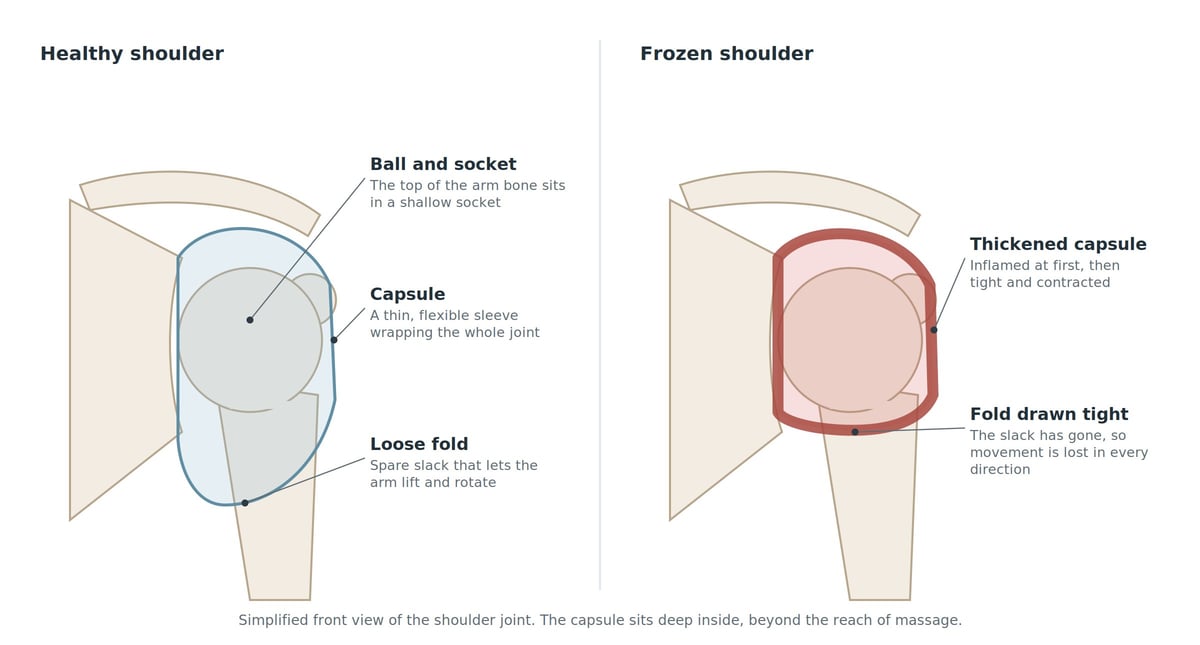
The shoulder is a ball and socket joint, and the socket is shallow. What holds the joint together and keeps it stable is a capsule, a sleeve of tissue that wraps around the whole joint. In a frozen shoulder that capsule becomes inflamed, then thickens and contracts. It loses its ability to stretch, and because it wraps the entire joint, it restricts movement in every direction rather than in one.
That last point is the one that most clearly separates a frozen shoulder from other shoulder problems. A rotator cuff problem usually hurts in a particular direction, often reaching overhead or reaching behind your back. A frozen shoulder restricts everything, including movements you would not expect to involve the shoulder at all. Fastening a bra behind your back, reaching for a seatbelt, putting on a coat, hanging up washing or reaching into a cupboard above your head all become difficult, and the movements that are lost first are usually the ones where the arm rotates.
It also behaves differently in another important way. In most shoulder conditions, pain limits the movement. In a frozen shoulder, the tissue itself has genuinely lost its range, and someone else moving your arm for you will meet a hard stop rather than the resistance of a muscle guarding. Clinicians describe this as a capsular pattern, and it is one of the things that helps distinguish it from other causes.
Why it happens is not fully understood, and it is worth being honest about that. What is known is that it is considerably more common in women than men, that it most often appears between the ages of 40 and 60, and that it is strongly associated with diabetes. It also occurs more often around the time of menopause, and it sometimes follows a period where the shoulder has been kept still after an injury or an operation. Where there is no clear trigger, it can feel as though it arrived for no reason at all, which is one of the things people find hardest about it.
How it progresses
The three stages, and what each one asks of you
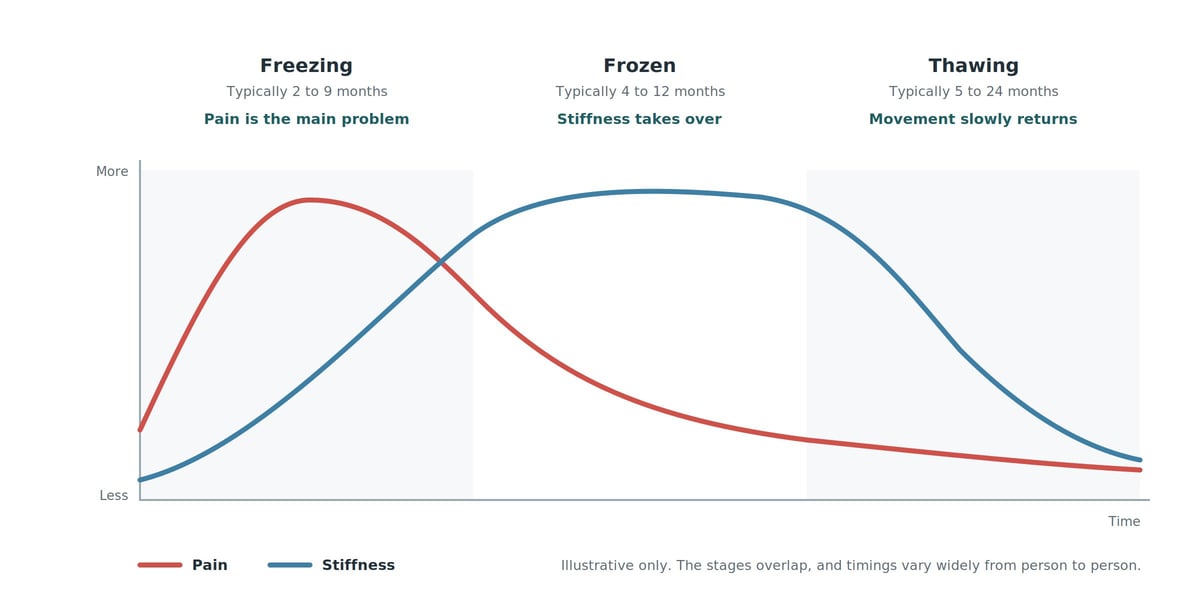
A frozen shoulder is not a single experience. It moves through three overlapping stages, and they feel completely different from each other. Knowing which stage you are in is genuinely useful, because it changes what helps and what does not.
The freezing stage
This is the painful stage, and for most people it is the worst of the three. The shoulder aches, often at rest and often at night, and the pain can be sharp enough to wake you. Movement starts to reduce, but slowly, and you may find it hard to say exactly which movements have gone. What makes this stage distinctive is that pain is the dominant problem rather than stiffness. People commonly describe being unable to lie on that side, and being woken by a sudden sharp pain when they roll over in their sleep. If you are in this stage, the priority is settling the pain and protecting your sleep, not pushing for range that is not available yet. This is the stage where people most often describe the shoulder as having a mind of its own.
The frozen stage
The pain usually eases noticeably in this stage, sometimes almost entirely, and that comes as a relief. What replaces it is stiffness. The shoulder becomes markedly restricted in every direction, and you will find a hard stop when you reach the limit rather than a stretch. Everyday tasks become a problem in a very practical way: dressing, reaching for a seatbelt, doing up a bra, reaching into a cupboard, and managing hair all take longer and need working around. This is the stage where the condition is most visible to other people, and where the frustration is often greatest, because the pain is better but you still cannot use your arm properly. It is also the stage where people are most likely to be told to push through it, which is worth being cautious about.
The thawing stage
The shoulder gradually loosens and movement returns, usually over many months rather than weeks. It does not happen at a steady rate. Progress is often slow enough to be invisible day to day, and the change is usually only obvious when you look back over a couple of months. Most people recover a good level of function, though a proportion find that some movement never fully returns. This is the stage where gentle, consistent movement work matters most, and where treatment tends to be most productive because the tissue is more willing to be worked with.
These timelines are wide for a reason
The ranges above are commonly quoted, but they vary enormously between people. Some shoulders move through all three stages in under a year, and some take several years. There is no reliable way to predict which yours will be, and anyone who tells you confidently how long yours will last is guessing. What we would say is that the process is usually self limiting, meaning it tends to resolve on its own in time, and that the aim of treatment is to get you through it in reasonable comfort rather than to force it to finish sooner.
How people describe it
What it feels like, day to day
The clinical description of a frozen shoulder is tidy and orderly. Living with one is not, and the practical experience matters more than the theory.
The first thing most people mention is sleep. Lying on the affected side becomes impossible, and rolling onto it during the night brings a sharp pain that wakes you. Many people end up sleeping propped up or on their back, which is uncomfortable in its own way, and the loss of unbroken sleep is often the hardest part of the early months. If you are in this stage, it is worth knowing that this is typical rather than a sign that something worse is happening.
The second is the surprising list of things you cannot do. It is rarely the movements you would expect. Reaching for a seatbelt, fastening a bra behind your back, doing up a zip, putting on a coat, hanging up washing, reaching into a low cupboard, reaching for the kettle on a high shelf, and even washing your hair become awkward or impossible. Many people describe developing workarounds without noticing, and only realising how many adaptations they have made when someone asks about it.
The third is the frustration of being told you should push through it. Because a frozen shoulder is not painful in the same way for the whole time, people are often encouraged to work harder at it, and in the wrong stage that makes things worse. If you are in the painful stage, pushing into a shoulder that is already inflamed tends to increase the pain and disturb your sleep further. If you have been told to push through and it is not working, that is not a failure on your part.
The fourth is how long it takes to be believed. Because the shoulder looks normal from the outside, and because the pain often eases while the stiffness remains, many women find that the condition is underestimated by the people around them. It is a genuinely limiting condition, and it is reasonable to take it seriously even after the pain has settled.
What is worth holding onto is that the arc of this condition is towards recovery. It is slow, and the middle stage is particularly tedious, but the shoulder does usually loosen again. Treatment while you wait is about making that time easier.
The honest picture
How massage may help, and what it cannot do
What it cannot do
Massage does not cure a frozen shoulder and it does not shorten it. The capsule that has tightened is deep inside the joint, and no amount of work on the muscles around the shoulder can change it. Anyone who tells you they can free a frozen shoulder with massage is overstating what is possible, and anyone who offers to force the shoulder through its range is doing something that is likely to make the pain worse. If you have been told that aggressive stretching will speed it up, it is worth being sceptical. In the painful stage, forcing the joint tends to increase inflammation and disturb sleep, which is the opposite of what you need.
What it may help with
What treatment can do is work on the muscular side of the problem. When a shoulder stops moving, the muscles around it, the upper back and the neck adapt to that. They become tight, they work in different patterns, and in many cases they develop their own pain. This is why people with a frozen shoulder very often have neck and upper back ache alongside it, and why working only on the shoulder misses a large part of what is troubling you.
Easing that muscular tension serves two purposes. It makes the shoulder more comfortable in the position it is currently stuck in, which matters a great deal when you cannot move it freely. And it helps preserve the movement you still have, because a shoulder surrounded by tight, guarded muscles loses range faster than one that is supported by tissue that is as relaxed as it can be.
Where treatment is most valuable is in the later stages. In the painful freezing stage, the honest role of a therapist is limited: gentle work to ease the surrounding muscles and protect your sleep, and no more than that. As the pain settles and stiffness takes over, treatment becomes more useful, and in the thawing stage it sits alongside consistent movement work as something that genuinely helps.
Easing the surrounding muscles
The shoulder, upper back and neck tighten when movement is lost, and this often causes pain of its own.
Protecting what moves
Keeping the muscles as free as possible helps you hold onto the range you still have.
Getting through the wait
The condition takes its own time. Treatment is about being more comfortable while it does.
What to expect here
What treatment looks like at the practice
The assessment begins with working out which stage you are in, because that determines everything that follows. We will ask how long it has been going on, whether the pain is still the main problem or whether stiffness has taken over, whether it wakes you at night, and which movements you have lost. We will also ask about your general health, because diabetes in particular is strongly associated with this condition and it is relevant to how quickly shoulders tend to settle.
If your shoulder has not been assessed by anyone yet, we would normally suggest seeing your GP as well as coming to us. A frozen shoulder has a recognisable pattern, but there are other shoulder conditions that present similarly and benefit from being properly identified. Where your GP wants to refer you to physiotherapy or to a specialist, that sits alongside what we do rather than competing with it.
The treatment itself works on the shoulder, the upper back, the neck and the chest. In the painful stage the work is gentle and focuses on the surrounding muscles rather than the joint. In the later stages, once the pain has settled, the work can be firmer and more directed at keeping the tissue as mobile as it can be. What we will not do at any stage is force the shoulder through a range it does not have, because that is not how a frozen shoulder recovers.
You will also get guidance on what to do between appointments. That normally covers keeping gently active within what is comfortable, sleep positions that take the pressure off the shoulder, practical ways to manage dressing and reaching, and the difference between a stretch that is useful and one that is provoking the shoulder. Where you are in the thawing stage, consistent movement matters more than anything done on the table.
This page is reviewed by senior therapist Richard Clarke. The treatment used is deep tissue massage, which works into the deeper layers of muscle and connective tissue around the shoulder, upper back and neck. Where the shoulder is in the painful stage and firm pressure is not appropriate, gentler work is used instead.
Important
When it is not massage, and you need medical help
A frozen shoulder is not an emergency, and it is not dangerous. The reason to see a GP is different here: not because something is urgent, but because several other shoulder conditions look similar and are treated differently. Getting the right diagnosis matters.
The shoulder followed a fall or an injury
A shoulder that became painful and stiff after an impact, a fall onto the arm or a sudden wrenching injury needs assessing before treatment, because the cause may be structural rather than a frozen capsule.
You cannot lift the arm at all, rather than it being stiff
A complete inability to lift the arm, particularly after an injury, is a different picture from the restricted movement of a frozen shoulder and needs medical assessment.
There is numbness, tingling or weakness in the arm or hand
Symptoms travelling down the arm suggest a nerve is involved. This needs assessing rather than treating.
The shoulder is hot, red, swollen or you feel unwell
A hot, swollen shoulder together with fever or feeling generally unwell needs urgent medical attention the same day. Infection in a joint is a medical emergency.
The pain is severe and came on suddenly
A sudden onset of severe shoulder pain, particularly with no obvious cause, needs prompt assessment rather than a massage appointment.
You have a history of cancer or unexplained weight loss
Shoulder pain in these circumstances needs investigation rather than treatment.
Your GP has not assessed it and you are unsure of the diagnosis
This is the most common reason to see your GP first, and the least alarming. Several conditions present like a frozen shoulder, including rotator cuff problems, and they need different management.
What to do
- Call 999 or go to A&E if your shoulder is hot, red and swollen and you feel unwell or have a fever, or if the pain came on suddenly and severely.
- Call NHS 111 for urgent advice if you are unsure how serious something is, or if symptoms are worsening quickly.
- See your GP if the shoulder has not been properly assessed, if it followed an injury, or if there is numbness, tingling or weakness in the arm.
Where none of those apply, massage is a reasonable thing to try, and where your GP has confirmed a frozen shoulder it can be a useful part of managing it. If we assess you and conclude that your shoulder needs medical investigation or a different kind of help, we will say so plainly and refer you on. That is a normal part of the job and not a disappointment.
Questions
Questions we get asked
How do I know which stage I am in?
The clearest signal is the balance between pain and stiffness. If pain is the main problem, if it wakes you at night, and if movement has been reducing gradually, you are most likely in the freezing stage. If the pain has largely settled but the shoulder is markedly stiff in every direction, you are in the frozen stage. If movement is slowly returning over months, you are thawing. The stages overlap, and it is common to feel you are between two of them.
Can massage unfreeze my shoulder?
No, and we would not claim it can. The restriction comes from the capsule deep inside the joint, which massage cannot reach or change. What massage can do is ease the muscular tension around a shoulder that is not moving, which makes the shoulder more comfortable and helps preserve the range you still have. That is a genuinely useful thing, but it is support rather than a cure.
Should I push through the pain and stretch it?
In the painful freezing stage, no. Forcing a shoulder that is already inflamed tends to increase the pain and disturb your sleep further, and it does not speed the process up. In the later stages, once the pain has settled, gentle and consistent movement work is helpful. The distinction between a useful stretch and a provoking one is something we will go through with you, because it changes as you move through the stages.
How long will it last?
Commonly quoted ranges put the freezing stage at two to nine months, the frozen stage at four to twelve months, and thawing at five to twenty four months. In practice it varies enormously. Some shoulders move through all three stages in under a year and some take several years, and there is no reliable way to predict which yours will be. Anyone who tells you confidently how long yours will take is guessing.
Why did I get this?
It is not fully understood, and it is worth being honest about that. What is known is that it is considerably more common in women than men, that it most often appears between 40 and 60, and that it is strongly associated with diabetes. It also occurs more often around the time of menopause, and sometimes follows a period where the shoulder was kept still after an injury or an operation. Where there is no clear trigger, it can feel as though it came from nowhere, which is one of the things people find hardest about it.
Does having diabetes change anything?
Yes. Diabetes is strongly associated with frozen shoulder, and shoulders in people with diabetes tend to be more stubborn and to take longer to settle. It is one of the first things we will ask about, because it affects how we would set expectations with you. It is also a reason to make sure your GP is involved, since managing the diabetes well is part of the picture.
Will my movement come back completely?
Most people recover a good level of function, and many recover fully. A proportion of people find that some movement never entirely returns, particularly into rotation behind the back. That is worth knowing rather than being surprised by later. Where the shoulder is treated well and kept moving gently through the process, the outcome tends to be better than where it is left completely still.
Are there other treatments I should ask my GP about?
Possibly. Depending on the stage and how much it is affecting you, your GP may discuss options including pain relief, a steroid injection, or referral to physiotherapy or a specialist. We are not able to advise on those, and they are not alternatives to what we do rather than something that sits alongside it. If your shoulder is severely affecting your sleep or your daily life, it is worth raising with your GP rather than only managing it with massage.
The muscles around the shoulder behave in much the same way as in neck and shoulder pain, so that page covers the related ground. Where the shoulder is associated with the changes that come with menopause joint pain, that is worth reading too. If your shoulder hurts in specific directions but you can still move it in most of them, that is a different problem and rotator cuff pain is the page to read. You can also see the full list of conditions we help with.
Areas we cover
Where we treat frozen shoulder
Frozen shoulder is stubborn and slow, and clients travel in from across South Wales because they want it assessed properly. These are the areas we cover in detail.
Clients travel to us from all over the surrounding area, from the city and from the towns and villages around it. If you are not sure whether we cover where you are, ring us and ask.
Main areas we cover
Also covered
Skewen, Birchgrove, Clydach, Glais, Trebanos, Rhos, Neath Abbey, Cadoxton, Cimla, Briton Ferry, Gorseinon, Gowerton, Fforestfach, Loughor, Pontardawe, Pontarddulais, Killay, Ammanford, Burry Port.
Ready to book your session?
Choose a time that suits you, or call us and we will find one that works.