
Conditions we help with
Massage for plantar fasciitis
Plantar fasciitis is the most common cause of heel pain, and it has a signature that most people recognise immediately. If the first few steps out of bed in the morning are the worst part of your day, that is usually it.
- Published in the British Journal of Sports Medicine
- Practising since 2007
- Level 4 SMA therapists
- Treated Olympic and Commonwealth athletes
The short answer
Can massage help plantar fasciitis?
Plantar fasciitis is irritation of the thick band of tissue that runs along the sole of the foot from the heel to the toes, usually where it attaches to the heel bone. It is the most common cause of heel pain in adults. Massage can ease the tightness in the calf, the foot and the plantar tissue itself, which often makes walking and standing more comfortable. It is not a cure on its own, and the loading work you do between appointments is what changes the condition. If the pain is following an injury, or if there is numbness, tingling or loss of feeling in the foot, that needs medical assessment rather than a massage appointment.
Where it tends to help
Calves and foot muscles that have tightened up around a painful heel, and the plantar tissue itself where it has become short and sensitive.
When to see a GP first
Pain following a fall or an injury, or pain with numbness, tingling or loss of feeling in the foot, needs a medical opinion before a treatment table.
The anatomy, in plain English
What is actually happening in your heel
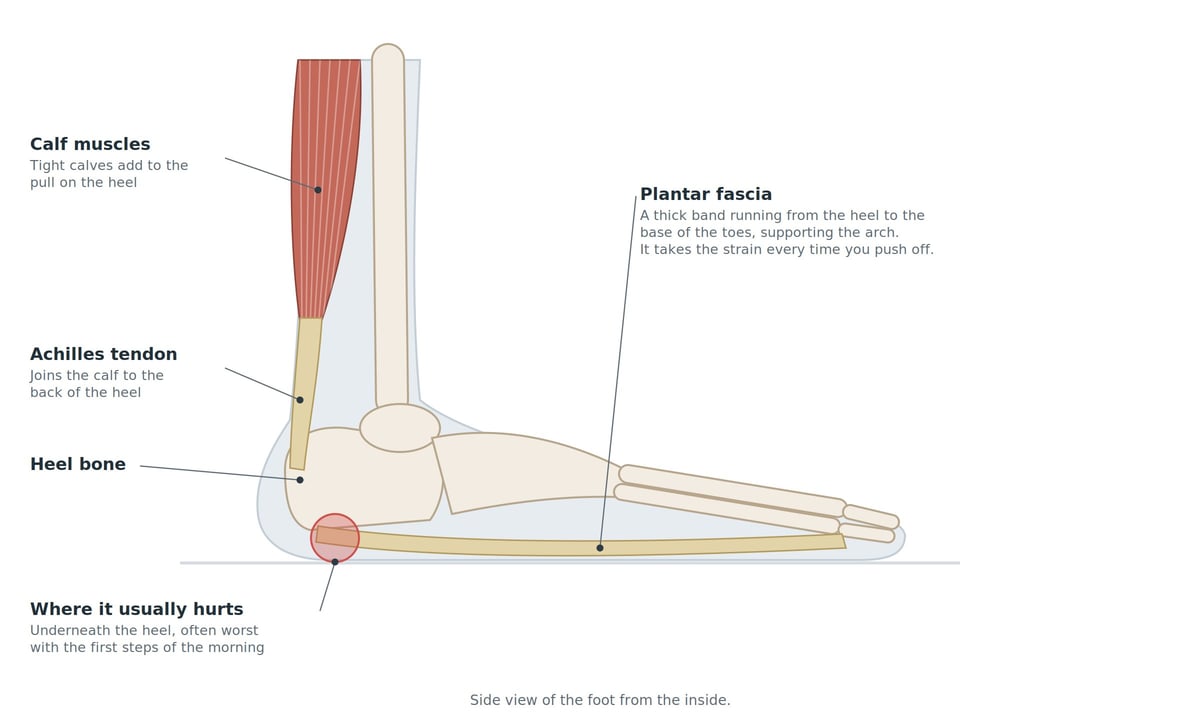
The plantar fascia is a thick band of connective tissue that runs from the heel bone along the sole of the foot to the base of the toes. It works like a bowstring. Every time you put weight through the foot it tightens, lifts the arch and gives the foot the spring it needs to push off. It is one of the reasons walking is efficient rather than exhausting.
The problem usually starts where the band attaches to the heel bone, which is the point of highest tension. Repeated strain there causes a small amount of ongoing irritation. What makes this condition behave differently from a pulled muscle is that the tissue does not repair itself overnight. The irritation is low grade and continuous, partly because the tissue has a poor blood supply right where it attaches, and partly because you cannot rest it. Every step you take loads it again.
The characteristic morning pain comes from the tissue healing into a shortened position overnight. While you are off your feet, the band and the calf tighten. The first steps of the day force it to stretch suddenly, which is why the pain is sharpest then and eases as you keep moving. The same thing happens after any period of sitting, which is why people notice it after a long drive or after an hour at a desk.
It is not only runners. The people we see with it are often on their feet all day for work, have recently increased how much they walk, have put on weight, or have changed their footwear. Age is a factor too. It is considerably more common between the ages of 40 and 60, and it becomes more common again later in life. Flat feet and high arches both increase the load through the band, though people with entirely typical arches get it as well.
The name is worth a word, because it is misleading. The condition ends in itis, which usually signals inflammation, and it was originally understood as an inflammatory problem. More recent work suggests the picture is closer to a degenerative strain response in the tissue than to classic inflammation. The name has stuck, and you will see it everywhere, including on this page, but it is worth knowing that the tissue is more overloaded than inflamed.
How people describe it
What it feels like
The descriptions people give of this are consistent to the point that it is one of the easier things to recognise.
The first is the morning. People describe a sharp, stabbing pain under the heel as they put their foot down for the first time, often severe enough that they limp to the bathroom. Within a few minutes of walking it eases noticeably, and by the time they have been up for twenty minutes it may be barely there. Then it comes back. Anyone who has had it can describe this pattern without being prompted, and it is the single most useful thing to mention when you ring us.
The second is the same pattern after rest. An hour in the car, a meeting, a long film, and the first few steps afterwards bring it straight back. This is why people often say it is worse in the evening than the morning on days when they have been sitting, and why it can be hard to explain to anyone who has not had it.
The third is where it hurts. The pain is usually under the heel, often slightly towards the inside of the foot, and people will point to one specific spot with a fingertip rather than waving at the general area. Pressing that spot is tender. Some people get it in the arch instead of the heel, which is the same condition in a slightly different part of the band.
Alongside the pain, people commonly describe the calf feeling tight, difficulty standing on tiptoe on that side, and a sense that the foot is stiff first thing. Some notice the foot rolling in more than it used to. Many have already tried heel cups or insoles, some of which helped and some of which did not, and that is worth mentioning because it tells us something useful.
What people usually do not describe is numbness or a burning sensation, and if either of those is present this is likely to be something else. That distinction matters, and it is covered below.
Causes
Why it happens
Almost always it is about load rather than about one specific moment. The tissue has been asked to cope with more than it can recover from, and the reasons are usually a combination rather than a single cause. Below are the patterns we see most.
A sudden increase in walking or running
This is the most common trigger by a distance. A training plan that ramps up too quickly, a first half marathon, a new job that involves being on your feet, or a holiday spent walking far more than usual. The tissue tolerates a gradual increase well and a sudden one poorly. When people look back at when it started, there is usually a change in volume in the weeks before it.
Being on your feet for work
Teaching, nursing, hospitality, retail, security and trades all involve many hours of standing and walking on hard floors. It is the cumulative daily load rather than any single day that causes the problem, and it is why this condition is so common in people who do not run at all. Where the job cannot be changed, how the load is managed across the week matters more.
Changes in footwear
Moving from supportive shoes to flat ones, wearing worn out shoes well past their useful life, or spending a summer in sandals after a winter in trainers all change the load through the band. Shoes with no support and no cushioning ask more of the tissue, particularly on hard surfaces. So does walking barefoot on hard floors at home, which many people do far more than they realise.
Tight calves
A tight calf limits how far the ankle can bend, which changes how you walk and puts more demand through the plantar fascia with every step. This is why calf work is part of nearly every treatment plan for heel pain, and why stretching the calf is one of the few things that reliably helps. If your calf has always been tight, or has become tighter since the pain started, that is worth addressing directly.
Weight and age
Carrying more weight increases the load through the foot with every step, and it is a recognised factor. Age matters as well. The condition is considerably more common between 40 and 60, and the tissue loses some of its elasticity over time. Neither of these is a criticism. They are simply part of the load picture, and they are things that can be worked with rather than barriers.
Foot shape
Flat feet and high arches both change how the load travels through the sole. With a flat foot the arch drops and the band is stretched with each step. With a high arch the foot absorbs less shock, so more of the impact goes through the heel. Neither foot shape means you are destined to get this, and plenty of people with typical arches get it too. It does mean that support in the right place can make a real difference for some people.
The honest picture
How massage may help, and what it cannot do
What it cannot do
Massage will not repair the plantar fascia on its own, and anyone who tells you a few sessions will cure it is overstating what soft tissue work can do. This is a condition driven by load, and the thing that changes it is how that load is managed over weeks and months. A treatment that eased the pain but left you walking the same distances in the same shoes would give you a good afternoon and nothing more.
It is also worth being honest about what treatment feels like. Working directly into the sole of a foot that is already sore is uncomfortable, and some people find it more than they want. The plantar tissue is thin and sits right against bone, so there is no cushioning to work through. We adjust to what you can tolerate on the day, and there is no benefit in gritting your teeth through something that leaves you limping afterwards.
What it may help with
What treatment can do is address the muscular side of the problem, and there is more of it than people expect. A tight calf limits how the ankle moves, which changes how you walk and increases the demand on the plantar fascia. The muscles along the sole of the foot tighten in response to pain, which adds its own discomfort. The muscles at the front of the shin often join in as you change how you walk to avoid the sore spot. Working on all of that can make a genuine difference to how the foot feels day to day.
The clearest benefit most people notice is the morning. Where the first steps of the day are the worst of it, loosening the calf and the foot before you get up can take the edge off that considerably. That is a practical improvement to the part of the day people dread most, and it is worth having even though it is not a cure.
Where treatment fits best is alongside a loading plan rather than instead of one. The evidence for progressive loading of the plantar tissue and the calf is stronger than for anything done on a treatment table, and we will say so plainly. Our job is to make the tissue comfortable enough for you to do that work, and to help you stay consistent with it. Where massage is presented as the whole answer, it sets you up to be disappointed.
Loosening the calf
A tight calf changes how you walk and increases the load through the sole with every step.
Easing the foot
The muscles along the sole tighten around a painful heel and become sore in their own right.
Taking the edge off mornings
Loosening the tissue before you get up makes the first steps of the day easier to face.
What to expect here
What treatment looks like at the practice
The assessment starts with the history, because the trigger is usually in there. We will ask when it started and what changed around that time, whether the morning pattern fits, whether you have increased your walking or running, what you spend the day doing, and what you wear on your feet. We will also ask how the ankle and the calf move, because restricted ankle movement is one of the most common things we find alongside heel pain.
If the picture fits, we will treat it. If it does not, we will tell you that instead. Heel pain has several possible causes, and some of them need a different approach entirely.
The treatment covers the calf, the muscles along the shin, the sole of the foot and the plantar tissue itself. Much of the actual benefit comes from the calf work rather than from the foot work, which surprises people, though we will work the plantar tissue as well. The pressure is adjusted to what you can genuinely tolerate. We will also look at how you walk, because the pattern you have adopted to avoid the sore spot is often itself part of the problem.
You will get a small number of things to do between appointments, and we keep the list short deliberately. What we suggest normally covers calf and plantar stretching done at the right time of day, a sensible way to build walking or running back up rather than stopping and starting, and footwear that supports the foot without changing how you walk. Where the condition has been going on for months, we will set expectations honestly rather than suggesting it will settle in a fortnight.
This page is reviewed by senior therapist Richard Clarke. The treatment used is deep tissue massage, which works into the deeper layers of the calf and the foot. Where the foot is too sore for firm pressure, gentler work is used and the calf is treated more thoroughly instead. If you have not been to the practice before, our page on your first visit explains what happens when you arrive.
Important
When it is not massage, and you need medical help
Heel pain is usually not serious, and the great majority of it is this condition. There are other causes that look similar and are managed differently, and a few that need prompt attention. If any of the following apply, see your GP rather than booking with us.
Numbness, tingling or loss of feeling in the foot
Symptoms that travel into the foot or the toes suggest a nerve is involved rather than the plantar fascia. This is a different problem with a different management and it needs assessing rather than treating.
The pain came on after a fall or a sudden injury
A heel that became painful after an impact, a fall from height or a heavy landing needs imaging. A fracture of the heel bone and this condition feel quite different, and landing on it is the wrong decision.
You cannot put weight on the foot at all
Being unable to bear weight, particularly after an injury, is not the picture this page describes and needs urgent assessment. A structural injury is a possibility.
The heel is swollen, red, hot or you feel unwell
A hot, swollen and red foot together with fever or feeling generally unwell needs urgent medical attention the same day.
Pain that is worse at night and does not ease with rest
This condition improves when you take the weight off. Pain that does the opposite, and particularly pain that wakes you, needs investigating rather than treating.
You have diabetes or poor circulation in the feet
Foot problems in these circumstances need proper assessment. Reduced sensation can mean a problem is more advanced than it feels, and the management is different.
You have had it for months and nothing has changed it
This is the most common reason and the least alarming. Where the standard approaches have not helped, it is worth having the diagnosis confirmed rather than assuming, because several other conditions present in a similar place.
What to do
- Call 999 or go to A&E if the foot is hot, red and swollen and you feel unwell or have a fever, or if you cannot bear weight after an injury.
- Call NHS 111 for urgent advice if you are unsure how serious something is, or if symptoms are worsening quickly.
- See your GP if there is numbness or tingling, if the pain followed an injury, if you have diabetes or circulation problems, or if the standard approaches have not helped.
Where none of those apply, and your heel pain fits the pattern described on this page, massage is a reasonable thing to try alongside the loading work. If we assess you and conclude that your foot needs medical investigation or a different kind of help, we will say so plainly and refer you on. That is a normal part of the job and not a disappointment.
Questions
Questions we get asked
How do I know if it is plantar fasciitis?
The usual sign is pain under the heel that is sharpest on the first steps out of bed in the morning and eases after a few minutes of walking. The same thing happens after any period of sitting, and the pain is usually worst when you start moving and better once you are going. People can often point to one tender spot under the heel with a fingertip. If you have numbness, tingling or burning rather than this pattern, it is likely to be something else and worth having assessed.
How long does it take to settle?
It is usually measured in months rather than weeks, and it is worth setting that expectation early. Many people notice a clear improvement within six to twelve weeks of managing the load properly, and some take considerably longer. The pattern that drags on is usually the one where the load never really changes, or where it is reduced dramatically and then built back up too quickly. Being consistent matters more than being aggressive.
Can massage cure it on its own?
No, and we would not claim it can. This is a condition driven by load, and the work that changes it over time is progressive loading of the tissue along with sensible management of how much you are doing. Massage addresses the muscle tightness around the problem and makes the foot more comfortable, which helps you stay consistent with the loading. That is a useful supporting role rather than a cure.
Will I have to stop running?
Usually not entirely, unless the pain is severe or your walking is affected. Complete rest tends to make things worse over time, because the tissue loses tolerance for load and the calf tightens further. What normally works better is reducing volume and intensity to a level the foot can cope with, then building back gradually. We will talk through what that looks like for you specifically rather than handing you a general rule.
Should I stretch it, or does that make it worse?
Both answers exist, which is why the timing matters. Stretching the calf and the plantar tissue generally helps, but doing it first thing in the morning while the tissue is cold and shortened can be uncomfortable. Many people do better stretching after they have been moving for a while, or after a warm shower. Aggressive stretching into sharp pain tends to aggravate it rather than help.
Do I need insoles or heel cups?
Some people find them helpful and some find they make no difference at all. Support in the right place can reduce the load through the band for certain foot shapes, and a heel raise can take some tension off first thing in the morning. They are not a treatment in themselves, and they do not change the underlying tissue. If you have already tried them, bring them in and we will talk through what did and did not help, because that tells us something useful.
Will it come back?
It can, and the usual reason is that the load went back up more quickly than the tissue could handle. Once you have had it, it is worth keeping the calf reasonably mobile and building any increase in walking or running gradually rather than in jumps. That is not a reason to avoid activity. It is a reason to manage changes in volume sensibly.
How many sessions will I need?
It depends on how long it has been there and how your foot responds. Where it is recent, a small number of appointments alongside the loading work is often enough to get it moving in the right direction. Where it has been present for many months, treatment tends to be part of managing it over a longer period rather than a short course with a fixed end. We will give you an honest view at the assessment rather than a number now.
Where the pain sits further up the back of the leg rather than in the heel, Achilles pain covers that picture. If the pain is along the shin rather than the sole, that is shin splints, which we treat but have not written a page for yet. Where a calf strain is part of the history, the same applies. You can also see the full list of conditions we help with.
Areas we cover
Where we treat plantar fasciitis
Heel pain brings clients in from across the area, usually after months of working around it. These are the areas we cover in detail.
Clients travel to us from all over the surrounding area, from the city and from the towns and villages around it. If you are not sure whether we cover where you are, ring us and ask.
Main areas we cover
Also covered
Skewen, Birchgrove, Clydach, Glais, Trebanos, Rhos, Neath Abbey, Cadoxton, Cimla, Briton Ferry, Gorseinon, Gowerton, Fforestfach, Loughor, Pontardawe, Pontarddulais, Killay, Ammanford, Burry Port.
Ready to book your session?
Choose a time that suits you, or call us and we will find one that works.