Conditions we help with
Massage for lower back pain
Lower back pain is the most common thing we see. What matters is what caused it, because a back that went after lifting something needs different work from a back that has ached for years.
Written by Richard Clarke, Senior therapist Last reviewed: September 2026
- Published in the British Journal of Sports Medicine
- Practising since 2007
- Level 4 SMA therapists
- Treated Olympic and Commonwealth athletes
The short answer
Can massage help lower back pain?
Massage may help lower back pain by easing the tight, guarding muscle tissue around the spine, hips and glutes that so often comes with it. It is not a treatment for the structures of the spine itself, and some back pain needs a GP rather than a therapist. Many clients find that soft tissue work makes moving more comfortable and helps them get back to normal activity sooner.
Where it tends to help
A back that has tightened up gradually, or that guards after a strain, often eases once the muscle around it lets go.
When to see a GP first
Pain after a fall, numbness, weakness in a leg, or pain that wakes you at night needs a medical opinion before a treatment table.
The anatomy, in plain English
What is going on in your back
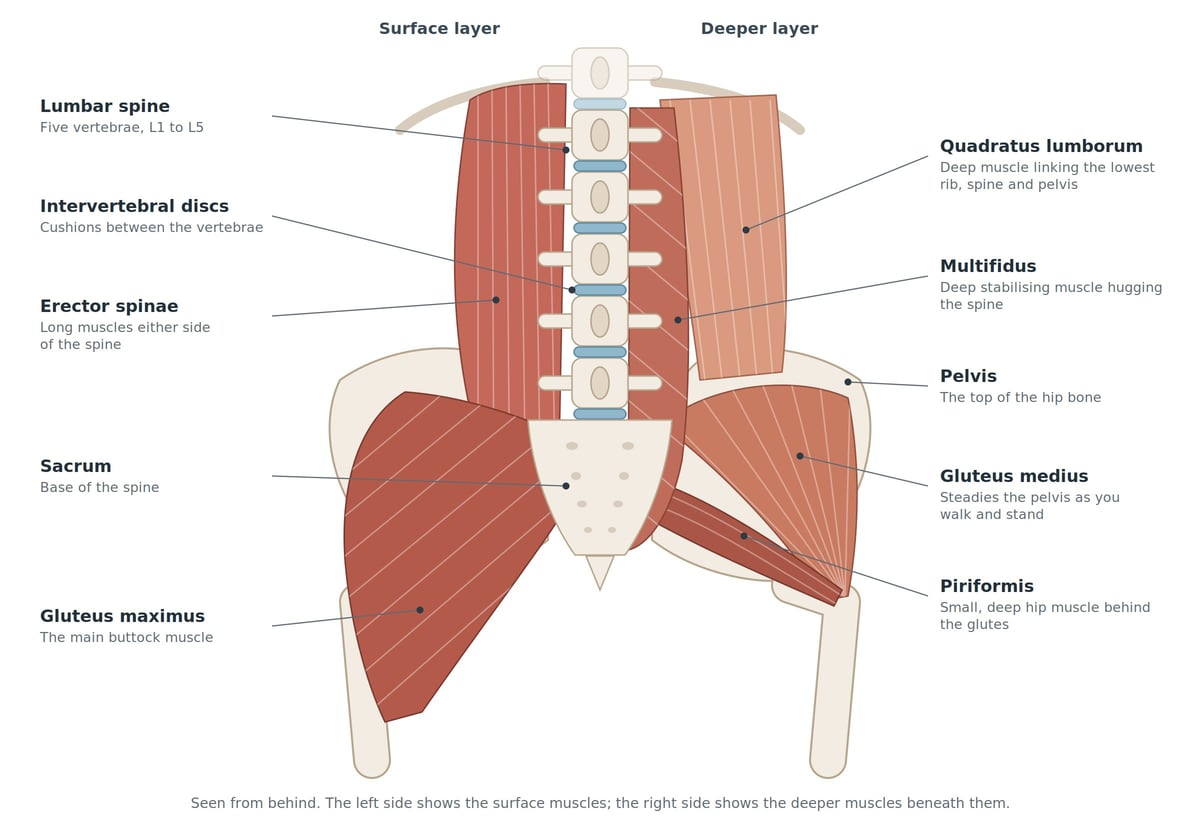
The lower back is built around the lumbar spine, a stack of bones with cushions between them. Around that sit the deep muscles that run along the spine itself, the larger muscles of the back, and the glutes and hip muscles below. These layers work together, and when one of them becomes tight or stops doing its share, the others are asked to do more.
That is why back pain is rarely just about the back. The deep muscles that stabilise the spine can become tight and guarded, and tightness in the hips and glutes changes how the whole lower half moves. When the hip cannot move freely, the lower back picks up the slack. A lot of what we treat is that relationship rather than the spine itself.
Most lower back pain does not have a single dramatic cause. It accumulates. That is also why it tends to come back, because the pattern that produced it in the first place has not changed.
How people describe it
What it feels like
Back pain is described in a handful of ways, and the words people choose usually tell you which kind they have.
The first is the one that catches. People say it went, or it gave way, or that they felt something shift. It usually happens during a specific movement, most often bending forward to pick something up, sometimes with a twist. In the hours afterwards the back stiffens and certain movements become impossible. Straightening up from a chair, getting out of a car or putting on socks are the ones people mention. Bending forward is usually the worst.
The second is the long, dull ache that has been there so long it has become background noise. People describe it as a band of tightness across the base of the back, worst at the end of the day, and often worse after sitting than after moving. Some find it is always there but only becomes a real problem when they try to do something physical. This is the pattern that tends to creep up gradually rather than announce itself.
The third is the one that does not stay put. The ache spreads into one buttock, sometimes into the hip, and occasionally down the thigh. Some clients describe it as everything seizing up together, so that they cannot tell where the back ends and the hip begins. When pain travels down the leg below the knee, that is a different picture and worth reading our page on sciatica.
Alongside the pain, people commonly mention stiffness first thing in the morning that takes a while to ease, a feeling that the back needs to be supported, difficulty standing upright for long periods, and a reluctance to bend at all because of what might happen. That reluctance is worth naming out loud, because moving less makes backs stiffer, and the stiffness is part of the problem.
Causes
Why it happens
There is no single cause, and the useful question is not what happened to your back but what your back has been asked to do. Below are the four patterns we see most.
From lifting and physical work
Lifting with a rounded back, twisting under load, or lifting something heavier than expected are all common triggers. It is not only heavy loads that cause trouble. Bending to pick up something light from an awkward position, repeatedly, for years, loads the same tissue far more than one heavy lift does. Trades that involve bending, kneeling or working in confined spaces sit squarely in this group.
From desk work
Sitting is not inherently bad for the back, but sitting in the same position for hours without moving is. Long periods in a chair keep the hip muscles shortened and the deep back muscles switched off, and the tissue adapts to whatever you ask of it most often. Home working has made this worse for many people, because improvised setups on sofas and kitchen tables rarely support the lower back at all.
From driving
Driving combines three problems at once. You sit for a long time, the seat vibrates, and the position is fixed. Add stop-start traffic and a clutch pedal, and you have hours of the same posture with one leg working and the other not. Drivers are one of the groups most likely to arrive with a lower back that is tight on one side and fine on the other.
From training
Sport and gym work load the lower back constantly, and the back usually copes. What it copes less well with is a sudden change. A jump in training volume, a new exercise, a return after a break or a change of surface are all common points where a back that was fine starts complaining. Running and cycling are both implicated, in different ways, as are deadlifts and squats performed with a form that has drifted.
An acute episode versus a long standing ache
The difference between these two matters more than almost anything else, because it changes both the treatment and the timescale.
An acute episode is the one that arrived suddenly, usually within the last few days or weeks, often after a specific movement. The tissue is irritated and the muscles around it are guarding hard. Acute backs are usually treated gently at first. Working deeply into an angry, freshly injured back tends to make it guard harder, which is the opposite of what you want. Early appointments focus on settling the guarding and getting you moving, with deeper work coming once things have calmed.
A long standing ache behaves completely differently. There is nothing acutely irritated, but the tissue has adapted to a pattern that has been in place for months or years. This is where deeper, more sustained work tends to be useful. The timescale is also different. An acute episode often settles relatively quickly with sensible management, while long standing patterns usually respond to a course of treatment and some changes to the things that caused them in the first place.
We will not promise you a number of weeks either way. How fast a back responds depends on what is causing it, how long it has been there and what you are able to change alongside treatment. We will give you an honest view after assessing you rather than before.
The honest picture
How massage may help, and what it cannot do
What it cannot do
Massage does not put a disc back, and it does not change the structure of your spine. If your pain is coming from a compressed nerve, or from something that needs medical investigation, soft tissue work will not fix that. It is also not a substitute for the things that actually change a back over time, which are staying active, building strength and changing the positions you spend your day in.
What it may help with
What it can do is work on the muscular layer. Backs that hurt guard themselves, and guarding is exhausting and self reinforcing. Tight, protective muscles limit how freely you move, which makes the back stiffer, which makes it guard harder still. Many clients find that easing that muscular tension interrupts the cycle and makes normal movement more comfortable again.
It also addresses the hip and glute tightness that so often sits alongside lower back pain. Because the hip and the lower back share the work of bending, twisting and lifting, a hip that cannot move freely puts more demand on the back. Working on both together tends to make more difference than working on the back alone.
Where a back has been sore for a long time, the honest value of treatment is often in combination with everything else. Many clients find it makes the exercise and activity they have been advised to do more manageable, which is where the real change happens.
Settling the guarding
The protective tension around a sore back is what soft tissue work addresses most directly.
Freeing the hips
Tight glutes and hip muscles change how the lower back moves, so they are part of the work.
Supporting activity
Moving is what helps a back most. Treatment can make that easier to do.
What to expect here
What treatment looks like at the practice
Every appointment starts with an assessment, and for back pain that assessment covers more ground than people expect. We will ask when it started and whether it came on suddenly or gradually, which movements make it worse, how far the pain travels, and whether there is any numbness or tingling. We will ask how much of your day is spent sitting, driving or lifting, and whether your training has changed recently. Those questions are usually what tells us which of the four patterns above you fall into.
The treatment works on the lower back, the glutes and the hips together. For an acute episode, the early work is usually gentler and focused on settling the guarding rather than pushing into tight tissue. Once things have calmed, or where the pattern is long standing, the work is slower and more sustained, because deep muscle layers need time to release rather than repeated pressure applied on top of them.
You will also get guidance on what to do between appointments. That normally covers staying gently active, which may feel counterintuitive when your back is sore, some specific stretches or positions to relieve pressure, and practical changes to how you sit, drive or lift. Where the cause is a working position, changing that matters more than anything we can do on the table.
This page is reviewed by senior therapist Richard Clarke, who usually handles clients presenting with lower back pain. The treatment used is deep tissue massage, a whole body treatment that works into the deeper layers of muscle and connective tissue.
Important
When it is not massage, and you need medical help
Most lower back pain is not an emergency. There are occasions when it is, and those occasions mean you should not be booking a massage. If any of the following apply, seek medical help rather than an appointment.
Numbness around the groin or saddle area
Loss of feeling or altered sensation between the legs or around the genitals, or in the area that would touch a saddle. This needs urgent medical assessment, the same day.
Changes to bladder or bowel control
Difficulty passing urine, not being able to tell when you need to go, or loss of bowel control. This also needs urgent assessment, the same day.
Numbness or weakness in both legs
Symptoms affecting both legs at once, particularly weakness or heaviness, rather than one side only.
A back that followed a fall or an accident
Significant trauma, or a fall from height, needs medical assessment before any soft tissue work.
Unexplained weight loss, fever or night pain
Back pain that wakes you at night, comes with a fever, or alongside unexplained weight loss needs investigation rather than treatment.
What to do
- Call 999 or go to A&E if you have lost control of your bladder or bowel, or have numbness around the groin and saddle area together with weakness in both legs.
- Call NHS 111 for urgent advice if you are unsure how serious something is, or if symptoms are worsening quickly.
- See your GP for persistent pain, for pain that is getting steadily worse, or if you have any of the symptoms in the list above that are not severe enough to need urgent care.
Where none of those apply, massage may still not be the right answer for you. If we assess you and conclude that your back needs medical investigation or a different kind of help, we will say so plainly and refer you on. That is a normal part of the job and not a disappointment.
Questions
Questions we get asked
Should I rest or keep moving?
Generally, keep moving gently. Long periods lying down or sitting still tend to make a back stiffer and slower to settle. Relaxing completely was standard advice decades ago and is not what is recommended now. Gentle movement, little and often, is usually better, while avoiding the specific things that provoked it.
Is it safe to have massage when my back has just gone?
Yes, with the right approach. A freshly irritated back is treated gently at first, because deep pressure on tissue that is already guarding tends to make it guard harder. Early sessions focus on settling things and keeping you moving, with deeper work once the acute stage has passed. It is not a case of no treatment, it is a case of the right treatment.
How soon can I get back to the gym?
It depends on what is causing the pain and how you respond. Most people can keep doing something fairly quickly, often at reduced load, rather than stopping entirely. Heavy lifting, particularly deadlifts and squats, usually waits until the acute stage has settled and you can move without guarding. We will give you a view based on your assessment rather than a blanket rule.
Can my posture be causing this?
Posture matters, but not in the way it is usually presented. There is no single correct sitting position, and holding any position for hours is what causes trouble. The useful advice is to change position regularly, move often, and set up your desk so the lower back has some support. Home working on a sofa or a kitchen table is where we see the biggest problems.
Will it come back?
Lower back pain does often recur, and that is worth knowing rather than being surprised by. The reason is usually that the pattern which caused it, whether that is a working position, a training habit or an area of tightness, has not changed. That is also the good news, because those are things you can influence, and treatment alongside those changes is where the lasting difference tends to be made.
Do I need a scan before having treatment?
Usually not. Most lower back pain does not need imaging, and scans often show changes that are not the cause of the pain at all. If your symptoms suggest something that does need investigating, we will refer you to your GP rather than treating you. That decision is part of the assessment.
If the pain travels down your leg, read our page on sciatica instead, as the picture and the treatment differ.
Where the cause is the working day rather than a single event, desk and posture related pain covers that in more detail. If the tightness sits higher up, between the shoulder blades, see upper back pain. And if your back is complaining because you have started training again, returning to exercise over 40 explains why that happens and what helps.
Areas we cover
Where we treat lower back pain
Lower back pain is the most common thing we see, from across Swansea, Neath, Llanelli and the towns between. These are the areas we cover in detail.
Clients travel to us from all over the surrounding area, from the city and from the towns and villages around it. If you are not sure whether we cover where you are, ring us and ask.
Main areas we cover
Also covered
Skewen, Birchgrove, Clydach, Glais, Trebanos, Rhos, Neath Abbey, Cadoxton, Cimla, Briton Ferry, Gorseinon, Gowerton, Fforestfach, Loughor, Pontardawe, Pontarddulais, Killay, Ammanford, Burry Port.
Ready to book your session?
Choose a time that suits you, or call us and we will find one that works.