
Conditions we help with
Massage for joint pain and stiffness during menopause
Aching joints and morning stiffness are among the most common symptoms of perimenopause and menopause, and among the least discussed. This page explains what may be happening, where soft tissue work fits, and why your GP is the right starting point.
- Published in the British Journal of Sports Medicine
- Practising since 2007
- Level 4 SMA therapists
- Treated Olympic and Commonwealth athletes
The short answer
Can massage help joint pain in menopause?
Joint aches and stiffness are a recognised symptom of perimenopause and menopause, and they are thought to be linked to changing hormone levels and the effect that has on joints, muscles and connective tissue. Massage may help by easing the muscular tightness that builds around joints that are sore and less active, and by supporting sleep and relaxation. It does not treat the underlying cause, and it is not a substitute for exercise or for medical care. If joint pain is new, severe, one sided, or comes with swelling, redness or heat, see your GP rather than booking with us.
Where it tends to help
Aching joints that have become less active, where the muscles around them have tightened and the pattern is feeding itself.
When to see a GP first
Pain that came on suddenly and severely, pain after a fall, or pain with numbness, weakness or fever needs a medical opinion before a treatment table.
What may be happening
Why your joints ache during menopause
Joint aches and stiffness are a recognised symptom of perimenopause and menopause. They are commonly reported, often described as a generalised aching or as stiffness that is worst on waking, and they can appear in joints that have never troubled you before. If you have found this happening and had nobody explain it, you are not alone in that, and it is not something you are imagining.
The explanation is not fully settled, and it is worth being honest about that rather than presenting a tidy answer. What is understood is that oestrogen has a role in joint and connective tissue health, and that levels of it change substantially through this transition. It is also understood that the supporting structures around joints, including the muscles and connective tissue, are affected by hormonal change. Beyond that, the picture is complicated, and researchers are still working on it.
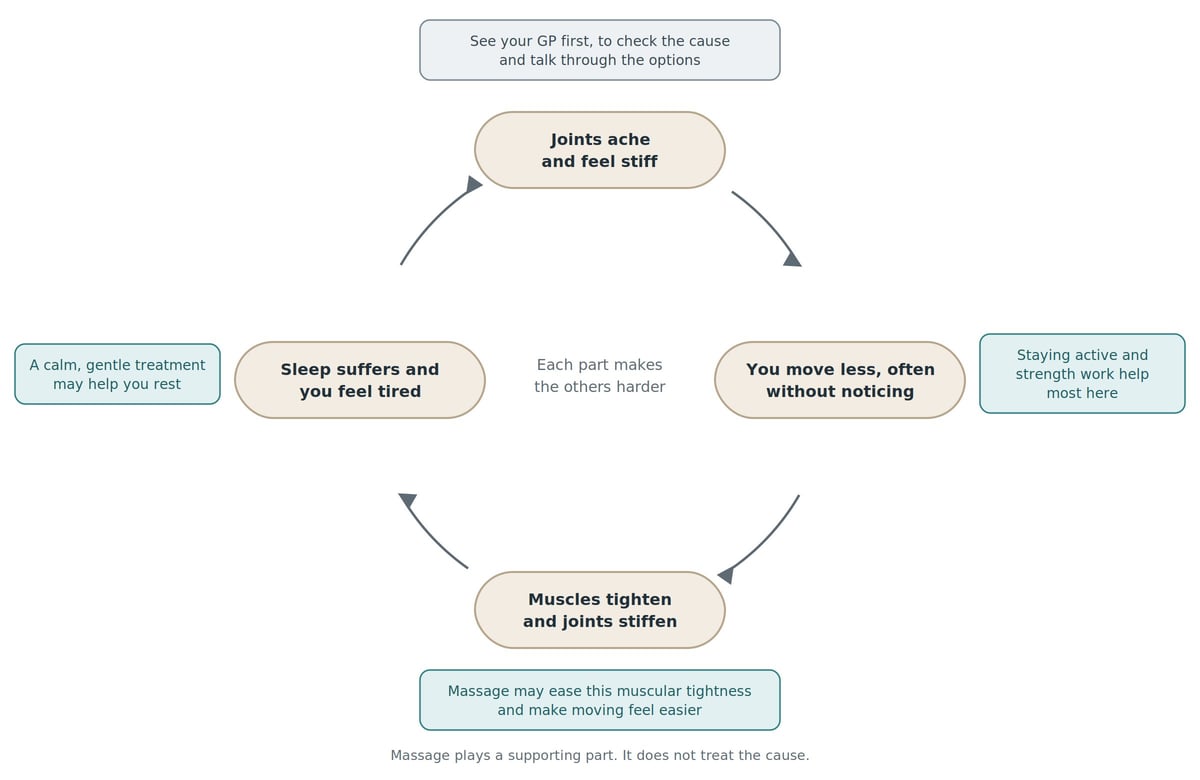
What is clearer is the practical consequence. Aching joints tend to make people move less, sometimes without realising it. You stop doing the movements that hurt, you sleep less well, and your activity reduces gradually. Muscles that are used less become tighter and less able to tolerate load, and joints that move less stiffen further. That cycle is the part soft tissue work can influence, because it sits in the muscles and the connective tissue rather than in the joints themselves.
It is also important to say what this is not. Menopausal joint pain is not the same thing as osteoarthritis, although the two can occur together and osteoarthritis also becomes more common around this age. It is not automatically a sign of inflammatory arthritis, and it is usually not a sign that your joints are being damaged. Distinguishing between these possibilities is exactly what your GP is for, and it is not something a massage therapist can determine.
How people describe it
What it feels like
The accounts people give of this are consistent, and they are usually quite different from the pain of a specific injury.
The most common description is a general aching rather than a sharp pain in one place. People say their joints feel stiff and sore, that several of them ache at once, and that it moves around in a way that makes it hard to describe to anyone. Knees, hands, shoulders and hips come up most often, and it is frequently both sides rather than one.
The second is the morning stiffness. People describe waking up stiff and needing time to get going, sometimes twenty minutes or more before they feel limber. This is often the thing that prompts concern, because it is a change from how the body used to behave, and it can feel like a sign of something serious rather than an ordinary part of the transition. It is worth knowing that this pattern is commonly reported at this stage, and also worth having it checked if it is new or worsening.
The third is the way it affects sleep, and this is often what makes everything else harder. Aching joints make it difficult to get comfortable, night sweats and disrupted sleep are common in their own right, and the combination leaves you tired. Being tired reduces how much you move the next day and lowers your tolerance for discomfort, which makes the aching feel worse. It is a loop, and each part of it reinforces the others.
The fourth is the effect on what you have stopped doing. Many people describe giving up particular activities gradually, without a decision being made about it. The long walks got shorter, the gardening stopped, the gym membership lapsed. Nobody chooses that, and nobody feels good about it, but it happens quietly. That reduction in activity is often a bigger contributor to how you feel than the joint pain itself, and it is the part that is most open to change.
Alongside the aching, people commonly mention muscles feeling tight and tense, difficulty staying active at the levels they used to manage, and a general sense of the body feeling less reliable than it did. If any of that sounds familiar, it is worth raising with your GP as well as with us.
The honest picture
How massage may help, and what it cannot do
What it cannot do
Massage does not treat the cause of menopausal joint pain, and it does not change your hormone levels or the joints themselves. It is not a treatment for osteoarthritis or for inflammatory arthritis, and it is not a substitute for exercise, for hormone replacement therapy or for any other treatment your GP may discuss with you. If someone tells you that massage can resolve menopausal joint pain, they are claiming more than the evidence supports, and we would rather be straight with you than sell you something.
What it may help with
What it can do is work on the muscular side of the problem. When joints ache, the muscles around them tighten and guard, and people move less. Muscles that are held tight and used less become a source of discomfort in their own right, quite separate from the joints. Easing that tightness can make movement feel easier and more comfortable, which matters more than it sounds, because movement is what helps joints most.
The other thing treatment can genuinely offer is support with sleep and relaxation. Relaxing massage is a calming treatment, and many people find it helps them settle. Where disrupted sleep is making everything else harder, having one part of the week that is restful is a real contribution, even though it is not a treatment for the joint pain itself.
The most useful thing we can do is often to help you keep moving. If a session leaves you feeling looser and more comfortable, and that makes it easier to carry on walking, swimming, gardening or whatever else you have been gradually giving up, then the treatment has done something that matters. The activity is what changes things over the long term. We are there to make it easier to keep doing.
Easing muscular tightness
Muscles that tighten around aching joints become uncomfortable in their own right.
Supporting rest
Where sleep is disrupted, a calm treatment can help you settle and recover.
Making movement easier
Feeling looser makes it easier to keep up the activity that helps most.
Where this fits
How soft tissue work fits alongside everything else
If you take one thing from this page, take this. Massage is the smallest part of the picture, and it is only useful alongside the other two.
Your GP, about symptoms and options
This is the starting point, and it is not a formality. Joint pain at this stage of life can have more than one explanation, and some of them need medical assessment rather than soft tissue work. Your GP can also talk you through the treatment options that exist for menopausal symptoms, which we cannot advise on at all. It is worth raising sleep and joint aches specifically, because they are sometimes overlooked when the conversation focuses on other symptoms. If you are offered a referral to physiotherapy or a specialist, that sits alongside what we do rather than competing with it.
Exercise, because it is what changes things
Staying active is the single most useful thing you can do for aching joints and for how you feel generally through this transition. This includes strength work, which matters more at this stage of life rather than less, because it supports the joints that are complaining and helps counter the loss of muscle that comes with age. It does not have to mean a gym. Walking, swimming, gardening and carrying shopping all count. The aim is consistency rather than intensity, and starting from where you actually are rather than where you used to be.
Soft tissue work, to help you keep going
This is where we come in, and it is a supporting role rather than a leading one. Easing tight muscles and helping you rest can make the first two easier to sustain. If treatment helps you stay active, it has done its job. If you expected it to resolve the joint pain on its own, you would be disappointed, and we would rather set that expectation now than at the end of a course of appointments.
What we would ask is that you do not treat this page as a substitute for that first step. If you have not spoken to your GP about what is happening, that is worth doing before or alongside booking with us, and it does not matter which comes first. We are happy to work with you either way.
What to expect here
What treatment looks like at the practice
The assessment here covers more ground about you than about the joints. We will ask which joints are troubling you and whether it is both sides, how long it has been going on, whether you have any swelling, redness or heat around a joint, and how your sleep has been. We will also ask about your activity, including what you have stopped doing, because that is usually the part that has changed most and nobody notices it happening. If anything you describe suggests this needs medical assessment rather than soft tissue work, we will say so.
The treatment itself is gentle. Where joints are sore, working firmly around them is not helpful, and the aim is to ease the muscular tension that has built up around them rather than to push into anything painful. Sessions often cover the shoulders, neck, back, hips and legs, following whatever has tightened as a result of moving less. If you find deep pressure uncomfortable on the day, tell us and it will be adjusted.
Because sleep matters so much here, we try to make treatment a genuinely restful experience rather than something you brace against. Many people tell us they sleep better the night after an appointment, and while that is not a cure for anything, it is a real benefit when you have been sleeping badly.
You will also get some practical suggestions for between appointments, usually about gentle ways to keep moving, how to manage stiffness in the mornings, and how to build activity back up without provoking anything. We keep this short deliberately, because adding a long list of exercises to someone who is already tired tends to achieve nothing.
This page is reviewed by senior therapist Richard Clarke. The treatment most often used is relaxing massage, which is gentler than deep tissue work and suits joints that are tender. It is available as a half body or full body treatment. If you have not been to the practice before, our page on your first visit explains what happens when you arrive.
Important
What should be checked by a GP first
Most joint aching at this stage of life is not serious. The reason to see your GP is that there are several possible explanations, and telling them apart is not something a therapist can do. If any of the following apply, see your GP before booking with us.
A joint that is swollen, red or hot to touch
Aches that come with visible swelling, redness or heat in a joint need medical assessment rather than soft tissue work. This is particularly true where it came on quickly.
Joint pain that came on suddenly, or is severe
Pain that appeared abruptly, or that is severe enough to stop you using the joint, needs assessing before treatment.
Pain in only one joint, particularly a single hot joint
The joint aching described on this page is usually generalised and often both sided. A single joint that is significantly worse than everything else is a different picture and needs checking.
Morning stiffness lasting more than an hour, most days
Stiffness that takes a long time to ease each morning, particularly alongside swelling, is something to raise with your GP.
Numbness, tingling or weakness in an arm or leg
Symptoms that travel away from a joint suggest a nerve is involved and need assessment rather than treatment.
Unexplained weight loss, fever or feeling generally unwell
Joint pain alongside these needs investigation rather than treatment.
You have not discussed your symptoms with your GP at all
This is the most common reason, and the least alarming. If joint aches and sleep disruption are new to you, it is worth having them looked at, and worth asking specifically about the treatment options that exist for menopausal symptoms.
What to do
- Call 999 or go to A&E if a joint is hot, swollen and red and you feel unwell or have a fever, as this needs urgent assessment.
- Call NHS 111 for urgent advice if you are unsure how serious something is, or if symptoms are worsening quickly.
- See your GP for joint pain that is new to you, that is not settling, or that comes with any of the symptoms in the list above. Ask about treatment options for menopausal symptoms as well as about the joint pain itself.
Where none of those apply, and your joint aching fits the general pattern described on this page, massage is a reasonable thing to try alongside whatever else you are doing. If we assess you and conclude that your symptoms need medical investigation or a different kind of help, we will say so plainly and refer you on. That is a normal part of the job and not a disappointment.
Questions
Questions we get asked
Is joint pain really a symptom of menopause?
Yes. Joint aches and stiffness are recognised symptoms of perimenopause and menopause, commonly reported and often described as a generalised aching or as morning stiffness. They are thought to be linked to changing hormone levels and the effect on joints, muscles and connective tissue, though the explanation is not fully settled. If you have found this happening without anyone explaining it, you are not alone in that.
Will my joints be damaged?
For most people, no. The joint aching described here is usually a symptom rather than a sign that joints are being destroyed. It is important to say that this is not the same as osteoarthritis, although the two can occur together and osteoarthritis also becomes more common around this age. If you are worried about damage, that is a question for your GP, and it is a reasonable one to ask.
Can massage cure it?
No, and we would not claim it can. Massage does not change your hormone levels or the joints themselves, and it is not a treatment for the underlying cause. What it can do is ease the muscular tightness that builds around joints that are sore and less active, and support rest. That is a supporting role rather than a cure, and it works best alongside exercise and whatever your GP recommends.
Should I see my GP first?
We would suggest yes, particularly if you have not discussed these symptoms with anyone yet. There are several possible explanations for joint pain at this stage of life, and your GP can also talk you through the treatment options that exist for menopausal symptoms, which we cannot advise on. It does not need to delay anything. If you would rather book with us at the same time, that is fine.
What about HRT?
That is a conversation for your GP and not one we can have with you. We are not able to advise on hormone replacement therapy or any other medication, and we would not try to. Plenty of our clients are on HRT and plenty are not, and it does not change what we do or whether treatment is appropriate. If it is something you want to explore, raise it with your doctor.
Will exercise make my joints worse?
The evidence points the other way for most people. Staying active is generally helpful for aching joints, and strength work in particular matters more at this stage of life rather than less, because it supports the joints that are complaining. The sensible approach is to start from where you actually are, build gradually, and expect some variation day to day. If a specific activity consistently makes things worse, that is worth mentioning to your GP or to us.
How many sessions will I need?
It varies, and it depends on what you are doing alongside treatment. Some people come periodically to keep on top of things, and some find a small number of appointments is enough to get moving again. What we would not do is suggest an open ended course with the implication that it is fixing the underlying cause.
I have stopped doing things I used to enjoy. Is that part of it?
Very often, yes, and it is one of the most common things we hear. Activities tend to drop away gradually rather than being given up deliberately. The long walks get shorter, the gardening stops, the gym membership lapses, and nobody makes a decision about it. That reduction in activity is often a bigger contributor to how you feel than the joint pain itself, and it is also the part that is most open to changing. It is worth talking about, and it is a reasonable thing to raise with your GP too.
Where the aching is concentrated in specific joints rather than generalised, massage for osteoarthritis covers that picture. If you are building activity back up, returning to exercise over 40 is worth reading. You can also see the full list of conditions we help with.
Areas we cover
Where we treat joint pain during menopause
Clients come to us from across the area for aching joints and disrupted sleep, often alongside their GP. These are the areas we cover in detail.
Clients travel to us from all over the surrounding area, from the city and from the towns and villages around it. If you are not sure whether we cover where you are, ring us and ask.
Main areas we cover
Also covered
Skewen, Birchgrove, Clydach, Glais, Trebanos, Rhos, Neath Abbey, Cadoxton, Cimla, Briton Ferry, Gorseinon, Gowerton, Fforestfach, Loughor, Pontardawe, Pontarddulais, Killay, Ammanford, Burry Port.
Ready to book your session?
Choose a time that suits you, or call us and we will find one that works.