
Conditions we help with
Massage for tension headaches
A lot of headaches that get called tension headaches really do start in the neck. If the ache sits at the back of the head, builds through the working day and comes with tight shoulders, the muscles are usually part of the picture.
- Published in the British Journal of Sports Medicine
- Practising since 2007
- Level 4 SMA therapists
- Treated Olympic and Commonwealth athletes
The short answer
Can massage help tension headaches?
Massage may help tension headaches by easing the tight muscles at the base of the skull, the back of the neck and across the shoulders, which are often where the ache begins. It is not a treatment for migraine, and it is not appropriate for a headache that is new, sudden, severe or different from your usual pattern. A headache that comes on suddenly and severely, or that comes with fever, a stiff neck, confusion, weakness or vision changes, needs urgent medical assessment rather than a massage appointment.
Where it tends to help
Headaches that begin in tight muscles at the base of the skull and across the shoulders, rather than in the head itself.
When to see a GP first
Pain that came on suddenly and severely, pain after a fall, or pain with numbness, weakness or fever needs a medical opinion before a treatment table.
The anatomy, in plain English
How a neck problem becomes a headache
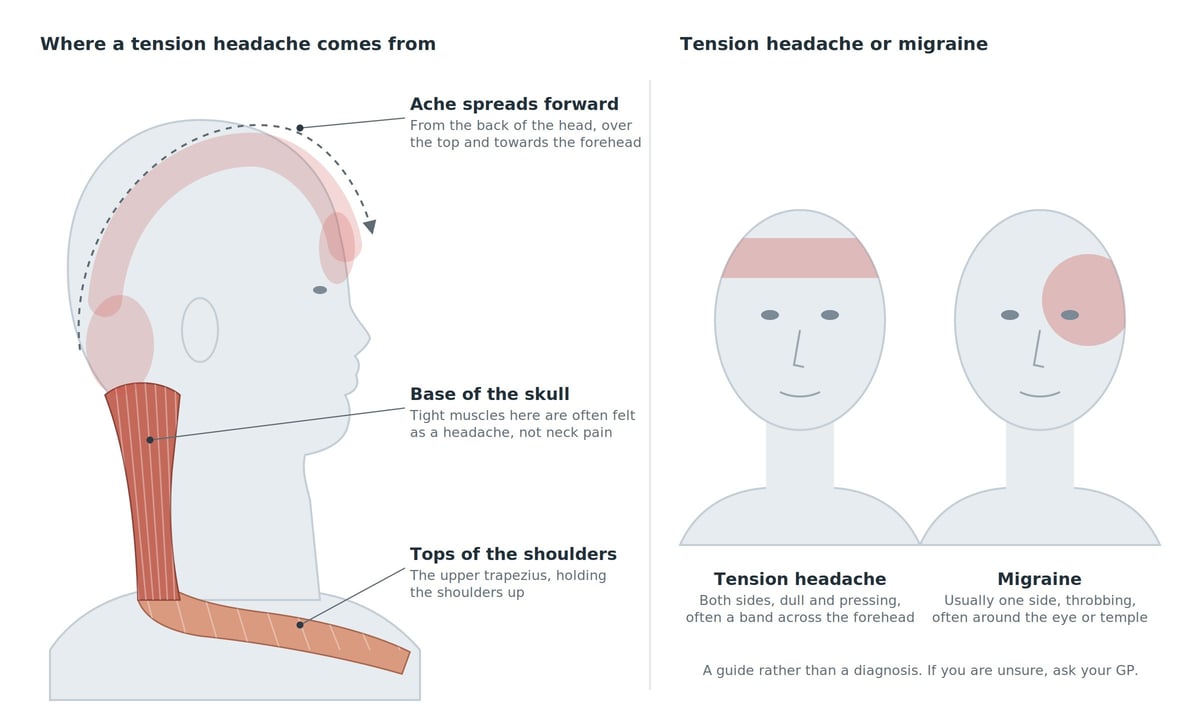
The muscles that run from the top of the neck into the base of the skull are the ones most often involved. When they tighten, they pull on the tissue at the back of the head, and the sensation is felt as a headache rather than as neck pain. This is why so many people describe the ache starting at the back of the head and spreading forward over the top.
There is a good reason you feel it in your head rather than your neck. The nerves that supply the upper part of the neck and the base of the skull also carry sensation from the back and sides of the head. They meet in the same place in the brain, and the brain cannot reliably tell which of the two is complaining. This shared pathway is why tight neck muscles can produce a headache you feel several centimetres away from the tissue that is actually causing it.
The upper trapezius, which runs from the neck out to the shoulder, and the levator scapulae, which runs from the neck to the shoulder blade, are usually both involved. These are the muscles that hold your shoulders up, and they work all day. When they are tight or fatigued, they pull the whole upper neck into a position that loads the small muscles at the base of the skull further, which is where the headache begins.
There is also a set of joints in the upper neck that refer pain into the head when they are stiff, and a headache that comes from these is a recognised clinical picture. It is usually one sided, often worse on the same side as the tightest part of the neck, and it is often brought on by sustained positions rather than by activity.
What all of this means is that a headache is sometimes a strain pattern rather than a problem in the head. That is not true of every headache, which is why the distinction below matters so much.
How people describe it
What it feels like
The descriptions people give are remarkably consistent, and they are quite different from the way migraine is described.
The most common is the band. People say it feels like a tight band or a vice across the forehead, or like a hat that is too small. It is usually on both sides rather than one, and it is a dull, pressing ache rather than a throbbing one. It tends to build through the day rather than being there when you wake, and it is often worst in the late afternoon.
The second is the one that starts at the back. People describe an ache at the base of the skull, sometimes spreading up over the top of the head and forward to behind the eyes. Alongside it they usually report that their neck feels stiff and that turning their head is tighter on one side than the other. This is the pattern where the muscular connection is most obvious, and it is usually the one where people say the headache and the neck are clearly linked.
The third is the one that follows a specific day. People notice the headache comes after a long drive, a day of back to back video calls, a night in an unfamiliar bed, or a stretch of intense work at a screen without moving. Because it is tied to what they were doing, it often disappears at the weekend and returns on Monday, and that pattern is itself a useful clue.
Alongside the head pain, people commonly mention a feeling of pressure behind the eyes, tenderness in the muscles at the back of the neck when pressed, difficulty finding a comfortable pillow, and a sense that their shoulders are permanently up around their ears. Some describe the scalp itself feeling tender, particularly when brushing or washing their hair.
What people do not usually describe is the visual disturbance, the nausea, the one sided throbbing or the aversion to light and sound that characterise migraine, and that difference is not a matter of degree. It points at a different condition with a different approach.
An important distinction
Tension headache or migraine
These are two different conditions, and treating them as though they were the same thing helps nobody. The table below sets out the differences as they are usually described, but it is a guide rather than a diagnosis. Plenty of people have both, and some headaches do not fit neatly into either column.
If your headaches are one sided, throbbing, made worse by movement and accompanied by nausea or by sensitivity to light and sound, that picture fits migraine rather than tension headache, and massage is not the treatment for it. Migraine is a neurological condition that needs proper medical management, usually starting with your GP. Working on the neck muscles may help with the tightness that often accompanies migraine, and plenty of clients find that, but it does not treat the migraine itself and we would never suggest it does.
If you are not sure which you have, that is a question for your GP rather than for us. Ringing us and describing your headaches is welcome, and we will tell you honestly whether we think we can help.
Causes
Why it happens
Where the headache is coming from muscular tension, the triggers are usually about sustained position rather than anything dramatic. Below are the four patterns we see most.
Sustained positions at a desk
Holding a position for hours is what creates the problem, not the position itself. A screen that sits too low pulls the head forward and loads the muscles at the back of the neck continuously. A single long stretch without standing up is worse than an imperfect posture you keep changing. People often report that their headaches are worst on the days with back to back meetings, because those are the days they move least.
Driving
Long drives combine several things at once. The head is held forward, the shoulders are raised slightly, the seat vibrates and the position is fixed. Add heavy traffic and a clutch pedal and it becomes hours of the same posture with one side working harder than the other. Clients who drive for a living are among the most consistent responders to treatment for this reason, and the headache is often worst on the drive home.
Stress and jaw clenching
Tension held in the jaw and shoulders during stressful periods produces exactly the muscle pattern that refers into the head. Clenching the teeth, particularly during sleep, works the jaw muscles that share a relationship with the upper neck, and many people with tension headaches wake with a sore jaw and a tight neck together. It is worth noticing whether you clench, because it is one cause that responds to addressing the clenching itself.
Sleep and pillow position
A pillow that is too high pushes the neck into a poor position for hours at a time, and a pillow that is too flat lets the head drop away from the spine. Both leave the muscles at the base of the skull strained, and many people report waking with a headache or developing one early in the morning. Sleeping on the front is the hardest position to support, because the neck stays rotated throughout.
The honest picture
How massage may help, and what it cannot do
What it cannot do
Massage does not treat migraine, and it is not a treatment for headaches with a medical cause. It will not help a headache that is new, that has changed character, or that is getting steadily worse. Above all, it is never the right response to a sudden severe headache, because that is a situation where the priority is assessment rather than treatment.
What it may help with
Where the headache is coming from tight muscles at the base of the skull and across the shoulders, working on those muscles is addressing the source rather than the symptom. The upper trapezius, the levator scapulae and the small muscles at the top of the neck are all reachable, and easing them often means the pulling on the back of the head reduces and the ache settles.
Treatment also loosens the upper neck as a whole, which is where the stiff joints that refer pain into the head tend to sit. Clients frequently describe the headache easing in the hours after a session and the neck feeling noticeably freer, which suggests the two were connected.
What treatment will not do is stop the headaches returning if the position, the pillow or the clenching has not changed. Where someone spends eight hours a day in the posture that creates the problem, a weekly appointment treats the result rather than the cause. The honest value of treatment is usually in combination with the changes you make between appointments.
Easing the base of the skull
The muscles that pull on the back of the head are the ones most often responsible for the ache.
Loosening the upper neck
Stiff joints in the upper neck refer pain into the head, and they respond to careful work.
Reducing what maintains it
Less tightness in the shoulders makes it easier to hold a better position through the day.
What to expect here
What treatment looks like at the practice
The assessment matters more than usual here, because the first question is whether your headaches are the kind we can help with. We will ask how long you have had them, how often they come, where they sit and what they feel like, whether anything makes them better or worse, and whether there is any nausea, visual change or sensitivity to light. We will also ask about your working day, how you sleep and whether you notice yourself clenching your jaw. If your answers point towards migraine or something that needs medical attention, we will tell you that rather than treating you.
Where the picture is muscular, the treatment covers the upper back, the shoulders, the neck and the base of the skull. The work around the top of the neck is slow and gentle rather than forceful, because these are small muscles in a sensitive area and they respond to patience rather than pressure. The shoulders and upper back often take firmer work, and treating them matters because they are part of what holds the neck in the pattern that produces the headache.
You will also get guidance on what to do between appointments. That normally covers the height of your screen, taking breaks before the headache starts rather than after, noticing and addressing jaw clenching, and looking at your pillow if you tend to wake with tightness. Where stress is a factor, that is worth naming too, because it is a real contributor and not something you can simply decide to stop.
This page is reviewed by senior therapist Richard Clarke, who usually handles clients presenting with tension headaches. The treatment most often used is relaxing massage, because the muscles involved respond better to slower, gentler work than to deep pressure. The neck and the base of the skull are not areas to force. Where the upper back and shoulders are holding a lot of tension, some deep tissue massage work is sometimes included alongside it.
Important
When it is not massage, and you need medical help
Headaches are common and most are not serious. Some are, and the distinction matters more here than on any other page we have written. If a headache is new, sudden, severe or different from your usual pattern, it needs medical assessment rather than a massage. Book an appointment with your GP rather than with us, and if any of the following apply, seek urgent help.
A sudden, severe headache that came on in seconds
Sometimes described as being hit on the back of the head or a thunderclap. This needs emergency assessment, immediately, and is not a headache to wait on.
Headache with fever, a stiff neck or a rash
Particularly if you also feel generally very unwell or find bright light unbearable. This needs urgent medical attention the same day.
Headache with weakness, numbness or difficulty speaking
Weakness or numbness down one side, a drooping face, slurred speech, confusion or difficulty finding words. Call 999.
Headache with vision changes that are new
Loss of vision, double vision or a sudden change in what you can see, other than the temporary aura that some people get before a migraine.
Headache after a head injury
Any headache following a blow to the head, a fall or an accident needs medical assessment before anything else is considered.
A headache that is getting steadily worse
A pattern of headaches that is worsening over days or weeks, changing in character, or waking you from sleep, needs investigating rather than treating.
Headache with a history of cancer or a weakened immune system
A new headache in these circumstances needs medical assessment rather than soft tissue work.
Headache in pregnancy, or shortly after giving birth
A new or severe headache during pregnancy or the weeks after birth needs urgent assessment. This is not something to wait and see about.
What to do
- Call 999 for a sudden severe headache, or a headache with weakness, numbness, slurred speech, confusion or difficulty breathing.
- Go to A&E or call 111 for a headache with fever and a stiff neck, a headache after a head injury, or a new severe headache in pregnancy or after giving birth.
- See your GP for any headache that is new to you, that has changed from your usual pattern, that is getting worse, or that is not responding to the things that normally help. If you are not sure which of these applies, your GP is the right first call.
Where none of those apply, and your headaches fit the tension pattern described on this page, massage is a reasonable thing to try. If we assess you and conclude that your headaches need medical investigation or a different kind of help, we will say so plainly and refer you on. That is a normal part of the job and not a disappointment.
Questions
Questions we get asked
How do I know if my headaches are tension headaches?
The usual pattern is an ache on both sides, often a band across the forehead or starting at the back of the head, described as dull and pressing rather than throbbing. It is not usually made worse by movement, there is no nausea and no sensitivity to light and sound, and it tends to build through the day. If your headaches are one sided, throbbing, worse when you move, or come with nausea or visual changes, that fits migraine instead and needs a different approach. If you are unsure, ask your GP rather than us.
Can tight shoulders really cause a headache?
Yes, and it is a well recognised pattern. The muscles that run from the top of the neck into the base of the skull share a nerve supply with the back and sides of the head, so tightness there is felt as a headache rather than as neck pain. This is why so many people describe the ache starting at the back of the head and spreading forward, and why it often comes with tight shoulders.
Should I have a massage during a headache?
It depends on the headache. A tension headache that has built up gradually is usually fine to treat, and many people find a session eases it. A severe headache, a headache that came on suddenly, or one with any of the symptoms in the urgent list above is not a situation for massage. If you are in doubt on the day, ring us and describe it rather than assuming.
Will massage stop my headaches coming back?
Not on its own, if the things causing them have not changed. Where the pattern comes from a working position, a pillow or clenching your jaw, treatment addresses the tightness but not the thing producing it. The clients who get lasting change are usually the ones who combine treatment with changing how long they hold a position, and that is what we will talk to you about.
How many sessions will I need?
That depends on how long the pattern has been there and what is maintaining it. Where the headaches are recent and tied to a particular change, a small number of appointments is often enough. Where they have been part of daily life for years, treatment tends to be an ongoing part of managing them rather than a course with a fixed end.
Is it safe to have my neck treated?
Yes, with the right approach. The muscles around the upper neck are small and sit close to important structures, so they are treated slowly and gently rather than with force. We do not perform manipulation or cracking of the neck. If any therapist offers to manipulate your neck without a proper assessment first, that is a reason to be cautious.
Could my headaches be something more serious?
Most headaches are not, but there are patterns that need checking, and this page lists them above. The ones to take seriously are a headache that came on suddenly and severely, a headache with fever and a stiff neck, a headache with weakness, numbness or difficulty speaking, a headache after a head injury, and any headache that is new to you or getting steadily worse. If any of those describe yours, see your GP rather than booking with us. We would rather turn you away than treat something that needs investigating.
Do you treat migraine?
No. Migraine is a neurological condition and massage does not treat it. What we can do is work on the neck and shoulder tightness that often accompanies migraine, and plenty of clients find that helpful alongside their medical management, but we would never suggest it treats the migraine itself. If your headaches are migrainous, the right first step is your GP.
The muscles involved are the same ones that cause neck and shoulder pain, so that page covers the other half of the picture. If your headaches are tied to your working day, see desk and posture related pain, or read the full list of conditions we help with.
Areas we cover
Where we treat tension headaches
Tension headaches bring clients in from across the area, often after months of working around them. These are the areas we cover in detail.
Clients travel to us from all over the surrounding area, from the city and from the towns and villages around it. If you are not sure whether we cover where you are, ring us and ask.
Main areas we cover
Also covered
Skewen, Birchgrove, Clydach, Glais, Trebanos, Rhos, Neath Abbey, Cadoxton, Cimla, Briton Ferry, Gorseinon, Gowerton, Fforestfach, Loughor, Pontardawe, Pontarddulais, Killay, Ammanford, Burry Port.
Ready to book your session?
Choose a time that suits you, or call us and we will find one that works.