Conditions we help with
Massage for tennis elbow
A sore outside of the elbow that makes gripping and lifting uncomfortable, and often nothing to do with tennis at all.
- Published in the British Journal of Sports Medicine
- Practising since 2007
- Level 4 SMA therapists
- Treated Olympic and Commonwealth athletes
The short answer
Can massage help tennis elbow?
Tennis elbow is pain on the outside of the elbow that comes from overloading the forearm muscles you use to grip and lift your wrist. Massage may help ease tension in those muscles and make everyday movements more comfortable while the tendon settles. It works best alongside rest, sensible changes to how you use your arm and the exercises your GP or physiotherapist recommends.
Where it tends to help
Tight forearm muscles around an irritated tendon, and the gripping and lifting that has become uncomfortable because of it.
When to see a GP first
A hot, red or swollen elbow, a fall or blow to the joint, or numbness, tingling or weakness in the hand needs a medical opinion before a treatment table.
Written by Richard Clarke, senior therapist. Sports and exercise science honours degree, with research published in the British Journal of Sports Medicine and the International Journal of Sports Medicine. Last reviewed November 2026.
The anatomy, in plain English
What it actually is
The muscles that lift your wrist and straighten your fingers run along the top of your forearm. They join a shared tendon, the common extensor tendon, at a bony point on the outside of your elbow called the lateral epicondyle. You can feel this point if you bend your elbow and press just above it on the outer side.
Tennis elbow happens when this tendon becomes irritated and sore from more load than it can handle. The muscle most often involved is the extensor carpi radialis brevis, which steadies your wrist every time you grip something. Its medical names are lateral epicondylitis and lateral elbow tendinopathy.
Despite the name, most cases have nothing to do with tennis. Pain on the inside of the elbow is the mirror image, and our page on golfers elbow covers that side.
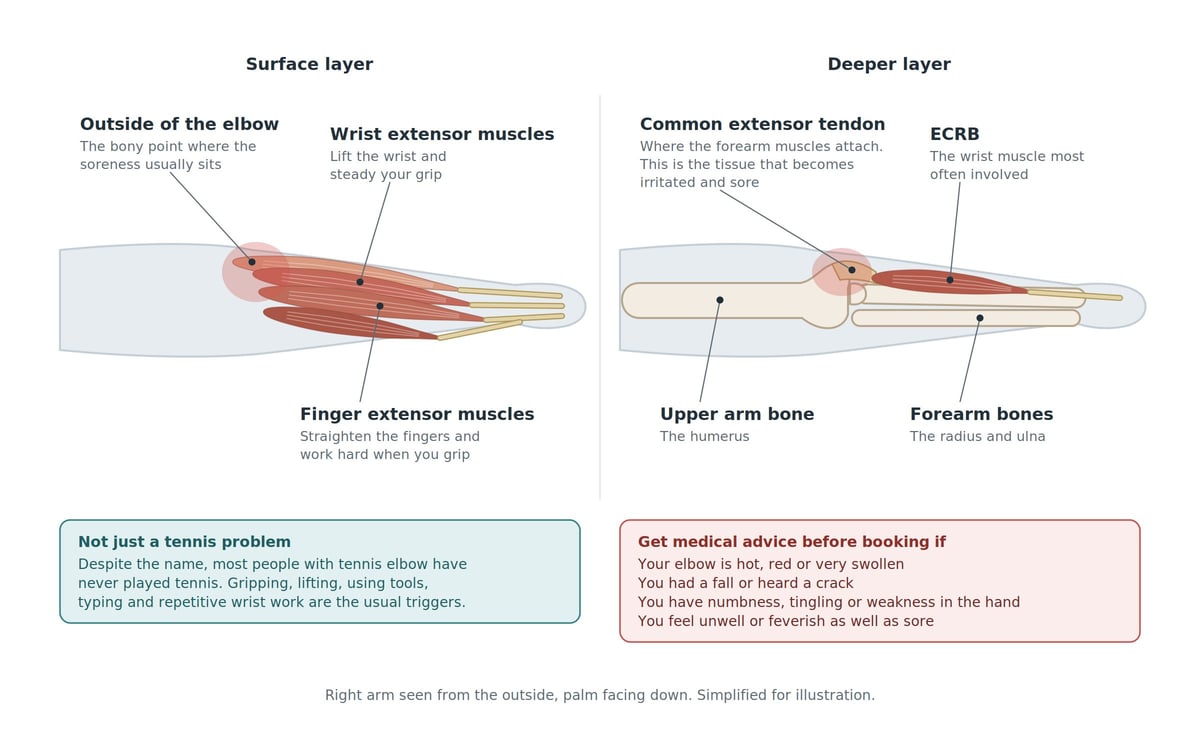
The wrist extensor muscles and the tendon that attaches them to the outside of the elbow.
How people describe it
What it feels like
- A sore spot on the outside of the elbow that is tender to press
- Pain when gripping, such as lifting a kettle, turning a door handle or shaking hands
- An ache that spreads down the top of the forearm, sometimes towards the back of the hand
- A grip that feels weaker than it should
- Stiffness first thing in the morning, or after a long day of using the arm
The NHS notes that the pain can range from mild discomfort when you move your arm to constant pain that affects your sleep.
Causes
Why it happens
Tennis elbow usually builds up from repeated gripping and wrist work rather than from a single injury. The common causes are:
Work
Using a mouse and keyboard all day, trade work with tools, warehouse lifting and assembly line tasks.
Home
DIY, decorating, gardening with shears or a long weekend of jobs around the house.
Sport
Racket sports, climbing, weight training with a heavy grip and golf.
Change
A sudden jump in how much you use the arm, such as a new job, a new hobby or a new tool.
It is most common in people between their mid thirties and mid fifties, according to NICE.
The honest picture
How massage helps, and what it cannot do
We want to be straightforward here. Massage does not repair an irritated tendon. What it can do is work on the muscles around it. Many clients find that releasing tension in the forearm makes gripping and everyday tasks feel easier, and that the arm feels less tight at the end of the day.
Research on massage for tennis elbow specifically is limited. NHS guidance puts rest, changes to how you use the arm and exercise first, and we see massage as a support to those rather than a replacement.
The techniques we may use include:
- Soft tissue release along the wrist and finger extensors
- Myofascial release through the forearm and upper arm
- Gentle friction work near the tendon, kept within a comfortable level
- Work on the shoulder, upper back and neck, because tension there often comes with the same desk or tool habits
We do not press hard on an irritated tendon. If something is too sore to touch on the day, we work around it.
This work sits within a sports massage, which is the treatment we use for forearm and upper arm work. Where the ache runs further down into the hand, wrist and forearm pain covers that side.
What to expect here
What a treatment looks like here
Your first appointment starts with an assessment. We ask about your work, your hobbies and when the pain started, then check how your elbow, wrist, shoulder and neck move. Some neck and shoulder problems can cause pain around the elbow, so we check this before working on the arm. Where the ache runs further down into the forearm and hand, our guide to wrist and forearm pain looks at that.
The session itself focuses on the forearm and upper arm, plus the shoulder and upper back where that is relevant. Afterwards we will talk you through what to change between appointments, such as your grip, how your desk is set up or how you use your tools. If you have been given exercises by a GP or physiotherapist, we fit our work around them.
How many sessions you need depends on how long you have had the pain and what you do every day. We will give you an honest view after your assessment rather than booking you in for a fixed course.
You can find out more about our therapists on our team page.
Important
When it is not massage
Please get medical advice before booking if:
What to do
- Call 999 or go to A&E if the elbow is hot, red and swollen and you feel unwell or have a fever, or if the joint looks deformed after an injury.
- Call NHS 111 for urgent advice if you are unsure how serious something is.
- See your GP if there is numbness, tingling or weakness in the hand, if the pain followed a fall, or if it is not easing.
If anything in your assessment suggests massage is not the right answer, we will tell you plainly and point you to your GP or a physiotherapist. That is how we already work, and it is part of looking after you properly.
Questions
Frequently asked questions
Do I have to stop using my arm completely?
Usually not. The NHS advises avoiding or reducing the activities that make it worse, which is different from not using the arm at all. We can help you work out which tasks to change and how.
Should I wear an elbow strap or brace?
Some people find a forearm strap makes gripping more comfortable. It is worth asking your GP or a pharmacist whether one suits you. We are happy to talk it through at your appointment.
Will the massage hurt?
The forearm can feel tender, but you should not be in sharp pain. We keep the pressure at a level you are comfortable with and adjust it as we go.
Is tennis elbow the same as golfers elbow?
No. Golfers elbow affects the inside of the elbow and the muscles that bend the wrist. It is a different problem with a different treatment. Our golfers elbow page covers that side.
Do I need a GP referral?
No, you can book directly. If you have already seen a GP or physiotherapist, it helps to tell us what they said.
You can also see the full list of conditions we help with, and deep tissue massage explains the treatment we use for forearm work.
Areas we cover
Where we treat tennis elbow
Elbow and forearm pain brings clients in from across the area, often after months of working around it. These are the areas we cover in detail.
Clients travel to us from all over the surrounding area, from the city and from the towns and villages around it. If you are not sure whether we cover where you are, ring us and ask.
Main areas we cover
Also covered
Skewen, Birchgrove, Clydach, Glais, Trebanos, Rhos, Neath Abbey, Cadoxton, Cimla, Briton Ferry, Gorseinon, Gowerton, Fforestfach, Loughor, Pontardawe, Pontarddulais, Killay, Ammanford, Burry Port.
Ready to book your session?
Choose a time that suits you, or call us and we will find one that works.