Conditions we help with
Massage for wrist and forearm pain
The ache that builds by the end of a day at the keyboard or with tools, and what massage can and cannot do about it.
- Published in the British Journal of Sports Medicine
- Practising since 2007
- Level 4 SMA therapists
- Treated Olympic and Commonwealth athletes
The short answer
Can massage help wrist and forearm pain?
Aching wrists and forearms usually come from muscles and tendons that are working hard for long periods, whether at a keyboard, with a mouse or with tools. Massage may help ease tightness in the forearm and hand and make everyday tasks feel more comfortable. It works on the muscles and soft tissue around the wrist. It is not a treatment for nerve problems such as carpal tunnel syndrome. We will always tell you if we think that is what is going on.
Where it tends to help
The tight, tired forearm and hand that builds up through repetitive work, rather than a nerve that is being squeezed.
When to see a GP first
Tingling or numbness in the thumb, index or middle finger points to the median nerve, which needs assessing before anyone works on it.
Written by Richard Clarke, senior therapist. Sports and exercise science honours degree, with research published in the British Journal of Sports Medicine and the International Journal of Sports Medicine. Last reviewed November 2026.
The anatomy, in plain English
What it actually is
Your forearm holds two main groups of muscles. The extensors on the back of the forearm lift your wrist and straighten your fingers. The flexors on the palm side bend your wrist and curl your fingers to grip. Long tendons run from these muscles across the wrist and into the hand.
Every time you type, click, grip a tool or hold your phone, these muscles are working. If they do that for hours without a break, they can become tight, tired and sore. The NHS uses the term repetitive strain injury for pain in muscles, nerves and tendons caused by repetitive movement and overuse.
On the palm side of the wrist there is a narrow passage called the carpal tunnel. The flexor tendons and the median nerve pass through it. When the nerve is squeezed there, it causes carpal tunnel syndrome, which is a nerve problem and needs to be assessed by a GP.
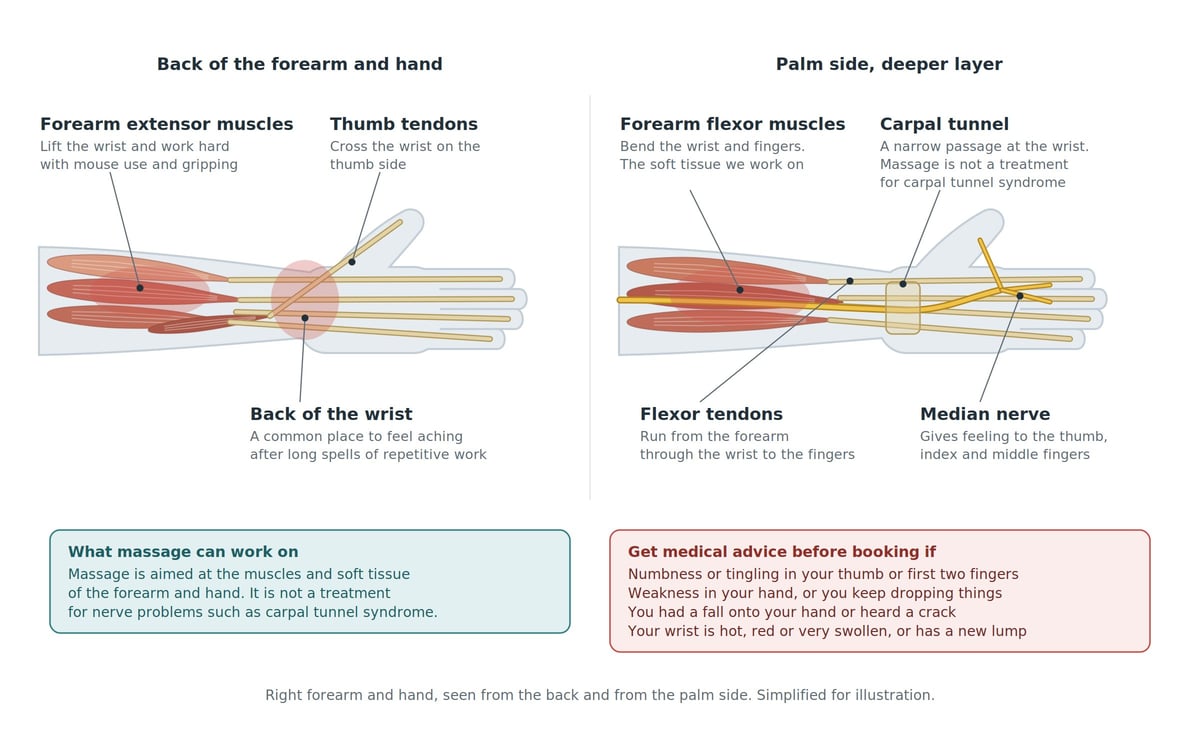
The forearm muscles and tendons, and where the median nerve passes through the carpal tunnel.
How people describe it
What it feels like
- An ache along the top or underside of the forearm
- A tired, tight feeling in the wrist after a long day at a keyboard or with tools
- Soreness on the back of the wrist or around the base of the thumb
- Stiffness when you first start moving your hands in the morning
- A grip that feels weaker towards the end of the day
Tingling or numbness in the thumb, index and middle fingers is different. It can be a sign of carpal tunnel syndrome, so please see the section on when it is not massage below.
Causes
Why it happens
The common causes are:
Desk work
Long hours of typing and mouse use, often with the wrists bent back or resting on a hard edge.
Phones and tablets
Scrolling and typing with the thumbs for long periods.
Trade work
Gripping tools, using vibrating equipment, plastering, decorating and hairdressing.
Sport and training
Climbing, rowing, racket sports and lifting with a heavy grip.
Pain in the forearm can also be linked to the elbow. If yours sits close to the elbow, our pages on tennis elbow and golfers elbow may be more relevant.
The honest picture
How massage helps, and what it cannot do
Massage works on the muscles and soft tissue of the forearm and hand. Many clients find it eases the tight, tired feeling that builds up with repetitive work and make their hands feel freer to move.
The techniques we may use include:
- Soft tissue release through the forearm flexors and extensors
- Myofascial release along the forearm and into the hand
- Gentle work around the base of the thumb and the palm
- Work on the upper arm, shoulder and neck, because tension there often comes with the same posture
It does not change what is happening with a nerve. If your symptoms point that way, we will refer you on rather than work on it.
This work sits within a sports massage, which is the treatment we use for forearm and hand work.
What to expect here
What a treatment looks like here
Your first appointment starts with an assessment. We ask about your work, how you use your hands and when the pain started, and we check the movement in your wrist, elbow, shoulder and neck. We will also ask about any tingling or numbness, because that changes what we do next.
The session focuses on the forearm and hand, plus the shoulder and neck where that is relevant. Afterwards we will talk you through practical changes, such as your keyboard and mouse position, taking regular breaks, and how you grip your tools. Our desk and posture pain page has more on setting up your workstation.
How many sessions you need depends on how long you have had the pain and what your work involves. We will give you an honest view after your assessment.
You can find out more about our therapists on our team page.
Important
When it is not massage
Please get medical advice before booking if:
What to do
- Call 999 or go to A&E if the wrist is hot, red and swollen and you feel unwell or have a fever, or if the wrist looks deformed after a fall.
- Call NHS 111 for urgent advice if you are unsure how serious something is.
- See your GP if your thumb and first two fingers tingle or feel numb, if your grip is weakening, or if the pain is not easing.
If anything in your assessment suggests massage is not the right answer, we will tell you plainly and point you to your GP or a physiotherapist.
Questions
Frequently asked questions
Can massage help carpal tunnel syndrome?
Carpal tunnel syndrome is a nerve problem, and massage is not a treatment for it. If you have tingling or numbness in your thumb and first two fingers, see your GP first. Once you have been assessed, we are happy to work on the surrounding forearm muscles if that is appropriate. Pain that runs from the neck down the arm is described on our trapped nerve page. Pain that runs from the neck down the arm is described on our trapped nerve page.
Is it RSI?
The NHS uses repetitive strain injury as a general term for pain caused by repetitive movement and overuse. It is not a single diagnosis. We describe what we find in the muscles and soft tissue and leave diagnosis to your GP.
Should I wear a wrist support?
Ask your GP or a pharmacist whether a support suits you. Changes to how you work often make a bigger difference, and we can talk those through with you.
Will the massage hurt?
The forearm can feel tender, but you should not be in sharp pain. We keep the pressure at a level you are comfortable with.
You can also see the full list of conditions we help with, and deep tissue massage explains the treatment we use for forearm work.
Areas we cover
Where we treat wrist and forearm pain
Repetitive work builds up quietly, and people often come in once it is interfering with the day. These are the areas we cover in detail.
Clients travel to us from all over the surrounding area, from the city and from the towns and villages around it. If you are not sure whether we cover where you are, ring us and ask.
Main areas we cover
Also covered
Skewen, Birchgrove, Clydach, Glais, Trebanos, Rhos, Neath Abbey, Cadoxton, Cimla, Briton Ferry, Gorseinon, Gowerton, Fforestfach, Loughor, Pontardawe, Pontarddulais, Killay, Ammanford, Burry Port.
Ready to book your session?
Choose a time that suits you, or call us and we will find one that works.